 English
 Español
 عربى
عربى

Engineered specifically for harsh environmental conditions, the Weatherproof Outdoor GRC door and wi...
READ MOREMay 13, 2026
Content
Modern roads are expected to do more than carry traffic. They must remain safe during heavy rain, protect pavements from water damage, support cleaner urban environments, and fit into tight construction schedules with minimal interruption to public life. The Integrated Precast Curb Drainage Ditch answers these demands by combining two essential roadside functions into one engineered unit: a road curb and a high-capacity drainage channel. Instead of treating the curb and the drainage system as separate components, this product integrates them into a single modular structure that collects, conveys, and controls surface runoff directly at the edge of the roadway.
This integrated concept is especially valuable for municipal roads, urban renewal projects, parking areas, bus lanes, industrial access roads, residential communities, and commercial streets where space is limited and performance expectations are high. Traditional drainage layouts often require separate curb construction, trench excavation, gully installation, pipe connection, and multiple finishing steps. By contrast, the integrated precast curb drainage ditch reduces the number of construction interfaces, shortens installation time, and improves consistency across the project.
The product belongs to the drainage channel series and is closely related to GRC and customized precast systems. It is designed to deliver reliable hydraulic performance, strong structural resistance, clean road-edge appearance, and simplified project management. For contractors, designers, and municipal authorities, the key value lies not only in water collection but also in the overall lifecycle benefit: faster installation, lower maintenance complexity, improved road safety, and a more orderly urban landscape.
Jiangsu Yameng Traffic Road Facilities Co., Ltd. supports this product with manufacturing experience in drainage ditches, cover plates, manhole covers, GRC customization, drainage pipes, PE pipes, slot drainage systems, U-shaped drainage channels, linear drainage ditches, polymer-based channels, ductile iron covers, stainless steel stamped covers, steel gratings, resin concrete covers, and related municipal products. With professional design, mold development, CNC engraving, production, construction, and after-sales capabilities, the company provides a complete service chain from technical planning to on-site application.
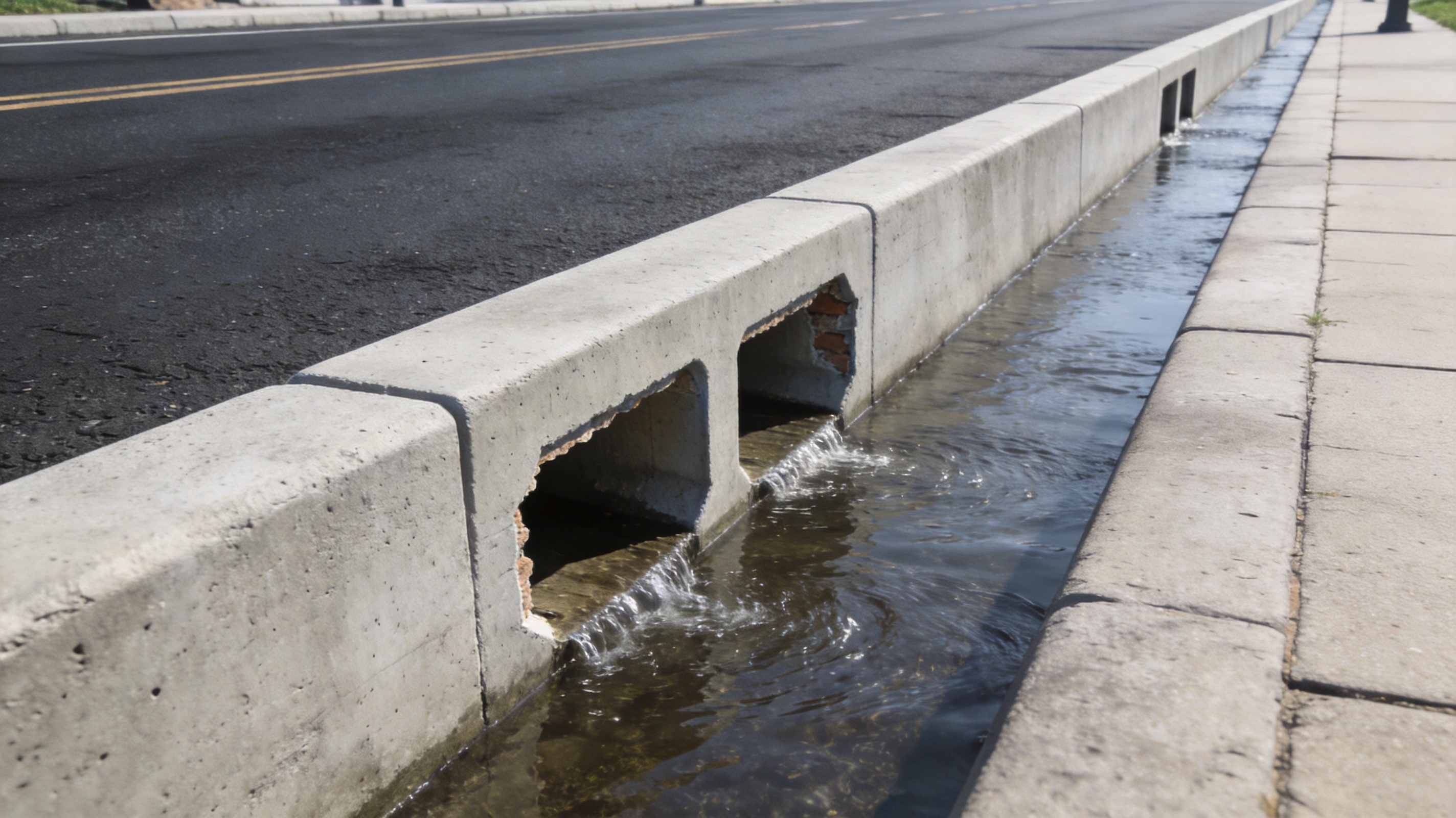
The integrated precast curb drainage ditch is built around a simple but powerful idea: the curb should not merely define the road edge; it should also become an active drainage element. In conventional urban road systems, the curb blocks and guides traffic while separate point gullies or channels handle runoff. This arrangement often creates inefficiencies because water must travel along the road surface until it reaches a drainage inlet. During intense rainfall, surface water can accumulate between inlets, resulting in water films, splashing, hydroplaning risk, pedestrian inconvenience, and long-term pavement deterioration.
In an integrated curb drainage ditch, the drainage inlet is positioned continuously or semi-continuously along the curb line. Surface runoff is collected immediately at the edge and conveyed through the internal channel. This linear capture method is more efficient than relying only on isolated point gullies, especially on long road sections, intersections, roundabouts, parking zones, and areas with limited crossfall. The result is a cleaner, drier, and safer pavement surface.
The product is typically manufactured as a modular precast unit. Each module includes a curb profile and an internal drainage channel. Depending on project requirements, the unit can be made from high-strength resin concrete, precast concrete, GRC-related composite material, or other engineered cementitious materials. The modular design enables rapid alignment, joining, and installation. It also allows replacement or maintenance of individual sections without disturbing the entire drainage line.
Because the curb and drainage body are integrated, the product reduces the need for separate components and separate construction sequences. This is a major advantage in projects where time, labor, traffic management, and road closure duration are critical cost factors. Municipal road upgrades, for example, often require work to be completed quickly to reduce disruption. The plug-and-play nature of the integrated precast system helps construction teams achieve this goal.
Urban drainage design is changing. Cities are experiencing more intense rainfall events, denser traffic, tighter road corridors, and higher expectations for visual order. Traditional drainage systems remain useful, but they can struggle when road surfaces must be kept clear of water quickly and when construction space is limited. Integrated curb drainage systems respond to these pressures by offering a compact, efficient, and standardized solution.
One of the most important reasons for the growing interest in this product is space efficiency. In many roads, the edge zone is crowded with curbs, drainage inlets, utility corridors, sidewalks, landscaping strips, lighting foundations, traffic signs, and underground pipes. A two-in-one system simplifies this zone. It frees up valuable width, reduces the number of separate structures, and supports cleaner streetscape design.
Another reason is hydraulic performance. Point drainage systems collect water only at specific locations. If the distance between gullies is long or if the road gradient is insufficient, water can remain on the pavement. A linear drainage curb captures runoff more evenly along the curb line. This improves drainage speed and helps reduce the chance of standing water, vehicle spray, and hydroplaning.
Installation efficiency is also a strong driver. Cast-in-place curb and drainage construction can involve formwork, reinforcement placement, concrete pouring, curing, and multiple inspections. Separate drainage units and curb stones require careful coordination. A precast integrated module arrives at the site with the key geometry already formed, quality checked, and ready for placement. This helps contractors reduce uncertainty and improve project scheduling.
Durability is equally important. Road curbs are exposed to vehicle impact, tire rubbing, freeze-thaw cycles in some climates, chemical attack from deicing salts, abrasion from sediments, and repeated wet-dry conditions. A well-designed integrated curb drainage system must resist both hydraulic and mechanical stress. By using high-strength materials, controlled production processes, and precise molds, the product is made to maintain stable performance over long service periods.
The Integrated Precast Curb Drainage Ditch offers several practical advantages over conventional curb-and-gully systems, basic trench drains, and lower-quality drainage channels. These advantages are not limited to a single performance metric; they cover space use, drainage efficiency, structural reliability, installation speed, maintenance convenience, and visual integration.
The most visible advantage is the two-in-one structure. By merging the curb and drainage channel into one unit, the system eliminates duplication between road-edge construction and drainage construction. This is especially useful in urban areas where every centimeter of road width matters. Instead of installing a curb, then excavating or positioning a separate drainage channel beside it, contractors can install one integrated product.
This space-saving design is particularly advantageous for narrow roads, bus lanes, bicycle lanes, roadside parking areas, pedestrian-friendly streets, and redevelopment projects where existing underground utilities restrict excavation. A compact drainage edge also helps improve the appearance of the streetscape because it avoids scattered inlet covers and irregular transitions between curb stones and drainage grates.
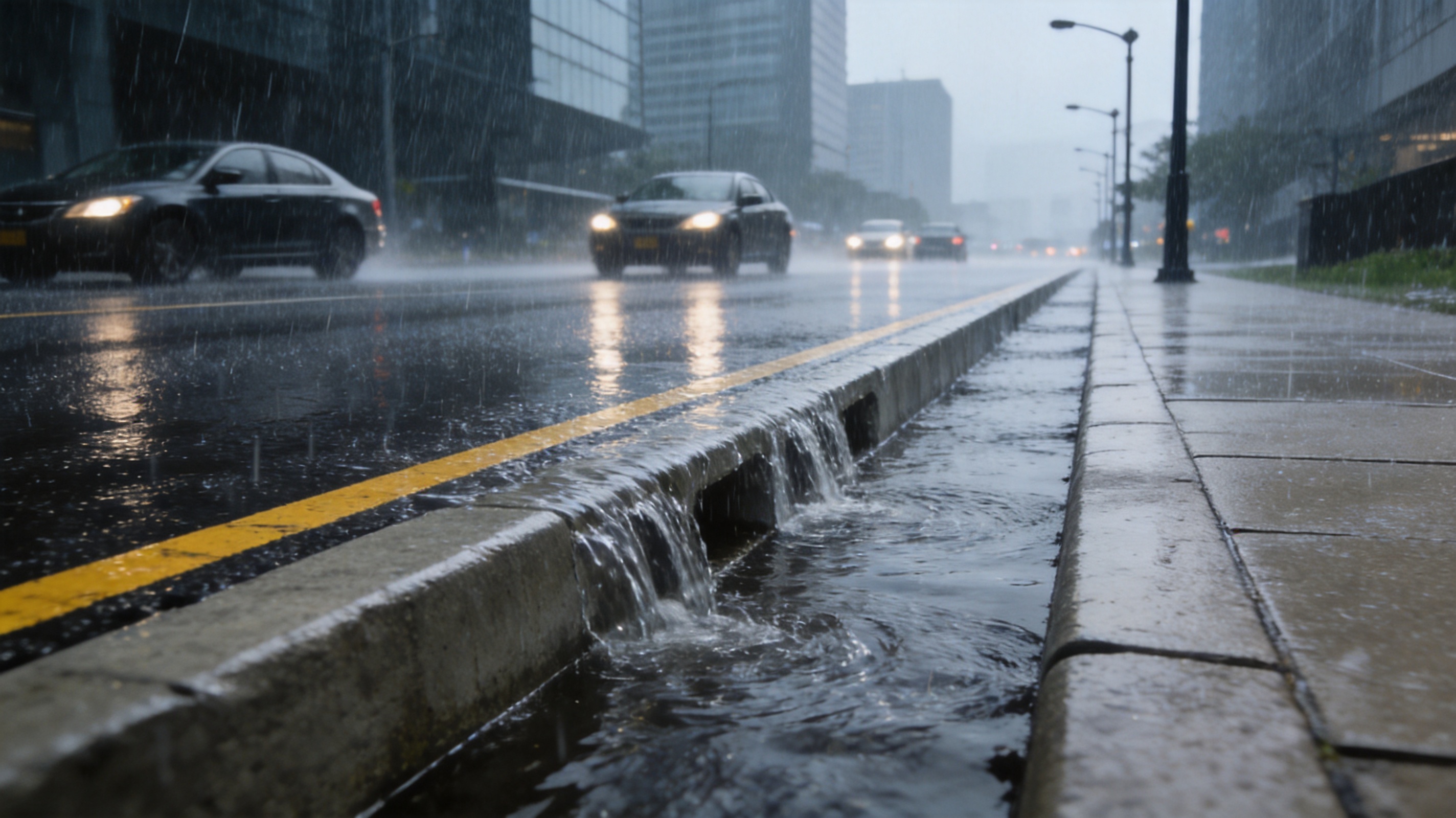
Compared with point gullies, the integrated curb drainage ditch captures water more continuously. A continuous or linear inlet along the curb line allows runoff to enter the channel quickly, reducing the travel distance of water across the road surface. This helps prevent water film formation, limits splash, and reduces the risk of hydroplaning. In road safety terms, removing water from the vehicle path is a major benefit.
Traditional gullies may become overwhelmed during sudden storms because each inlet receives runoff from a large surrounding area. Linear curb drainage distributes inflow along the road edge, reducing localized overload. The internal channel then conveys water downstream to the designated outlet or connection point. Properly designed slopes, channel cross-sections, and outlet spacing can further improve system performance.
A curb drainage system must withstand more than rainfall. It must also resist lateral vehicle impact, wheel loads near the road edge, accidental contact from maintenance equipment, pressure from adjacent pavement structures, and soil movement. The integrated precast curb drainage ditch is produced using high-strength materials and engineered profiles to provide reliable structural behavior.
In comparison with lightweight or poorly reinforced drainage products, a properly manufactured integrated unit offers better dimensional stability and impact resistance. The curb portion protects the road edge, while the channel body supports drainage flow and load transfer. The integrated form avoids weak joints between separate curb stones and separate drainage trenches, reducing the risk of displacement or cracking caused by misalignment.
For municipal projects, construction speed is not merely a convenience; it affects traffic flow, business access, noise, public satisfaction, and project cost. The modular plug-and-play design of the integrated precast curb drainage ditch can reduce installation time significantly compared with cast-in-place methods. Because the product is manufactured before site installation, the on-site team spends less time on formwork, curing, and geometry correction.
Shorter construction periods also mean less exposure to weather delays. Precast modules can be produced in advance and delivered according to the construction schedule. Once the foundation is prepared, modules can be positioned, aligned, connected, and sealed more efficiently. This is a clear advantage over systems that require multiple trades and extended curing periods on site.
Urban drainage products are part of the visible streetscape. Misaligned grates, broken curb stones, inconsistent inlet positions, and stained drainage points can reduce the quality of public space. Integrated curb drainage provides a more unified appearance because the curb and drainage line are designed as a coordinated element. The road edge looks cleaner, and the drainage function becomes less visually disruptive.
For commercial streets, residential communities, public plazas, and high-quality municipal roads, this visual consistency has practical value. A neat road edge reflects good engineering management and supports a more attractive environment. The product can also be customized in profile, dimension, and surface finish to fit different design requirements.
Maintenance teams benefit when drainage systems are easier to inspect and clean. A linear curb drainage system concentrates water flow inside a defined channel and reduces the number of separate point inlets scattered along the road. Depending on the design, access points or removable sections can be arranged for sediment removal and inspection.
Because the product integrates curb and drainage functions, there are fewer separate joints and interfaces where debris can accumulate or structural problems can begin. Strong precast construction also reduces the likelihood of early deformation, loose covers, or broken edges. Over the lifecycle of the road, these details contribute to lower maintenance burden and more predictable performance.
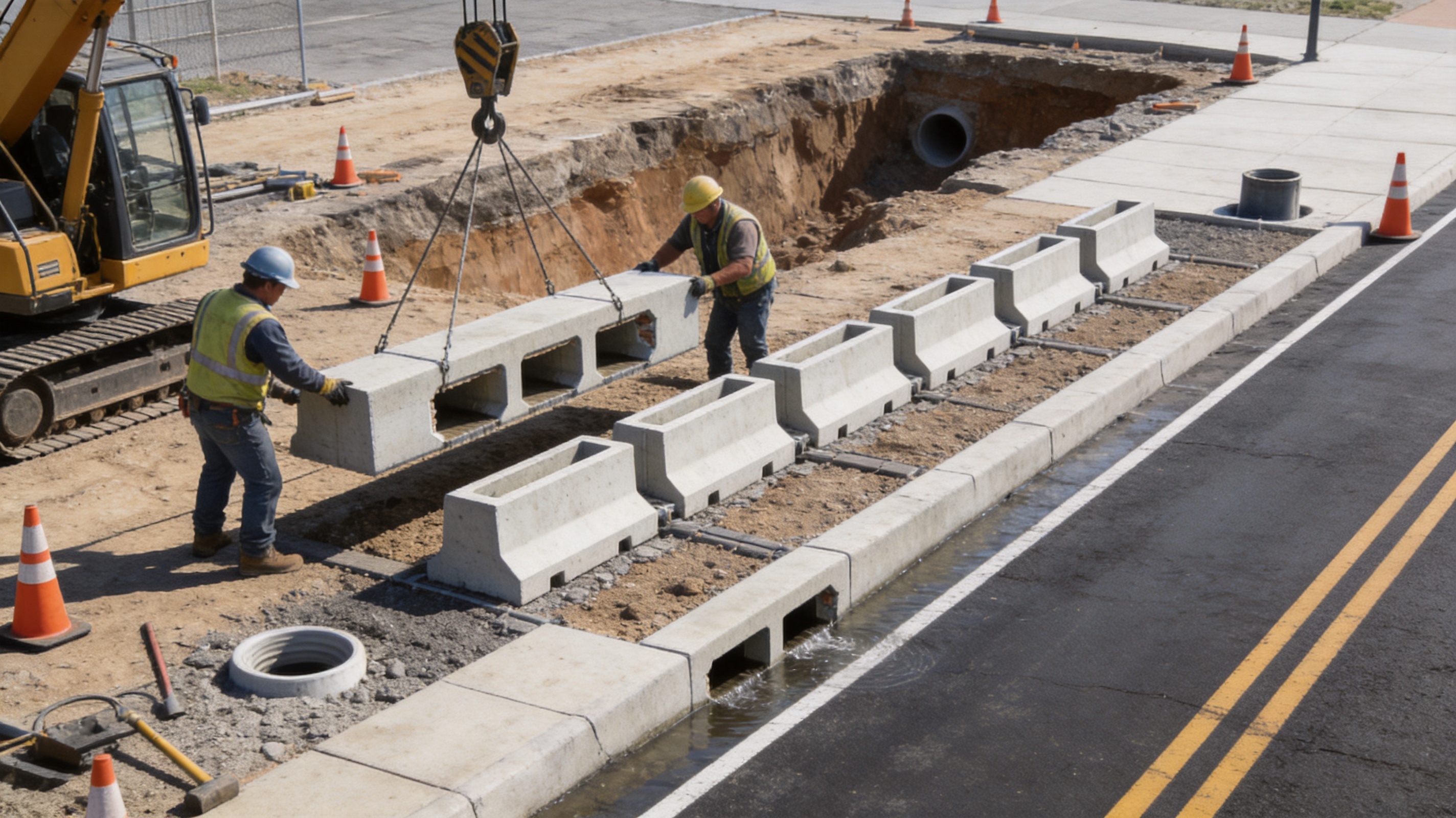
A high-quality integrated curb drainage product depends on accurate geometry, appropriate material selection, hydraulic design, and structural reinforcement. The following technical features illustrate how the system is engineered for municipal use.
The modular configuration allows standardized production and efficient installation. Each section is produced to controlled dimensions, enabling consistent alignment on site. Modules can be connected in sequence to create long drainage lines. Curved, transition, outlet, end, and inspection components may be customized depending on the project design.
Precast production offers significant quality advantages compared with uncontrolled on-site casting. In a factory environment, materials can be measured accurately, molds can be maintained properly, curing conditions can be controlled, and finished products can be inspected before shipment. This leads to more reliable dimensional accuracy and material strength.
The inlet design is essential to performance. Instead of relying on widely spaced point openings, the integrated curb drainage ditch can collect water through a continuous linear opening or distributed curb-side inlets. The configuration can be selected based on traffic type, expected rainfall intensity, road gradient, debris conditions, and maintenance preference.
A well-designed inlet must balance hydraulic intake capacity with safety and durability. Openings should capture runoff efficiently while preventing hazards for pedestrians, cyclists, and vehicles. For roadways with heavy traffic, inlet edges must be strong enough to withstand repeated contact and vibration.
The channel body must resist compressive forces, bending stress, abrasion, and water-related deterioration. High-strength resin concrete or precast concrete can be selected to meet these demands. Resin concrete offers high density, low water absorption, and chemical resistance, while precast concrete provides mass, robustness, and cost-effective structural capacity. GRC-related customization can be used where lightweight shaping, decorative finishing, or special profiles are required.
The material choice should match the project environment. Industrial areas may require higher chemical resistance. Urban roads may prioritize impact strength and long service life. Landscape areas may require special visual treatments. The integrated product can be adapted to meet these different priorities.
Road curbs are frequently exposed to vehicle wheel contact, parking impacts, sweeping equipment, and construction machinery. The integrated drainage curb is designed with this exposure in mind. The curb profile can distribute impact forces and protect the drainage channel from direct damage. Compared with separate curb stones placed next to a trench, the integrated body reduces the possibility of displacement between components.
This structural unity is one of the reasons the product is suitable for traffic environments. When the road edge receives lateral pressure, the integrated unit behaves as a coherent structure rather than as a group of loosely connected parts. Correct bedding and backfilling further improve its resistance to movement.
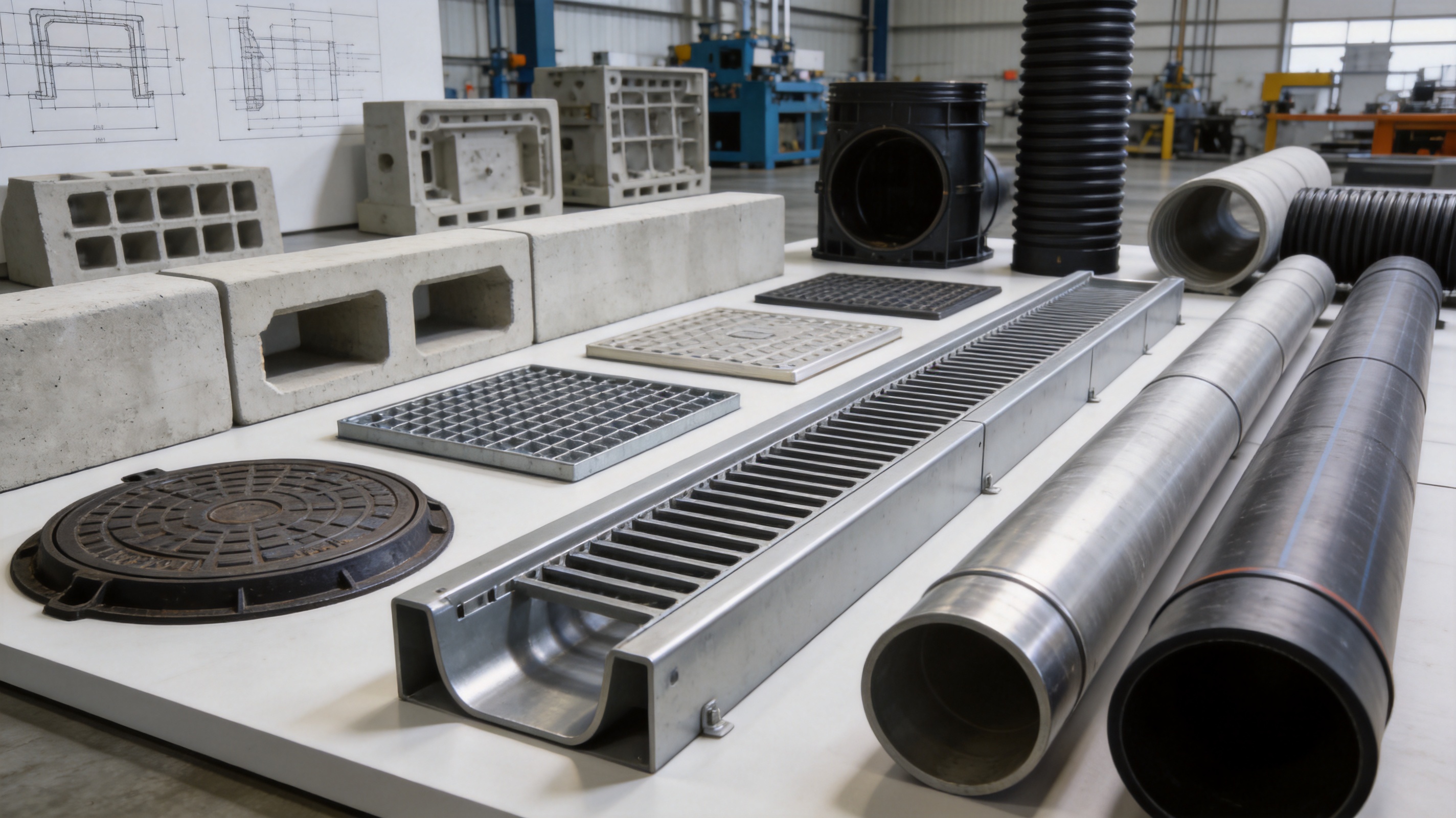
The product can be coordinated with different cover plates, outlets, inspection components, drainage pipes, and connection systems. Jiangsu Yameng Traffic Road Facilities Co., Ltd. manufactures and supplies a wide range of related drainage accessories, including ductile iron cover plates, stainless steel stamped cover plates, steel gratings, resin concrete cover plates, resin composite manhole covers, stainless steel manhole covers, ductile iron manhole covers, drainage pipes, and PE pipes. This broad product range helps ensure compatibility across the entire drainage project.
Compatibility matters because a drainage system is only as reliable as its weakest connection. A strong channel with poorly matched outlets or covers may fail to perform correctly. By providing integrated product support, the company can help customers select suitable components for hydraulic capacity, load rating, maintenance access, and service environment.
The performance of a precast drainage product is determined long before it reaches the construction site. It begins with design, mold accuracy, material control, production management, curing, inspection, and packaging. Jiangsu Yameng Traffic Road Facilities Co., Ltd. has built its strengths around a complete production and service system for drainage channel products and GRC customization.
Professional design is the first step in producing a reliable integrated drainage curb. Designers must consider road geometry, curb height, inlet position, channel volume, outlet spacing, installation method, load conditions, maintenance needs, and local construction practices. A product that looks simple on the surface requires careful technical coordination inside.
The company’s design support allows customers to move from concept to detailed drawings more efficiently. For customized projects, the design team can adjust dimensions, profiles, slopes, connection structures, and surface finishes. This is important because municipal projects often have unique site conditions that cannot be solved by a single standard product.
Mold quality directly affects product accuracy. If the mold is imprecise, every finished module may have alignment errors, uneven surfaces, or inconsistent joint dimensions. Jiangsu Yameng Traffic Road Facilities Co., Ltd. supports its GRC and drainage products with professional mold designers and CNC engraving capabilities. CNC processing helps achieve accurate shapes, repeatable details, and cleaner edges.
For integrated curb drainage ditches, mold accuracy is especially important because the product must align both as a curb and as a drainage channel. The curb face must be straight and visually consistent, while the internal channel must maintain the designed flow path. Accurate molds help achieve both objectives. They also reduce site adjustment work, saving installation time.
The company’s product range includes polymer-based drainage ditches, resin concrete products, precast drainage channels, GRC series products, cover plates, gratings, and manhole covers. This experience supports informed material selection. Different projects may require different combinations of strength, weight, appearance, chemical resistance, abrasion resistance, and cost efficiency.
Material control involves selecting suitable aggregates, binders, fibers, reinforcement, additives, and surface treatments where applicable. For precast concrete products, mix proportioning and curing quality are critical. For resin concrete, resin content, aggregate grading, and compaction influence density and durability. For GRC products, fiber distribution, mold quality, and curing control affect strength and finish. A manufacturer with broad material experience can recommend more suitable solutions for different environments.
Factory production provides a controlled environment that is difficult to reproduce on a road construction site. In the factory, dimensions can be checked, material batches can be monitored, curing conditions can be managed, and defects can be identified before delivery. This reduces the chance of receiving inconsistent products at the project site.
Quality inspection may include dimensional checks, surface inspection, strength-related evaluation, load-related assessment, inlet and outlet verification, joint compatibility checks, and packaging review. For drainage products, even small dimensional errors can affect alignment and hydraulic continuity. Consistent inspection helps maintain product reliability and customer confidence.
One of the company’s major strengths is the ability to provide complete services from detailed design, drawings, mold making, production, on-site construction support, and after-sales service. This full-chain capability reduces communication gaps between design intent and manufactured product. Customers can obtain technical suggestions during early planning, product customization during design development, and practical support during installation.
After-sales support is important for municipal drainage projects because site conditions can change. Unexpected underground utilities, revised road slopes, construction sequencing issues, or special outlet requirements may arise. A responsive manufacturer can help solve these issues more effectively than a supplier that only provides standard products.
The following table summarizes how the integrated precast curb drainage ditch compares with several common drainage approaches. Actual performance depends on project design, installation quality, and maintenance practice, but the comparison reflects typical differences.
Evaluation Item |
Integrated Precast Curb Drainage Ditch |
Traditional Curb With Point Gullies |
Separate Trench Drain Beside Curb |
Cast-in-Place Drainage Curb |
|---|---|---|---|---|
Space Efficiency |
High; curb and drainage channel are combined in one unit. |
Moderate; separate gullies and curb structures are required. |
Moderate to low; requires additional trench space. |
Moderate; can be integrated but often needs complex formwork. |
Hydraulic Collection |
Excellent; linear or distributed inlet captures runoff along the curb line. |
Variable; water must travel to point inlets. |
Good if grate openings are continuous and properly maintained. |
Good if carefully designed and built. |
Installation Speed |
Fast; modular precast sections support plug-and-play installation. |
Slower; multiple components and construction steps are needed. |
Moderate; trench preparation and separate curb work are required. |
Slow; formwork, pouring, curing, and finishing take time. |
Structural Consistency |
High; factory-controlled production improves dimensional accuracy. |
Variable; depends on site workmanship and component alignment. |
Variable; curb and channel may move differently over time. |
Variable; depends heavily on on-site curing and workmanship. |
Road Closure Impact |
Lower; faster installation reduces traffic disruption. |
Higher; sequential work extends construction time. |
Moderate; additional excavation can affect road access. |
Higher; curing time can delay reopening. |
Urban Appearance |
Clean and unified; fewer visible separate drainage elements. |
Less uniform; point inlets may interrupt the curb line. |
Depends on grate design; may look more industrial. |
Can be good but depends on finishing quality. |
Maintenance |
Simplified through planned access and fewer scattered inlet points. |
Requires inspection of multiple gullies and connecting pipes. |
Requires grate cleaning along trench sections. |
May be difficult if access points are not well planned. |
The integrated precast curb drainage ditch can be applied in a wide range of municipal and commercial environments. Its main value appears where road-edge drainage, construction efficiency, and clean appearance are all important.
Municipal roads need durable drainage systems that can handle everyday runoff and sudden rainfall. The integrated curb drainage ditch provides efficient water capture at the road edge and helps protect the pavement structure. It is suitable for new road construction, road widening, drainage improvement, and urban renewal projects.
On city roads, reducing water accumulation is critical for traffic safety. Even shallow water films can affect braking performance and vehicle stability. By collecting water continuously along the curb, the product helps maintain safer driving conditions during and after rainfall.
Intersections often have complex drainage patterns because of changing slopes, turning lanes, pedestrian crossings, and traffic islands. Point gullies may not capture runoff evenly in these areas. Integrated curb drainage can be placed along key edges to collect water before it spreads into pedestrian crossings or vehicle stopping zones.
The product’s strong curb profile is also useful where vehicles turn close to the road edge. Properly installed precast modules can resist typical road-edge impacts and maintain alignment over time.
Parking lots require drainage systems that are effective, durable, and visually acceptable. Water accumulation in parking areas can inconvenience drivers and pedestrians, damage pavement, and create maintenance problems. Integrated curb drainage can be used along parking aisles, perimeter curbs, and internal circulation roads.
Commercial areas benefit from the clean appearance of the system. A unified curb and drainage line creates a more organized environment than scattered drains or exposed trench grates. This is valuable for shopping centers, office parks, hotels, exhibition venues, and public service facilities.
Residential communities require drainage products that combine safety, appearance, and long service life. The integrated curb drainage ditch can be used along community roads, underground garage entrances, pedestrian-vehicle shared areas, and landscaped road edges. Its compact structure helps preserve usable space while controlling stormwater runoff.
Because residential projects often prioritize a neat environment, the integrated design is a strong advantage. It reduces the number of visible drainage elements and supports orderly road-edge finishing.
Industrial parks and logistics centers often experience heavy vehicle movement, frequent turning, and high runoff from large paved areas. The integrated precast curb drainage ditch can be designed with suitable strength and capacity for these conditions. When paired with appropriate covers, outlets, and downstream pipes, it helps manage runoff efficiently while maintaining road-edge durability.
In these settings, installation speed is also valuable. Industrial facilities often need roads and yards to return to service quickly. Precast modular drainage systems can reduce downtime compared with cast-in-place construction.
Even the best drainage product requires correct installation. Proper bedding, alignment, joint treatment, outlet connection, backfilling, and surface finishing all influence performance. The integrated precast curb drainage ditch is designed to simplify installation, but construction teams should still follow sound engineering practice.
The foundation must provide stable support for the module. Weak or uneven bedding can lead to settlement, misalignment, or cracking. Before installation, the base should be excavated to the required depth, compacted properly, and prepared with the specified bedding material. The bedding layer should support the full length of the module, not only isolated points.
Because the product functions as both curb and drainage channel, alignment is important for appearance and hydraulic flow. The curb line should be straight or follow the planned curve, while the internal channel should maintain the required slope toward outlets. Accurate positioning during installation reduces future maintenance problems.
Module joints should be connected according to the design requirements. In drainage systems, poorly sealed joints may allow leakage, soil loss, or root intrusion. Proper sealing helps preserve hydraulic efficiency and surrounding pavement stability. Joint details may vary depending on material, project environment, and water-tightness requirements.
The drainage channel must discharge to a suitable outlet, pipe, catch basin, or downstream stormwater system. Outlet capacity should match the expected flow. If the outlet is undersized or poorly positioned, water may back up inside the channel even if the inlet performs well. Coordination with drainage pipes and manhole systems is therefore essential.
After the modules are positioned, backfilling should be carried out carefully to avoid displacement. Pavement layers should meet the curb drainage unit cleanly, with correct surface levels to direct runoff into the inlet. If pavement is too low or too high relative to the inlet, drainage efficiency may be reduced.
A drainage system should be evaluated not only by initial purchase cost but also by lifecycle value. This includes installation time, traffic disruption, repair frequency, cleaning requirements, durability, safety improvement, and replacement convenience. The integrated precast curb drainage ditch performs well in lifecycle terms because it combines functions, reduces interfaces, and supports efficient maintenance.
Routine maintenance generally includes checking inlet openings, removing debris, inspecting outlet flow, and cleaning sediment where needed. In areas with heavy leaf fall, construction dust, or sand accumulation, cleaning frequency should be increased. Access points can be planned during design to make inspection easier.
The product’s integrated structure helps prevent many problems associated with separate systems. For example, when curb stones and drainage trenches are installed separately, differential settlement can create gaps, trip hazards, or water leakage paths. An integrated module reduces these risks because the curb and channel move as one body when properly supported.
From a municipal management perspective, faster installation and lower disruption can be as important as material durability. Road closures create indirect costs for residents, businesses, and transport systems. A precast modular drainage solution helps reduce these indirect costs by shortening construction time and improving schedule reliability.
Jiangsu Yameng Traffic Road Facilities Co., Ltd. is located in Nantong, Jiangsu Province, China, with convenient transportation and waterway access. This location supports efficient material supply and product delivery. The company focuses on drainage ditch projects and GRC customization, emphasizing integrity, quality, responsibility, focus, and innovation.
The company’s product portfolio is broad and relevant to integrated curb drainage systems. It includes linear drainage ditches, finished drainage ditches, polymer-based drainage ditches, slot drainage ditches, U-shaped drainage ditches, ductile iron cover plates, stainless steel stamped cover plates, steel gratings, resin concrete cover plates, resin composite manhole covers, stainless steel manhole covers, ductile iron manhole covers, drainage pipes, PE pipes, and related products. This range allows the company to support complete drainage solutions rather than isolated single components.
For GRC series products, the company is supported by professional designers, mold designers, CNC engravers, and an experienced production and construction technical team. This team can provide services from detailed design and drawings to mold making, production, on-site construction, and after-sales support. Such capabilities are particularly important for customized drainage and curb products because each project may require different dimensions, finishes, loads, or connection details.
The company’s commitment to product research and development also strengthens its competitiveness. Drainage products must evolve with changing municipal needs, rainfall patterns, road construction methods, and environmental expectations. A manufacturer focused on development can refine product profiles, improve installation details, enhance material performance, and respond to customer feedback more effectively.
Compared with suppliers that only sell standard drainage components, a manufacturer with design, mold, production, and construction support can create more value for engineering projects. Customers benefit from technical communication, compatible product selection, manufacturing consistency, and practical after-sales assistance.
The integrated precast curb drainage ditch competes in a market where buyers often compare products by cost, strength, appearance, delivery time, and ease of installation. Its competitive advantage comes from combining multiple benefits in one solution.
Basic drainage channels may collect water effectively, but they do not replace the curb. This means contractors still need to install a separate curb system, creating more work and more alignment challenges. The integrated product solves both tasks at once, reducing component count and improving road-edge consistency.
Point gullies remain common, but they can leave water flowing across the pavement for longer distances. During intense rainfall, this creates surface water problems. The integrated curb drainage ditch captures water along the curb line, providing faster runoff removal and improving safety.
Some precast drainage products suffer from inconsistent dimensions, rough finishing, weak joints, or poor load performance. With mold design, CNC engraving support, material control, and factory inspection, the integrated curb drainage ditch can achieve better consistency. This reduces installation problems and improves long-term performance.
Cast-in-place systems can be flexible, but they require time for formwork, pouring, curing, and finishing. They are also more dependent on weather and site workmanship. A precast modular solution transfers much of the work to the factory, enabling faster site installation and more predictable quality.
Because Jiangsu Yameng Traffic Road Facilities Co., Ltd. provides design, mold making, production, construction technical support, and after-sales service, customers can obtain guidance across the whole project process. This is a meaningful advantage over suppliers that only provide catalog products without engineering support.
Effective stormwater management contributes to urban resilience. Roads that drain quickly are safer, last longer, and require fewer emergency repairs. The integrated precast curb drainage ditch supports this goal by improving surface runoff capture and reducing water-related pavement stress.
Precast production can also reduce waste on site. Since the modules are manufactured to planned dimensions, there is less need for extensive on-site formwork and correction. Faster installation reduces disturbance to surrounding communities and traffic. In dense urban areas, this practical sustainability benefit is significant.
Water management is also connected to pavement durability. When water remains on or near pavement structures, it can enter joints, weaken base layers, and accelerate surface damage. By collecting runoff at the curb line and conveying it away, the integrated system helps protect road investment over time.
In future urban development, drainage products will be expected to provide higher performance in smaller spaces. Integrated systems such as this product represent a practical direction because they combine infrastructure functions rather than multiplying separate components.
When selecting an integrated precast curb drainage ditch, project owners and designers should consider several technical and practical factors. The correct product is not simply the strongest or largest; it is the one best matched to the project environment.
First, evaluate hydraulic requirements. Rainfall intensity, drainage area, road slope, surface type, and outlet capacity determine channel size and inlet configuration. A drainage system should be designed as a complete flow path, not just as an inlet product.
Second, assess load conditions. Roads with heavy trucks, bus traffic, or industrial vehicles require stronger structural capacity than pedestrian zones or light parking areas. The curb profile, material strength, bedding, and adjacent pavement design should all support the expected load.
Third, consider maintenance access. If the area has high debris loads, leaves, sand, or construction sediment, access points and cleaning methods should be planned in advance. A drainage system that is difficult to clean may lose performance over time.
Fourth, confirm material suitability. Resin concrete, precast concrete, and GRC-related solutions each have their advantages. The choice should reflect chemical exposure, visual requirements, weight limitations, cost targets, and expected service life.
Fifth, select a manufacturer capable of technical support. Customized drainage projects require coordination between design drawings, production molds, transport, installation, and after-sales service. A supplier with complete capabilities can reduce project risk.
It is a modular road-edge product that combines a curb and a drainage channel into one precast unit. It defines the road edge while collecting and conveying surface runoff through an internal channel.
A traditional system uses separate curbs and isolated drainage inlets. The integrated curb drainage ditch collects water along the curb line through continuous or distributed inlets, reducing water travel distance and improving runoff removal.
By collecting runoff quickly, it helps reduce standing water, water films, vehicle spray, and hydroplaning risk. Drier road surfaces support safer driving conditions during rainfall.
Yes, when designed with the proper material, load capacity, bedding, and installation method. High-strength precast or resin concrete structures can provide strong resistance to road-edge impact and traffic-related stress.
Yes. Because it is precast and modular, much of the work is completed in the factory. On-site installation is faster than many cast-in-place methods and can reduce road closure duration.
Yes. With professional design, mold development, CNC engraving, and production capabilities, customized dimensions, curb profiles, inlet forms, outlet details, and surface finishes can be developed for different projects.
Depending on the application, the product may use high-strength precast concrete, resin concrete, polymer-based materials, GRC-related materials, or other engineered solutions. Material selection should match load, environment, appearance, and budget requirements.
Maintenance generally includes removing debris from inlet openings, inspecting access points, checking outlet flow, and cleaning sediment from the channel when necessary. Proper design can make routine maintenance easier.
It is suitable for municipal roads, parking lots, commercial streets, residential communities, industrial parks, logistics facilities, intersections, bus lanes, and urban renewal projects.
A complete manufacturer can provide compatible channels, cover plates, grates, manhole covers, drainage pipes, technical drawings, mold support, production control, installation advice, and after-sales service. This reduces project coordination risk and improves overall system reliability.
The Integrated Precast Curb Drainage Ditch represents a practical upgrade for modern road drainage. By merging the curb and drainage channel into one engineered module, it solves several common problems at once: limited road-edge space, slow runoff collection, complicated installation, inconsistent appearance, and maintenance complexity. Its two-in-one design makes it especially valuable for municipal roads, urban redevelopment, parking facilities, industrial areas, and commercial streets.
Its advantages over conventional systems are clear. Compared with point gullies, it captures runoff more continuously. Compared with separate trench drains, it reduces component complexity and improves road-edge unity. Compared with cast-in-place construction, it offers faster installation and more consistent factory-controlled quality. Compared with low-precision products, it provides better reliability through professional design, accurate molds, controlled materials, and inspection.
Behind the product is the manufacturing and service capability of Jiangsu Yameng Traffic Road Facilities Co., Ltd., a company engaged in drainage ditch projects, GRC customization, and related municipal road facilities. With professional designers, mold designers, CNC engraving capability, production experience, construction technical support, and after-sales service, the company can support customers from drawings to installation. Its broad product range also helps create complete drainage solutions rather than isolated components.
As cities demand safer roads, faster construction, better drainage, and cleaner public spaces, integrated curb drainage systems will continue to gain importance. The Integrated Precast Curb Drainage Ditch provides a strong answer to these needs by combining hydraulic efficiency, structural strength, installation speed, and urban aesthetics in one durable product.
1. Butler, D., Digman, C., Makropoulos, C., and Davies, J. Urban Drainage. CRC Press.
2. Mays, L. W. Stormwater Collection Systems Design Handbook. McGraw-Hill Education.
3. American Concrete Institute. Guide for Precast Concrete Products and Quality Control Practices.
4. Construction Industry Research and Information Association. The SuDS Manual: Sustainable Drainage Systems Guidance.
5. Federal Highway Administration. Urban Drainage Design Manual.
6. National Precast Concrete Association. Precast Concrete Stormwater Management Product Guidance.
Related Products
Engineered specifically for harsh environmental conditions, the Weatherproof Outdoor GRC door and wi...
READ MOREEngineered specifically for harsh environmental conditions, the Weatherproof Outdoor GRC door and wi...
READ MOREEngineered specifically for harsh environmental conditions, the Weatherproof Outdoor GRC door and wi...
READ MOREEngineered specifically for harsh environmental conditions, the Weatherproof Outdoor GRC door and wi...
READ MOREEngineered specifically for harsh environmental conditions, the Weatherproof Outdoor GRC door and wi...
READ MOREEngineered specifically for harsh environmental conditions, the Weatherproof Outdoor GRC door and wi...
READ MORE
Contact us
Factory Address
Group 12, Quanxin Village, Donghai Town, Qidong City, Nantong City, Jiangsu Province, China
phone
+86-13914963840
+86-13451754670
products
QR CODE
 Wholesale Drainage Ditch Manufacturers