 English
 Español
 عربى
عربى

Engineered to address the long-term challenges of chemical erosion and structural aging in architect...
READ MOREJun 08, 2026
Content
Fluid Design Architectural GRC Curtain Wall Panels represent a refined approach to contemporary exterior architecture, combining sculptural freedom, long-term durability, and practical installation efficiency. As building envelopes become more expressive, architects and developers increasingly need façade materials that can deliver visual movement without compromising structural reliability. Glassfiber Reinforced Concrete, commonly known as GRC, is one of the most effective materials for this purpose because it provides the mineral character of concrete while remaining lighter, more adaptable, and more efficient than traditional precast concrete systems.
These architectural curtain wall panels are designed for projects that demand a distinctive façade identity. Their fluid geometry can create curved surfaces, flowing rhythms, three-dimensional textures, and elegant architectural statements across commercial, residential, cultural, and mixed-use buildings. Beyond appearance, the panels are engineered to resist outdoor exposure, including weather, ultraviolet radiation, corrosion-related deterioration, and daily environmental stress. This balance of form and performance makes them a competitive solution for modern building exteriors.
Jiangsu Yameng Traffic Road Facilities Co., Ltd. supports this GRC series with professional design, mold development, CNC engraving, production, construction guidance, and after-sales service. The company’s experience in drainage channel products and GRC customization gives it a practical understanding of engineering accuracy, site coordination, and long service life. For façade projects, this manufacturing and service capability is especially valuable because a successful curtain wall panel system requires more than a beautiful surface: it requires reliable detailing, repeatable quality, accurate installation, and dependable support throughout the project cycle.
Fluid Design Architectural GRC Curtain Wall Panels
Modern architecture often seeks surfaces that appear dynamic rather than static. Traditional flat cladding can be visually clean, but many landmark buildings require deeper expression. Fluid Design Architectural GRC Curtain Wall Panels answer this demand by allowing façades to move visually through curved outlines, sculpted relief, parametric textures, and custom module arrangements. The material can be molded into a wide variety of forms, enabling designers to achieve shapes that would be costly, heavy, or technically difficult with natural stone, conventional concrete, or many metal panel systems.
The word “fluid” in this product context describes more than a visual style. It reflects a design philosophy based on continuity, softness, and adaptability. A façade can appear to flow around building corners, rise vertically with wave-like shadows, or create a patterned surface that changes with daylight. These effects are particularly effective on office towers, shopping centers, hotels, transportation buildings, museums, schools, residential complexes, and public facilities that need to create a memorable exterior identity.
GRC is especially suitable for this type of design because it is cast in molds. Once the mold is developed, repeated panels can be produced with high consistency. For large projects, this means that a complex façade language can be translated into an organized construction system. Panels can be designed in different sizes, depths, textures, and finishes while still following a controlled modular logic. This gives architects creative freedom and gives contractors a more manageable installation process.
Compared with many competing façade materials, GRC offers a valuable combination of strength and lightness. Traditional precast concrete panels can be strong but heavy, increasing the load on the supporting structure and complicating lifting operations. Natural stone has beauty, but it can be limited by extraction dimensions, cost, brittleness, and weight. Metal panels are lightweight, but they may lack the mineral depth and sculptural mass that designers want for certain architectural expressions. GRC curtain wall panels occupy a strong middle position: they provide a concrete-like appearance and texture while reducing weight and expanding design possibilities.
Fluid Design Architectural GRC Curtain Wall Panels are manufactured from premium Glassfiber Reinforced Concrete. The reinforcement system uses glass fibers to improve tensile behavior and reduce the brittleness associated with ordinary cement-based materials. The resulting panel can be thinner and lighter than traditional concrete while maintaining the required strength for façade applications. This is a central advantage for curtain wall projects because façade panels must balance aesthetics, structural safety, transportation efficiency, and installation convenience.
The panels are intended as non-load-bearing exterior façade elements. They are typically installed on a supporting substructure, where they form the visible architectural skin of the building. Their role is to protect the exterior, define the visual character, and contribute to long-term building value. Because they are manufactured as customized components, they can be adapted to different building shapes, joint layouts, connection requirements, and surface designs.
In use, these panels deliver several key advantages: lightweight construction, high design flexibility, weather resistance, corrosion resistance, UV resistance, and low maintenance. The lightweight nature supports easier handling and can reduce structural burden. Design flexibility supports creative façade development. Environmental resistance helps the panels remain stable under outdoor exposure. Low maintenance reduces long-term building management costs, which is an important consideration for owners and facility managers.
Another important distinction is the product’s ability to support both commercial and residential projects. In commercial architecture, it can help buildings stand out in competitive urban environments. In residential development, it can provide a premium façade appearance without the excessive weight or cost that may accompany stone or thick precast concrete. For public architecture, the panels can provide durability and a sense of permanence while allowing expressive design.
Glassfiber Reinforced Concrete is a composite material that improves upon the limitations of ordinary concrete by incorporating alkali-resistant glass fibers into a cement-based matrix. These fibers help distribute stress and improve the panel’s ability to resist cracking during handling, transportation, installation, and service. While engineering design must always follow project-specific requirements, GRC is widely recognized for its ability to produce thin, strong, and lightweight architectural components.
One of the most important material advantages is reduced dead load. In façade construction, every kilogram affects lifting, anchoring, structure, and installation labor. A lighter panel can reduce the need for oversized structural supports and may allow more efficient installation equipment. This can create cost and schedule advantages, especially for high-rise or large-area buildings. Competitors using heavier cladding systems may require more complex installation planning and stronger supporting frames.
Another material advantage is moldability. GRC can reproduce smooth curves, sharp details, textured surfaces, ribbed patterns, hollow effects, and complex relief designs. This feature is crucial for fluid architectural forms. Materials such as stone or ceramic may be difficult or expensive to shape into large-scale flowing geometry. Metal can be shaped, but it often produces a different visual language and may require complicated bending or welding. GRC enables a more solid, monolithic, and mineral appearance with practical production repeatability.
GRC also performs well in exterior conditions when properly designed, manufactured, and installed. It is resistant to weather exposure and does not corrode like untreated steel. It maintains its architectural presence under sunlight, wind, rain, and temperature changes. For building owners, this means a façade that can remain attractive over time with relatively simple maintenance routines. For designers, it means confidence that a sculptural façade can remain functional as well as beautiful.
Fire performance is another reason mineral-based façade materials are valued in modern construction. While project compliance depends on the full wall assembly and local codes, cement-based panels are generally selected where non-combustible or fire-resilient exterior materials are desired. This gives GRC a competitive position compared with some polymer-heavy façade materials that may face stricter fire concerns.
Choosing a façade material usually involves a trade-off between appearance, weight, cost, durability, installation complexity, and maintenance. Fluid Design Architectural GRC Curtain Wall Panels are competitive because they reduce many of these trade-offs. They deliver a strong architectural appearance without the excessive mass of traditional concrete. They provide creative custom shaping without the extreme cost often associated with carved stone. They offer durability without the corrosion vulnerabilities of some metal components. They support repeatable production while allowing individual design variation.
Compared with traditional precast concrete, GRC panels are generally thinner and lighter. This can simplify transportation, lifting, and installation. Traditional precast panels may be suitable for structural or heavy façade applications, but their mass can restrict highly sculptural designs or increase substructure costs. GRC allows designers to achieve a concrete-like visual impression with a lighter building envelope solution.
Compared with natural stone, GRC offers more predictable customization. Stone has a prestigious appearance, but each piece is constrained by quarry conditions, natural flaws, slab thickness, and fabrication limits. Curved or deeply sculpted stone can become expensive and wasteful. GRC can be molded into designed shapes more efficiently, allowing large-scale façade patterns to be produced with consistent dimensions and controlled finish.
Compared with aluminum or other metal panels, GRC provides a warmer, more substantial mineral texture. Metal cladding is often appreciated for its lightness, but it may dent, oil-can, or visually age depending on finish and environment. In coastal, industrial, or polluted conditions, corrosion management may become a concern unless high-grade materials and coatings are used. GRC’s cementitious nature makes it a strong alternative where designers want a solid, stone-like, or concrete-like exterior rather than a metallic appearance.
Compared with fiber cement boards, GRC can provide more three-dimensional depth and customized form. Flat fiber cement panels are practical for many projects, but they may not deliver the sculptural presence required for landmark façades. GRC is better suited for projects where façade panels need to become architectural features rather than simple cladding sheets.
Compared with ceramic panels, GRC can provide larger custom forms and more flexible shaping. Ceramic systems can be elegant and durable, but complex fluid geometry often requires specialized production and may face limitations in module size. GRC is advantageous when a project needs flowing curves, custom profiles, and varied surface relief across a broad exterior area.
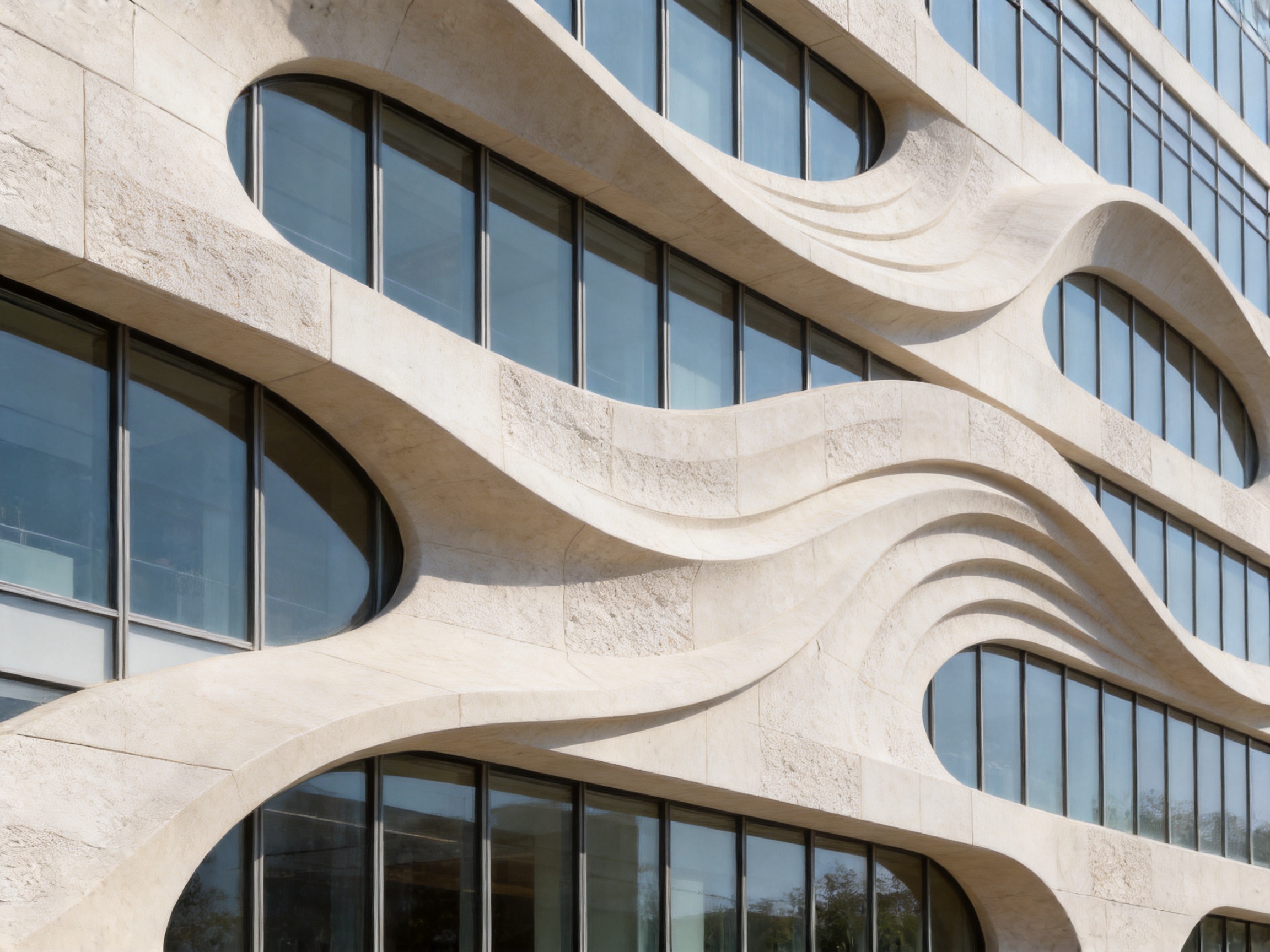
A successful façade is not only seen from the front; it is experienced through changing light, movement, distance, and viewpoint. Fluid Design Architectural GRC Curtain Wall Panels are well suited to this visual complexity. Their molded surfaces can create shadows that shift throughout the day. Curved ribs, wave patterns, recessed lines, and three-dimensional forms can make a building look different in morning light, midday brightness, and evening illumination.
The surface finish can be adapted to design intent. A smooth finish can create a clean contemporary appearance. A textured finish can add depth and tactile richness. Pigmented or coated finishes can coordinate with other building materials such as glass, metal, timber, stone, and landscape elements. Because the panels are manufactured through mold-based production, surface details can be repeated across multiple panels, helping the building maintain a unified visual rhythm.
For commercial developments, this visual performance can support branding and tenant attraction. A memorable exterior makes a property easier to recognize and can improve the perceived quality of the development. For public buildings, a fluid GRC façade can communicate openness, cultural identity, and civic value. For residential projects, it can elevate the building beyond ordinary flat cladding, creating a premium appearance that supports long-term property appeal.
The ability to control depth is particularly important. Flat panels reflect light in a simple way, but three-dimensional GRC panels create layered shadow and visual movement. The façade becomes an active architectural surface rather than a passive enclosure. This is one reason GRC is frequently chosen for projects that want a distinctive but durable exterior skin.
Although these panels are visually expressive, their success depends on sound engineering. Curtain wall panels must be designed with attention to panel size, thickness, reinforcement, connection points, wind load, thermal movement, drainage, joint design, and installation tolerances. GRC’s lightweight character helps reduce load, but every project still requires proper calculation and coordination with the building’s structural and façade systems.
The panel connection system is a critical component. Panels must be securely attached to the supporting frame while allowing for construction tolerances and movement. Proper anchoring prevents stress concentration and helps maintain long-term safety. The design team must consider how each panel will be lifted, aligned, fixed, sealed, and inspected. When the manufacturer provides drawing support and installation guidance, the risk of site errors can be reduced.
Joint layout also plays an important role. In fluid façades, joints should support both technical performance and visual continuity. Poorly planned joints can interrupt the intended design or create maintenance problems. With professional detailed design and mold planning, panel divisions can be arranged to respect architectural rhythm while remaining practical for production and installation.
Moisture management is another essential factor. A façade system should consider rainwater paths, ventilation, drainage, and sealant performance. GRC panels themselves resist weather exposure, but the complete façade assembly must be detailed to prevent water accumulation behind the panels or at connection points. The manufacturer’s background in drainage-related products provides a useful practical perspective: exterior building systems must guide water safely and predictably rather than ignore it.
Thermal movement must also be addressed. All exterior materials expand and contract under temperature changes. Proper joint width, connection detailing, and installation tolerance allow the façade to respond to environmental changes without unwanted stress. When these details are resolved early, the finished building can maintain its appearance and performance for many years.
The manufacturing strength behind Fluid Design Architectural GRC Curtain Wall Panels is one of the product’s key competitive advantages. Jiangsu Yameng Traffic Road Facilities Co., Ltd. supports GRC customization with professional designers, mold designers, CNC engravers, and an experienced production and construction technical team. This integrated capability helps transform architectural concepts into buildable façade products.
The process begins with design understanding. The manufacturer must interpret the architect’s drawings, façade intent, module logic, and performance requirements. At this stage, communication is crucial. A visually impressive concept must be evaluated for manufacturability, panel weight, mold feasibility, installation sequence, and budget practicality. By participating in detailed design, the company can help refine the product so that the final façade remains faithful to the concept while being realistic for production and construction.
After design confirmation, detailed drawings are prepared. These may include panel dimensions, section profiles, edge details, embedded components, fixing positions, joint widths, and mold requirements. Accurate drawings reduce misunderstandings and provide a technical foundation for production. In complex fluid designs, this step is especially important because small dimensional errors can disrupt the continuity of the façade pattern.
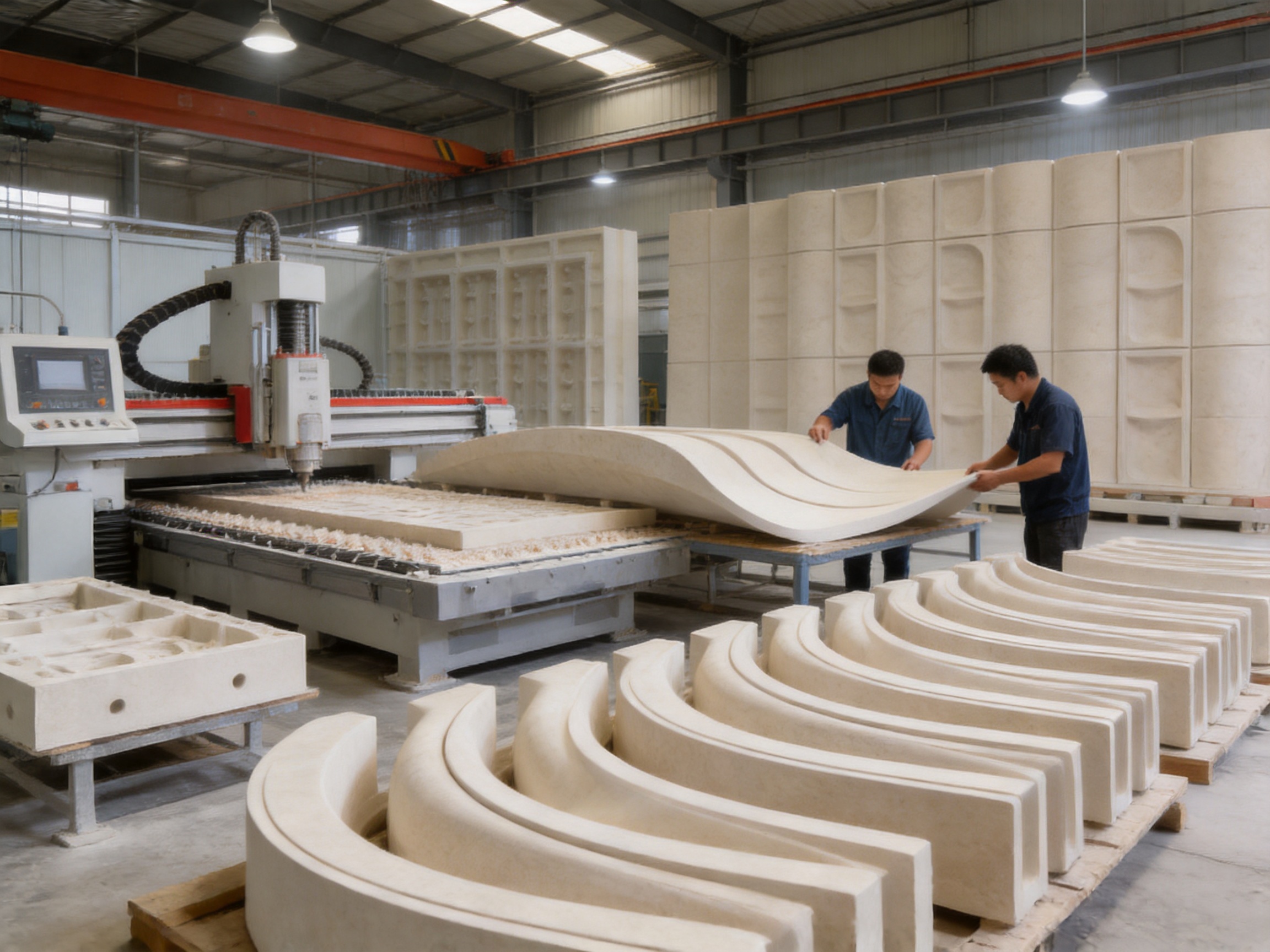
Mold making is then carried out according to the approved design. Mold quality directly affects panel quality. A precise mold produces accurate dimensions, consistent surface texture, and clean edges. For fluid designs, molds may require complex curvature, carefully controlled depth, and repeatable geometry. CNC engraving supports high-precision mold development, allowing digital design information to be translated into physical production tools with strong accuracy.
During GRC production, material preparation, fiber distribution, casting or spraying technique, curing, demolding, finishing, and inspection must be controlled. The goal is to produce panels that meet dimensional, surface, and performance requirements. Quality management should check visible defects, thickness consistency, embedded parts, panel shape, and surface finish. For architectural panels, appearance quality is as important as strength because the façade is a highly visible part of the building.
Curing is another essential stage. Cement-based materials gain strength through hydration, and controlled curing helps improve final performance. Improper curing can lead to weak surfaces, dimensional instability, or cracking. A disciplined production process ensures that panels reach suitable strength before handling, transport, and installation.
Finishing and packaging complete the manufacturing cycle. Panels must be protected during storage and transportation to avoid edge damage, surface staining, or impact. Proper labeling helps site teams identify panel locations quickly, which is especially useful on complex projects with many unique modules. This production-to-site coordination is an important sign of a mature façade supplier.
One of the strengths of Jiangsu Yameng Traffic Road Facilities Co., Ltd. is its ability to provide complete services from detailed design, drawings, mold making, production, on-site construction, to after-sales support. This full-process capability is valuable because façade projects involve many stages and many participants. When suppliers only provide products without technical support, contractors may face difficulties during installation. When a manufacturer understands the full process, potential problems can be prevented earlier.
During the design stage, the company can help optimize panel division and mold strategy. During the drawing stage, it can support precise technical documentation. During mold making, it can ensure the product’s appearance matches the design intent. During production, it can manage quality consistency. During on-site construction, it can provide guidance for handling, alignment, and installation details. During after-sales service, it can respond to maintenance questions or project feedback.
This service model creates advantages over competitors that focus only on low-price production. In façade construction, the cheapest initial panel cost is not always the most economical choice. Poor coordination can cause delays, rework, installation waste, and long-term maintenance problems. A supplier with integrated technical support can help reduce total project risk and protect the owner’s investment.
For international or domestic projects, communication and documentation are especially important. Clear product drawings, packaging lists, installation recommendations, and quality records can help project teams coordinate across locations. Because the company is committed to product research and development and serves both domestic and international markets, it is positioned to respond to varied project requirements and practical construction conditions.
The company’s broader product background includes linear drainage ditches, finished drainage ditches, polymer-based drainage ditches, slot drainage ditches, U-shaped drainage ditches, ductile iron cover plates, stainless steel stamped cover plates, steel gratings, resin concrete cover plates, resin composite manhole covers, stainless steel manhole covers, ductile iron manhole covers, drainage pipes, PE pipes, and related products. This experience may appear separate from façade panels at first, but it reflects a strong foundation in infrastructure components, precision manufacturing, and durable outdoor products.
Drainage products must perform under real environmental stress. They must handle water, load, corrosion, installation tolerances, and long-term exposure. This practical engineering mindset supports the company’s approach to GRC façade products. A curtain wall panel must also deal with weather, movement, durability, and installation accuracy. The company’s commitment to integrity, responsibility, focus, and innovation supports a manufacturing culture where product performance matters as much as appearance.
The company is located in Nantong, Jiangsu Province, China, with convenient transportation and waterway access. Logistics capability is important for large façade projects because panels must be delivered safely and on schedule. Efficient transportation access helps support project planning, especially when many panels and molds are involved. Large exterior projects often require phased delivery, so a supplier’s location and logistics organization can affect the entire construction schedule.
By combining infrastructure product experience with GRC customization, the company can serve customers who need practical, durable, and visually refined building components. This combination is a competitive strength because many façade projects fail not because of design ambition, but because production and site execution cannot keep pace with that ambition. A manufacturer with both engineering discipline and architectural customization capability can bridge that gap.
The following table summarizes the main performance features of Fluid Design Architectural GRC Curtain Wall Panels and explains how they benefit building projects.
| Feature | Project Benefit | Competitive Advantage |
|---|---|---|
| Lightweight GRC construction | Reduces façade dead load and supports easier handling | More efficient than heavy traditional precast concrete |
| High design flexibility | Allows curves, textures, relief patterns, and custom forms | Greater sculptural freedom than many flat cladding systems |
| Weather resistance | Supports long-term exterior performance in outdoor conditions | Suitable for commercial, residential, and public buildings |
| UV resistance | Helps preserve façade appearance under sunlight exposure | Reduces premature aging concerns compared with some surface finishes |
| Corrosion resistance | Minimizes risks associated with rust and metal deterioration | Advantageous in humid, coastal, or polluted environments |
| Custom mold production | Enables repeatable complex geometry and accurate panel profiles | Supports landmark architectural designs with controlled production |
| Professional design and construction support | Improves coordination from drawings to installation | Reduces project risk compared with product-only suppliers |
| Low maintenance requirement | Helps reduce long-term ownership cost | Attractive for property owners and facility managers |
These advantages show why GRC curtain wall panels are increasingly chosen for buildings that require both visual identity and dependable exterior performance. The product is not merely decorative; it is a practical façade system that can support long-term architectural value.
Commercial buildings often compete for attention. Shopping centers, office towers, hotels, business parks, and exhibition facilities need façades that attract visitors, tenants, and investors. Fluid Design Architectural GRC Curtain Wall Panels can create a distinctive exterior identity that improves recognition and enhances property value. A flowing façade can soften large building volumes, create memorable entrances, and integrate architectural branding into the building skin.
For retail and mixed-use buildings, the façade is part of the customer experience. A sculptural GRC surface can make the building feel modern and premium before visitors enter. It can also define zones, frame signage, or create visual movement along pedestrian routes. Because GRC can be customized, the façade can be designed to match the brand image of the development without relying on generic cladding products.
For office buildings, a high-quality façade supports corporate image. Tenants often prefer buildings that communicate stability, innovation, and professionalism. A fluid GRC curtain wall panel system can create a refined exterior that stands apart from standard glass-and-metal towers. When paired with glass curtain walls, the mineral depth of GRC can provide contrast and balance, making the building more visually grounded.
For hotels and cultural commercial spaces, the ability to create unique forms is especially valuable. Hospitality architecture benefits from memorable design because guest experience begins at the exterior. GRC panels can form elegant entrance canopies, vertical façade waves, patterned screens, or textured wall planes that reinforce the atmosphere of the property.
In residential architecture, façade quality strongly influences market perception. Homebuyers and tenants notice the exterior before they evaluate interior details. Fluid Design Architectural GRC Curtain Wall Panels can help residential developments achieve a premium look while maintaining practical durability. They are suitable for apartment buildings, villa communities, high-end residential entrances, podium façades, and landscape-related architectural features.
Compared with ordinary painted wall systems, GRC panels can provide more durable surface depth and a stronger architectural identity. They can be used to frame balconies, emphasize entrance lobbies, create textured podium walls, or add sculptural features to residential towers. Because the material is relatively lightweight compared with traditional concrete, it is more practical for façade installation on multi-story residential buildings.
Public buildings also benefit from the product’s combination of durability and expression. Schools, libraries, civic centers, transport stations, sports facilities, and healthcare buildings require materials that can withstand frequent use and long-term exposure. At the same time, public architecture often needs to communicate openness, culture, and community value. GRC panels can provide a durable façade with a customized visual language appropriate to the building’s function.
For renovation projects, GRC curtain wall panels may also be useful when the goal is to refresh an outdated exterior. Because of their manageable weight and custom appearance, they can help transform old façades into contemporary surfaces. Project-specific structural evaluation is always necessary, but the lightweight nature of GRC can be advantageous when working with existing buildings that cannot support very heavy cladding systems.
A façade panel is never isolated. It must integrate with windows, curtain wall glazing, doors, parapets, roof edges, waterproofing layers, insulation, structural frames, lighting, signage, and drainage paths. Fluid Design Architectural GRC Curtain Wall Panels can be designed to coordinate with these systems when the project team plans carefully from the beginning.
Integration with glass is one of the most common design strategies. GRC provides solidity and sculptural depth, while glass provides transparency and lightness. The contrast between the two materials can create a balanced modern façade. Proper detailing at the junction between GRC and glass is essential to manage movement, sealing, and appearance. The panel edges, reveals, and fixing positions should be coordinated with glazing systems before production begins.
Integration with lighting can further enhance fluid designs. Three-dimensional GRC surfaces respond dramatically to grazing light. Exterior lighting can emphasize waves, textures, and recesses at night, turning the façade into a dynamic visual feature. When lighting is planned early, panels can include appropriate recesses, mounting zones, or shadow lines that improve the final effect.
Integration with drainage is also important. Any exterior wall surface must consider how rainwater travels across and behind the façade. Drips, slopes, joints, and sealant details should prevent staining and water accumulation. Because the company has broad experience in drainage channel products, it understands the importance of guiding water effectively. This knowledge supports better façade detailing, particularly at horizontal ledges, recessed areas, and lower wall zones.
Integration with insulation and energy performance depends on the full wall assembly. GRC panels themselves form the outer architectural layer, while insulation and air barriers may be installed behind them depending on project design. The support frame must accommodate thermal performance goals, ventilation requirements, and moisture control. Professional coordination helps ensure that the final façade is not only beautiful but also technically sound.
One of the strengths of GRC is the wide range of possible surface expressions. Fluid Design Architectural GRC Curtain Wall Panels can be produced with smooth, textured, patterned, ribbed, or relief surfaces according to project requirements. The surface can be designed to resemble stone, concrete, or a more abstract architectural texture. This flexibility helps designers match the façade to the building’s concept.
Color can be achieved through material selection, pigments, coatings, or other finishing methods depending on specification. Neutral tones such as white, gray, beige, and sand colors are commonly used in modern façades because they emphasize form and shadow. Darker tones can create dramatic contrast, while lighter tones can make a building feel clean and refined. The selected finish should consider local climate, maintenance expectations, and compatibility with surrounding materials.
Texture depth should also be selected carefully. Deep textures produce stronger shadows and visual drama, but they may require more attention to cleaning and water runoff. Smooth surfaces are easier to maintain but may show stains or imperfections more clearly if not detailed properly. A professional manufacturer can help balance aesthetic goals with practical maintenance considerations.
Customization can extend to panel size, curvature, edge shape, joint layout, and embedded fixing components. For large projects, custom molds allow repeated use of specific design elements. For projects with many unique panels, digital modeling and CNC mold making can help manage complexity. The key is to choose customization that adds architectural value while remaining efficient to manufacture and install.
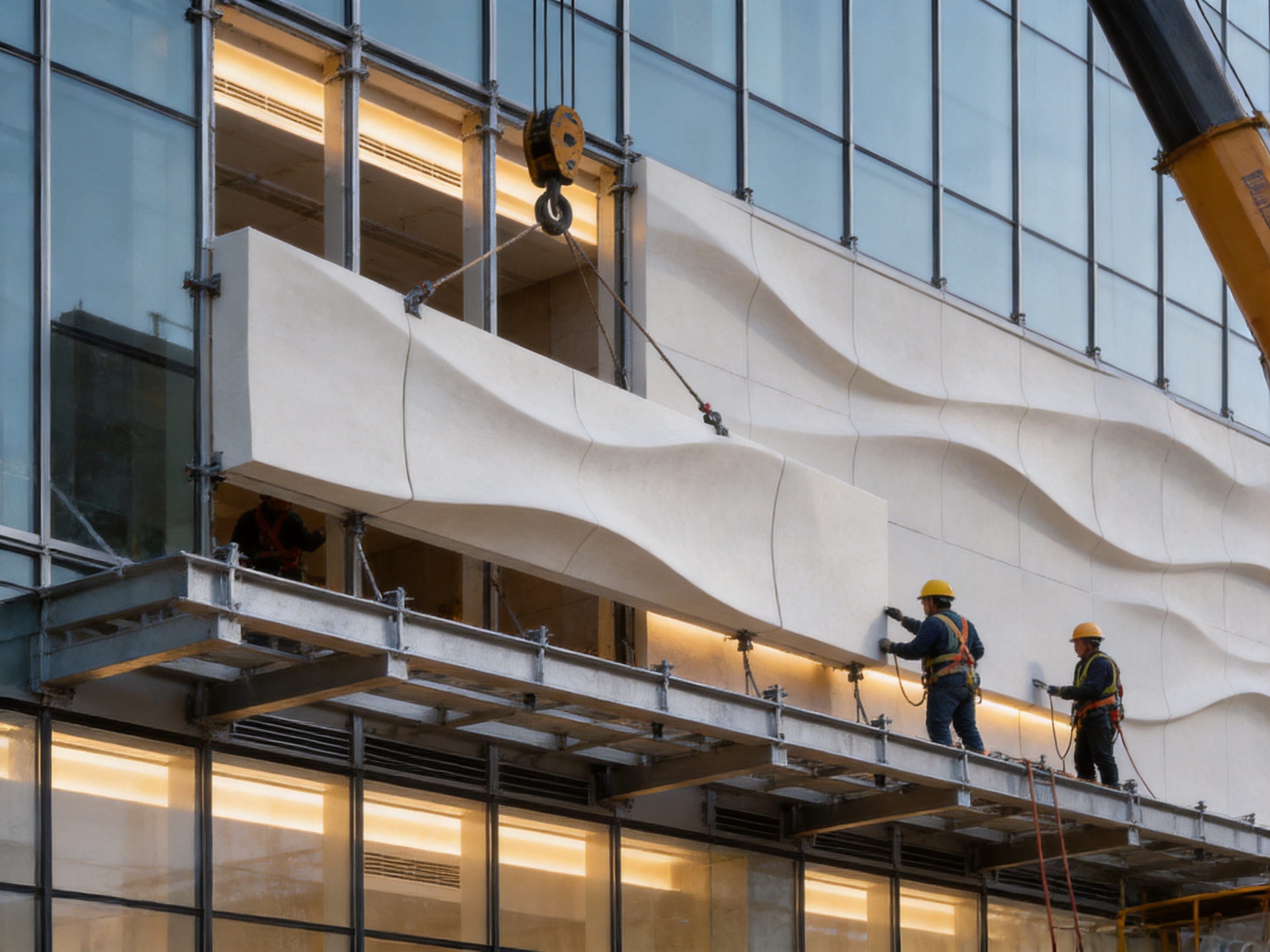
Installation efficiency is a major advantage of well-designed GRC curtain wall panels. Because the panels are lighter than many traditional concrete components, they can be easier to transport, lift, and position. This may reduce labor intensity and support faster façade enclosure, depending on project conditions. However, installation success depends on accurate preparation.
Before installation, the support structure should be checked for alignment and tolerance. Panels should be delivered according to the installation sequence whenever possible. Each panel should be labeled clearly, and site teams should understand lifting points, fixing methods, joint dimensions, and protection requirements. Proper handling prevents edge chips, surface scratches, and unintended stress.
During installation, alignment is essential. Fluid designs often rely on continuous patterns across multiple panels. If one panel is misaligned, the visual flow can be interrupted. This makes shop drawings, panel numbering, and experienced site supervision especially important. The company’s ability to provide on-site construction support helps reduce this risk.
Sealant and joint treatment must follow project requirements. Joints should accommodate movement while maintaining weather performance and visual consistency. The joint color and width can influence the final appearance, so they should be selected during design rather than left as an afterthought. In some designs, joints are emphasized as part of the rhythm; in others, they are minimized visually.
After installation, the façade should be inspected for alignment, surface damage, fixing quality, joint consistency, and cleanliness. Any necessary repairs should be carried out using compatible methods. A well-managed installation process protects the value created during design and manufacturing.
Long-term durability is one of the reasons GRC curtain wall panels are attractive for building owners. Exterior façades are exposed to sun, rain, wind, dust, pollution, temperature changes, and occasional impact. A material that resists weather and corrosion can reduce maintenance pressure and help keep the building looking professional for years.
Maintenance requirements are generally lower than those of materials that require frequent repainting, anti-corrosion treatment, or replacement of fragile surface elements. Routine cleaning and inspection are still recommended, especially in polluted or coastal environments, but the panels are designed to deliver lasting performance with minimal maintenance. This is particularly important for high-rise buildings where façade access can be expensive.
UV resistance helps the façade maintain appearance under sunlight. While all exterior finishes should be selected with aging behavior in mind, GRC’s mineral base supports stable outdoor use. Corrosion resistance is also important because exterior systems often encounter moisture. Unlike steel components that require protective coatings, the GRC panel body itself does not rust.
Durability should be considered as part of total cost. A cheaper material that requires frequent repair may become more expensive over the building’s life cycle. Fluid Design Architectural GRC Curtain Wall Panels provide value by combining an upscale appearance with long-term practicality. For property owners, this means the initial investment supports both design quality and reduced maintenance burden.
Sustainable construction is increasingly important in modern architecture. While every project must evaluate sustainability according to local standards, building life cycle, and material sourcing, GRC offers several qualities that can support responsible design. Its lightweight nature can reduce transportation and structural burdens compared with heavy precast concrete. Its durability can extend service life and reduce replacement waste. Its custom production can help optimize material use when molds and panel layouts are planned efficiently.
Long-lasting façade materials contribute to sustainability by avoiding premature replacement. A façade that remains functional and attractive for many years reduces waste, renovation disruption, and additional resource consumption. Low maintenance also reduces the repeated use of coatings, repair materials, and labor access systems over time.
Because GRC panels can be designed as thin elements, they use less cementitious material than thick conventional concrete panels for similar architectural cladding purposes. This can be beneficial when the design objective is to achieve a concrete-like surface without unnecessary mass. However, sustainability is always best improved through integrated design, efficient production, careful logistics, and durable installation details.
Responsible material selection also includes choosing products that match the building’s actual performance needs. If a project requires sculptural form, weather resistance, and long service life, GRC can be a more appropriate choice than materials that are either overbuilt, too fragile, or maintenance-intensive. The right material reduces waste by performing well in its intended application.
In architectural façade projects, product quality depends heavily on manufacturer capability. A design may look impressive in renderings, but it can only succeed if the manufacturer can produce accurate panels, manage molds, control quality, and coordinate delivery. This is especially true for fluid GRC designs, where geometry and surface continuity are central to the architectural effect.
Jiangsu Yameng Traffic Road Facilities Co., Ltd. offers strengths that directly support this need. Its professional designers help interpret and refine design requirements. Its mold designers and CNC engravers support precision in complex shapes. Its experienced production team helps ensure consistent manufacturing. Its construction technical team supports installation coordination. Its after-sales service provides continued customer support after delivery.
This integrated capability is an advantage over suppliers that rely on fragmented outsourcing or limited technical service. When design, mold development, production, and construction guidance are coordinated, the project team can respond more efficiently to changes and technical challenges. Problems can be solved at the drawing or mold stage rather than discovered during installation.
The company’s commitment to integrity and quality also matters. Façade components are long-term building assets, not disposable products. Customers need reliable communication, honest technical advice, and consistent manufacturing standards. A supplier that values responsibility and innovation can help customers make better decisions and achieve stronger project outcomes.
When selecting Fluid Design Architectural GRC Curtain Wall Panels for a project, owners and contractors should begin with clear requirements. These include design drawings, expected surface finish, performance standards, panel sizes, installation method, delivery schedule, and project location. The more complete the early information, the more accurately the manufacturer can provide technical recommendations and production planning.
Mock-ups are often valuable for architectural façade projects. A physical sample or full-size mock-up allows the design team to evaluate color, texture, joint appearance, shadow effect, and installation details before mass production. This step can prevent costly changes later. For fluid designs, mock-ups are especially useful because three-dimensional surfaces often look different in real light than they do in digital renderings.
Buyers should also consider mold strategy. If many panels share the same form, mold cost can be spread efficiently across repeated production. If every panel is unique, digital production planning becomes more important. The manufacturer can help optimize the balance between design uniqueness and production economy.
Packaging and transportation should be planned according to panel size, finish sensitivity, and site conditions. Panels need protection from impact and contamination. Delivery sequencing can improve installation speed and reduce storage problems on site. A good supplier will coordinate labeling and packaging to match project requirements.
Finally, buyers should evaluate total value rather than only unit price. A reliable GRC panel supplier provides design support, production quality, accurate delivery, and installation guidance. These services reduce hidden costs and project risk. In façade construction, the lowest price can become expensive if it leads to poor fit, delays, or maintenance issues.
They are used as exterior architectural façade panels for commercial, residential, public, and mixed-use buildings. They create modern building skins with flowing forms, sculptural surfaces, and durable weather-resistant performance.
GRC is generally lighter and more suitable for thin architectural cladding. It can reduce façade dead load, simplify handling, and provide greater flexibility for complex shapes. Traditional precast concrete can be strong, but it is often heavier and less efficient for fluid façade designs.
Yes. Customization is one of the main advantages. The panels can be designed with curves, textures, relief patterns, custom sizes, and project-specific finishes. Professional mold design and CNC engraving support accurate production of complex forms.
Yes. They are designed for exterior façade applications and offer resistance to weather, UV exposure, and corrosion-related deterioration. Proper engineering, installation, and maintenance are still important for long-term performance.
Metal cladding is lightweight, but it has a different visual character and may require careful corrosion or denting control depending on material and environment. GRC provides a more solid mineral appearance, strong sculptural depth, and resistance to rust in the panel body.
The manufacturer can assist with detailed design, technical drawings, mold making, production, construction support, and after-sales service. This full-process capability helps reduce project risk and ensures the final façade matches the design intent.
Maintenance is generally manageable. Routine cleaning and periodic inspection are recommended, especially in environments with dust, pollution, or salt exposure. The panels are designed for low-maintenance exterior performance compared with many materials that require frequent repainting or anti-corrosion treatment.
Yes. GRC panels are often combined with glass systems to create contrast between solid sculptural surfaces and transparent façade areas. Proper detailing is needed at junctions to manage movement, sealing, drainage, and visual alignment.
Project teams should confirm design drawings, panel dimensions, finish requirements, performance expectations, fixing method, joint layout, delivery schedule, and installation conditions. Samples or mock-ups are recommended for important visual decisions.
Its combination of lightweight strength, design freedom, custom mold production, weather resistance, and professional technical support makes it especially suitable for landmark projects requiring both visual impact and reliable construction performance.
Fluid Design Architectural GRC Curtain Wall Panels offer a compelling solution for modern façades that need to be both expressive and durable. They allow designers to move beyond flat surfaces and create architecture with rhythm, shadow, depth, and identity. At the same time, they provide practical benefits such as reduced weight, weather resistance, corrosion resistance, UV resistance, and low maintenance.
The product’s advantages become even stronger when supported by a capable manufacturer. Jiangsu Yameng Traffic Road Facilities Co., Ltd. brings together professional design support, mold design, CNC engraving, experienced production, construction technical service, and after-sales support. This complete service chain helps transform ambitious façade concepts into practical building solutions. The company’s broader engineering experience in drainage channels and outdoor infrastructure products further strengthens its understanding of durability, precision, and site performance.
For architects, the panels provide creative freedom. For developers, they support property value and visual distinction. For contractors, they offer manageable installation when properly coordinated. For owners, they deliver long-term façade quality with reduced maintenance pressure. In a construction market that increasingly values both design identity and life-cycle performance, Fluid Design Architectural GRC Curtain Wall Panels stand out as a balanced, advanced, and competitive façade material.
1. PCI Committee on Glass Fiber Reinforced Concrete Panels. Recommended Practice for Glass Fiber Reinforced Concrete Panels. Precast/Prestressed Concrete Institute.
2. ACI Committee 544. Guide to Fiber-Reinforced Concrete. American Concrete Institute.
3. GRCA. Specification for the Manufacture, Curing and Testing of Glassfibre Reinforced Concrete Products. International Glassfibre Reinforced Concrete Association.
4. Allen, E., and Iano, J. Fundamentals of Building Construction: Materials and Methods. Wiley.
5. Ching, F. D. K. Building Construction Illustrated. Wiley.
6. Watts, A. Modern Construction Envelopes. Birkhäuser.
Related Products
Engineered to address the long-term challenges of chemical erosion and structural aging in architect...
READ MOREEngineered to address the long-term challenges of chemical erosion and structural aging in architect...
READ MOREEngineered to address the long-term challenges of chemical erosion and structural aging in architect...
READ MOREEngineered to address the long-term challenges of chemical erosion and structural aging in architect...
READ MOREEngineered to address the long-term challenges of chemical erosion and structural aging in architect...
READ MOREEngineered to address the long-term challenges of chemical erosion and structural aging in architect...
READ MORE
Contact us
Factory Address
Group 12, Quanxin Village, Donghai Town, Qidong City, Nantong City, Jiangsu Province, China
phone
+86-13914963840
+86-13451754670
products
QR CODE
 Wholesale Drainage Ditch Manufacturers