 English
 Español
 عربى
عربى

Energy-Efficient Sustainable GRC Curtain Wall Panels are high-performance architectural panels desig...
READ MOREJun 18, 2026
Content
Precast drainage channels have become essential infrastructure components for modern cities, commercial developments, transportation networks, industrial zones, and architectural landscapes. They are no longer treated as simple trenches for collecting rainwater. Instead, they are engineered systems designed to manage stormwater quickly, safely, quietly, and attractively in environments with very different functional demands. A well-designed precast drainage channel must combine hydraulic efficiency, structural strength, installation speed, durability, aesthetic compatibility, and long-term maintenance convenience.
In a market where many drainage products look similar at first glance, true performance is determined by material selection, channel geometry, grating design, manufacturing accuracy, load-bearing capacity, corrosion resistance, locking reliability, and the ability to customize solutions for specific projects. The precast drainage channel discussed in this article is designed for a wide range of settings, from refined pedestrian plazas to municipal roads, airport aprons, logistics centers, industrial warehouses, residential communities, and landscape projects.
Compared with traditional cast-in-place drainage ditches, modular precast drainage systems offer clear advantages. They are produced under controlled factory conditions, which improves dimensional accuracy and consistency. They shorten construction schedules because installation does not rely heavily on wet concrete work on-site. They also reduce common risks such as cracking, uneven slopes, leakage, rough internal surfaces, and inconsistent cover plate alignment. For contractors, designers, property owners, and municipal project managers, these advantages translate into lower installation uncertainty, better appearance, reduced maintenance, and more predictable long-term performance.
Precast drainage channels can be used in various settings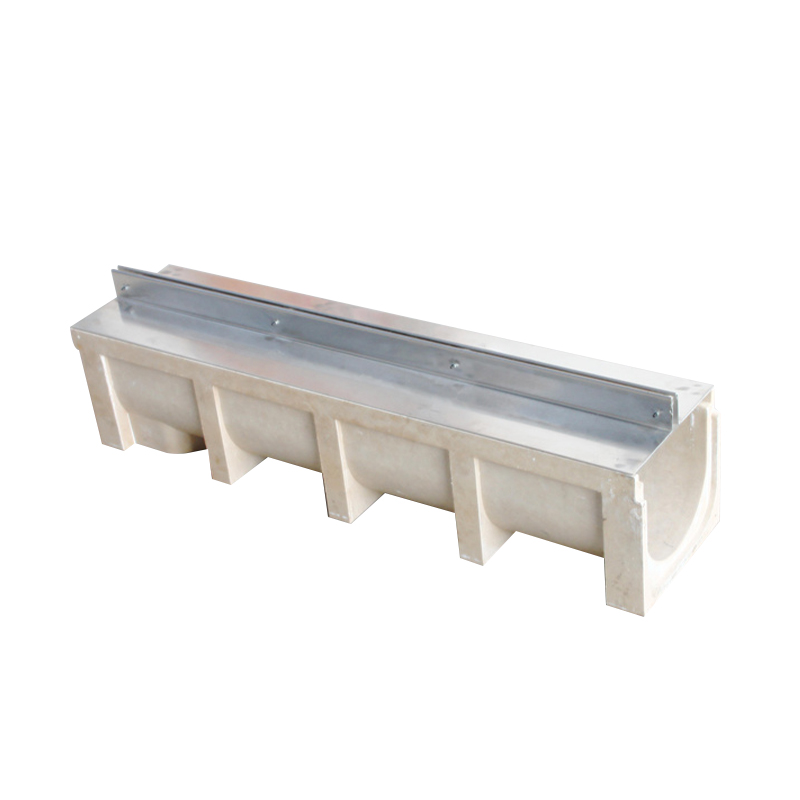
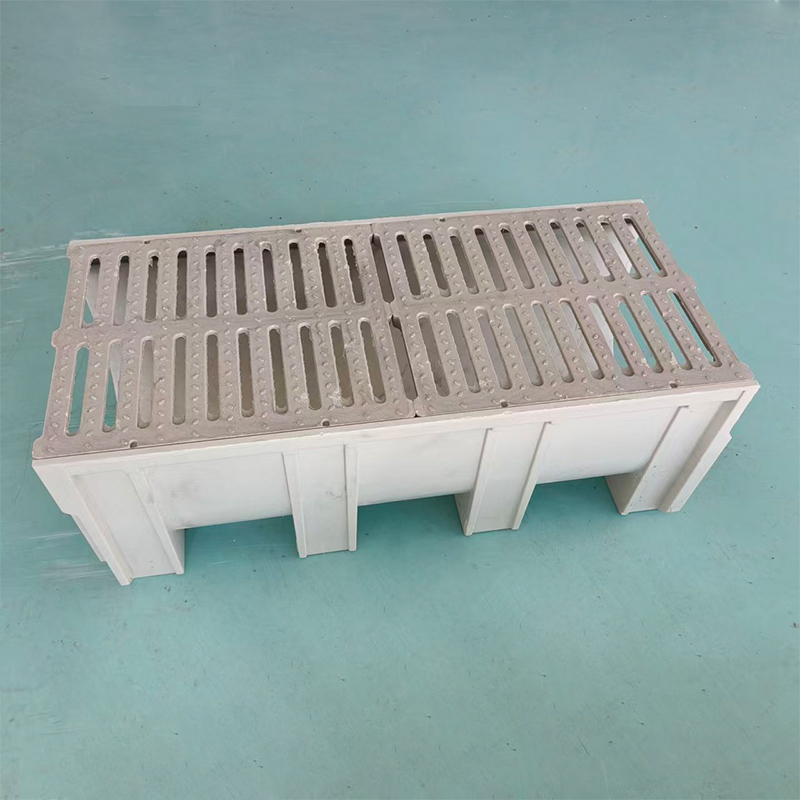
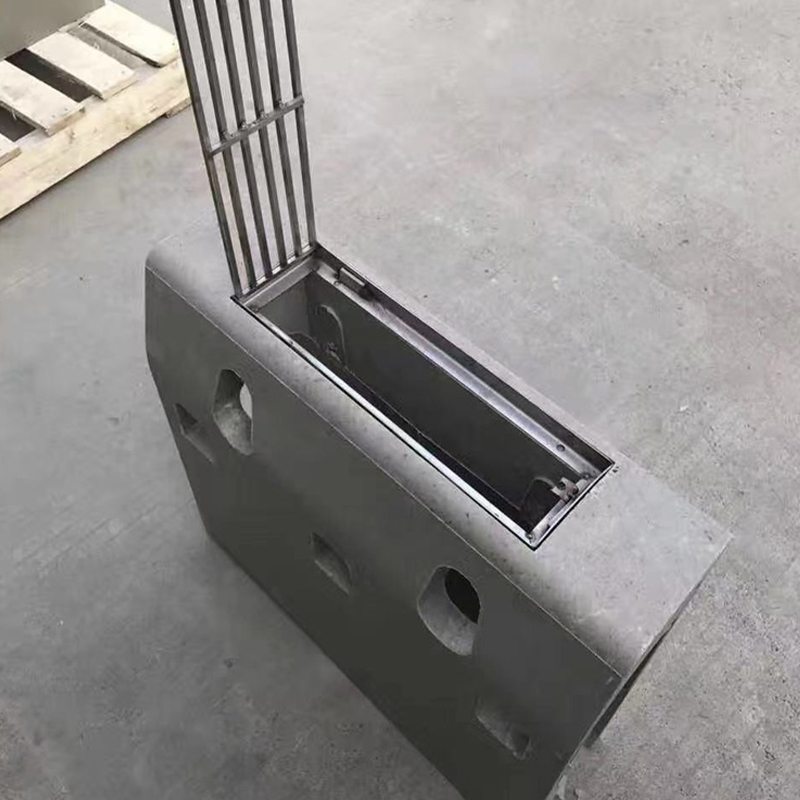
A precast drainage channel is a factory-made linear drainage unit used to collect, convey, and discharge surface water. It typically consists of a channel body, cover plate or grating, edge protection components, locking devices, outlet accessories, inspection modules, and connection parts. The system can be installed in a straight line, around corners, along road edges, beside buildings, across plazas, or within industrial pavements. Its modular nature allows designers to create drainage lines that match project layouts while maintaining hydraulic continuity.
The core value of a precast drainage channel is controlled water movement. Instead of allowing rainwater to spread across a surface and eventually find random low points, the system intercepts water along a continuous line. This linear collection principle is especially effective in areas where fast drainage is required. Roads, parking lots, pedestrian streets, loading yards, and paved landscapes benefit from rapid surface water removal because it reduces puddling, slipperiness, pavement damage, and disruption to daily operations.
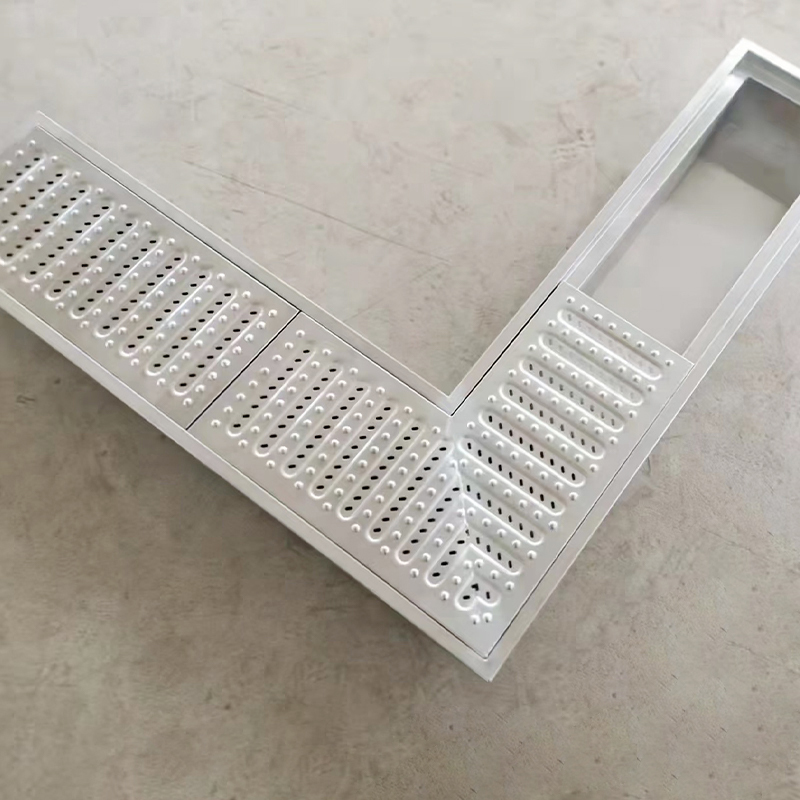
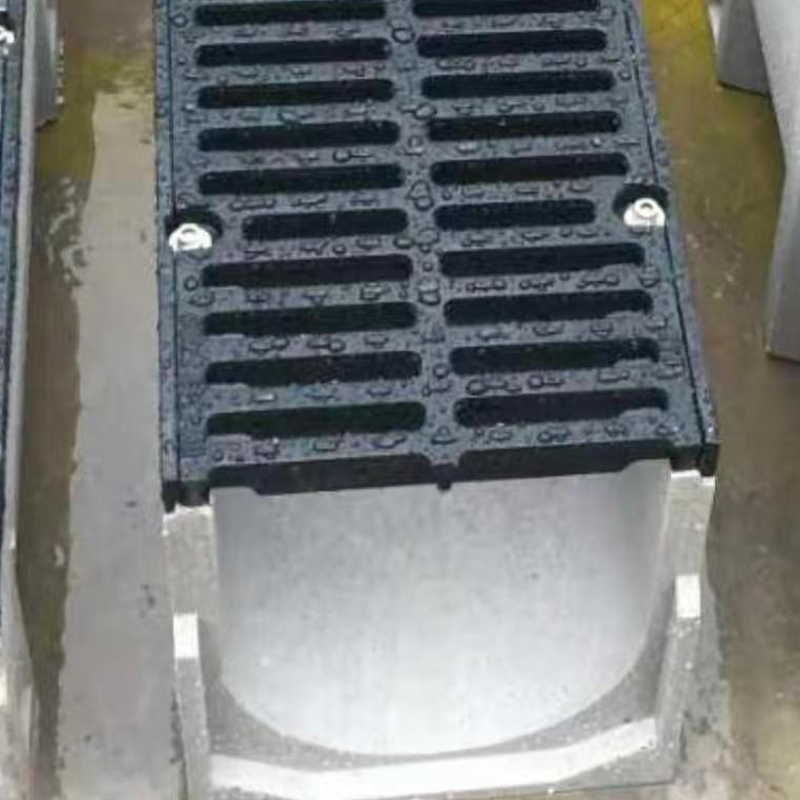
Precast channels can be configured with different cover styles. Slot drainage covers provide a narrow visible opening and are widely used where architectural appearance is important. Ductile iron gratings are selected for heavy traffic areas because of their high strength and impact resistance. Stainless steel stamped covers are preferred in projects that require a clean, modern appearance and good corrosion resistance. Steel gratings are suitable for industrial settings where open area and flow rate are important. Resin concrete cover plates and composite options can also be used for specific requirements related to weight, corrosion, and visual integration.
The product category also extends into GRC-related customization. GRC, or glass fiber reinforced concrete, is often used where shaped, decorative, or project-specific components are required. The ability to support both drainage channel production and GRC customization gives the manufacturer a broader technical base. It allows integrated solutions for projects where drainage performance and architectural form must be considered together.
Traditional drainage ditches are often formed on-site with concrete. While this method has been used for decades, it is highly dependent on field conditions, worker skill, curing time, weather, and quality control discipline. Variations in formwork, concrete mixing, slope control, joint treatment, and finishing can lead to problems after installation. Rough surfaces can trap sediment. Improper slopes can cause standing water. Weak edges can crack under traffic loads. Poor cover plate seating can create vibration and noise.
Precast drainage channels solve many of these issues through factory standardization. Each unit is manufactured using controlled molds, measured raw materials, proper curing conditions, and inspection procedures. The result is a product with stable geometry, smooth internal flow surfaces, consistent joint dimensions, and predictable load performance. This consistency is difficult to achieve with ordinary cast-in-place work, especially on large projects with tight schedules.
Installation speed is one of the most important competitive advantages. Precast units arrive on-site ready for placement. Contractors can prepare the trench, set the base, align the channels, connect outlets, install gratings, and complete surrounding pavement work much faster than forming and curing conventional concrete ditches. In many projects, installation can be three to five times faster than traditional methods. Faster installation reduces labor cost, shortens road closure time, accelerates commercial opening schedules, and minimizes disturbance to surrounding operations.
Another advantage is hydraulic performance. A factory-made channel can be designed with a smooth internal profile that reduces friction and encourages efficient water flow. Linear collection reduces the distance water must travel across the pavement before entering the drainage system. This helps prevent ponding and improves safety. On roads, quick surface water removal reduces the risk of aquaplaning. In pedestrian areas, it minimizes slip hazards and protects expensive paving materials.
Durability is also improved. Precast channels made from resin concrete or high-quality concrete-based materials can resist water penetration, freeze-thaw cycles, chemical exposure, and abrasion better than many conventional solutions. When reinforced edge rails are included, the system protects vulnerable upper channel edges from wheel impact, lateral shearing, and repeated loading. Stronger edges are especially important in truck yards, container terminals, airports, and municipal roads.
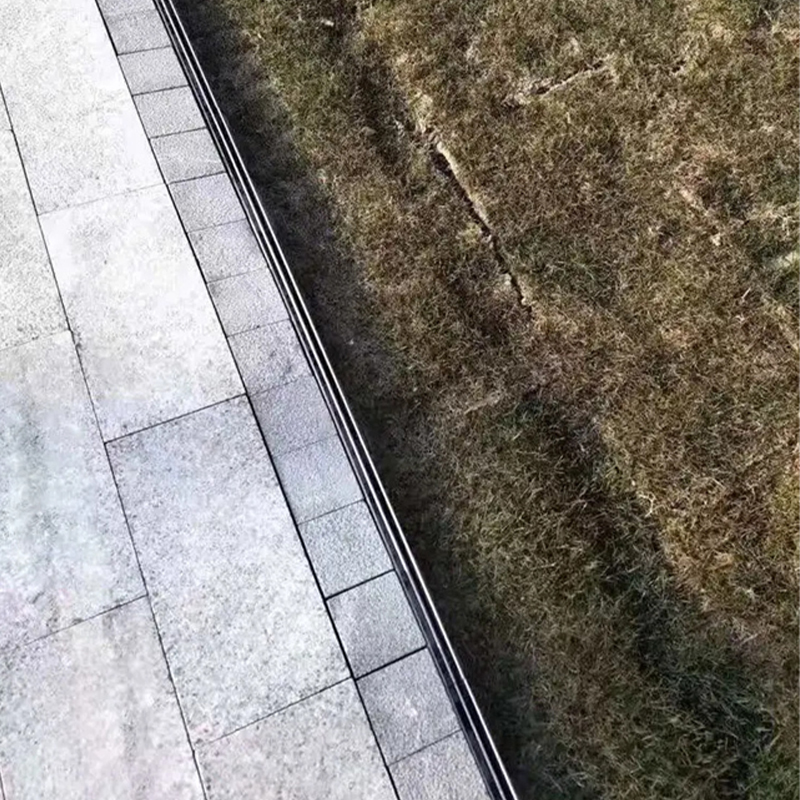
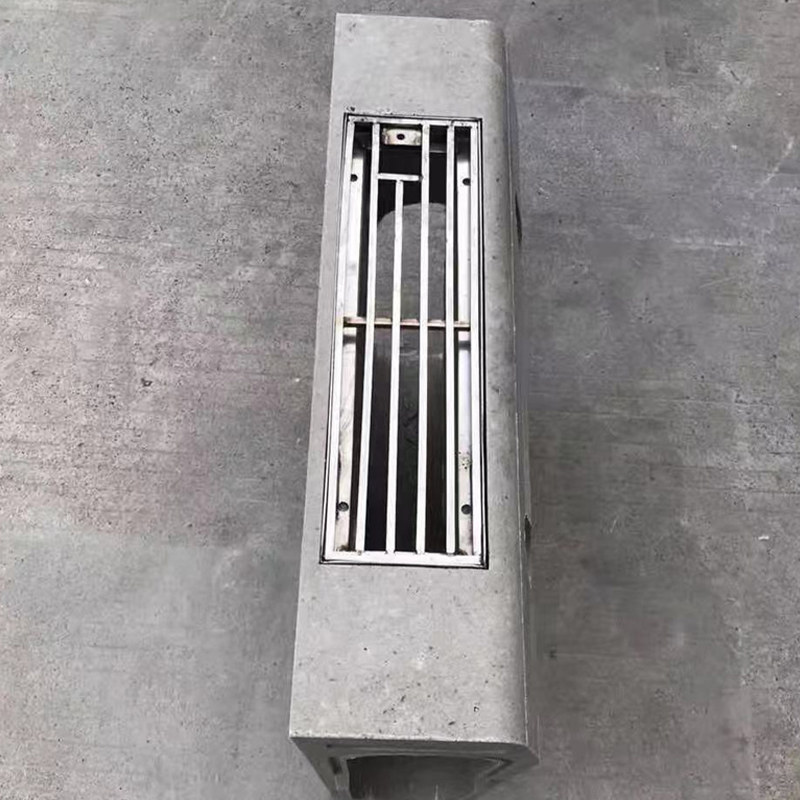
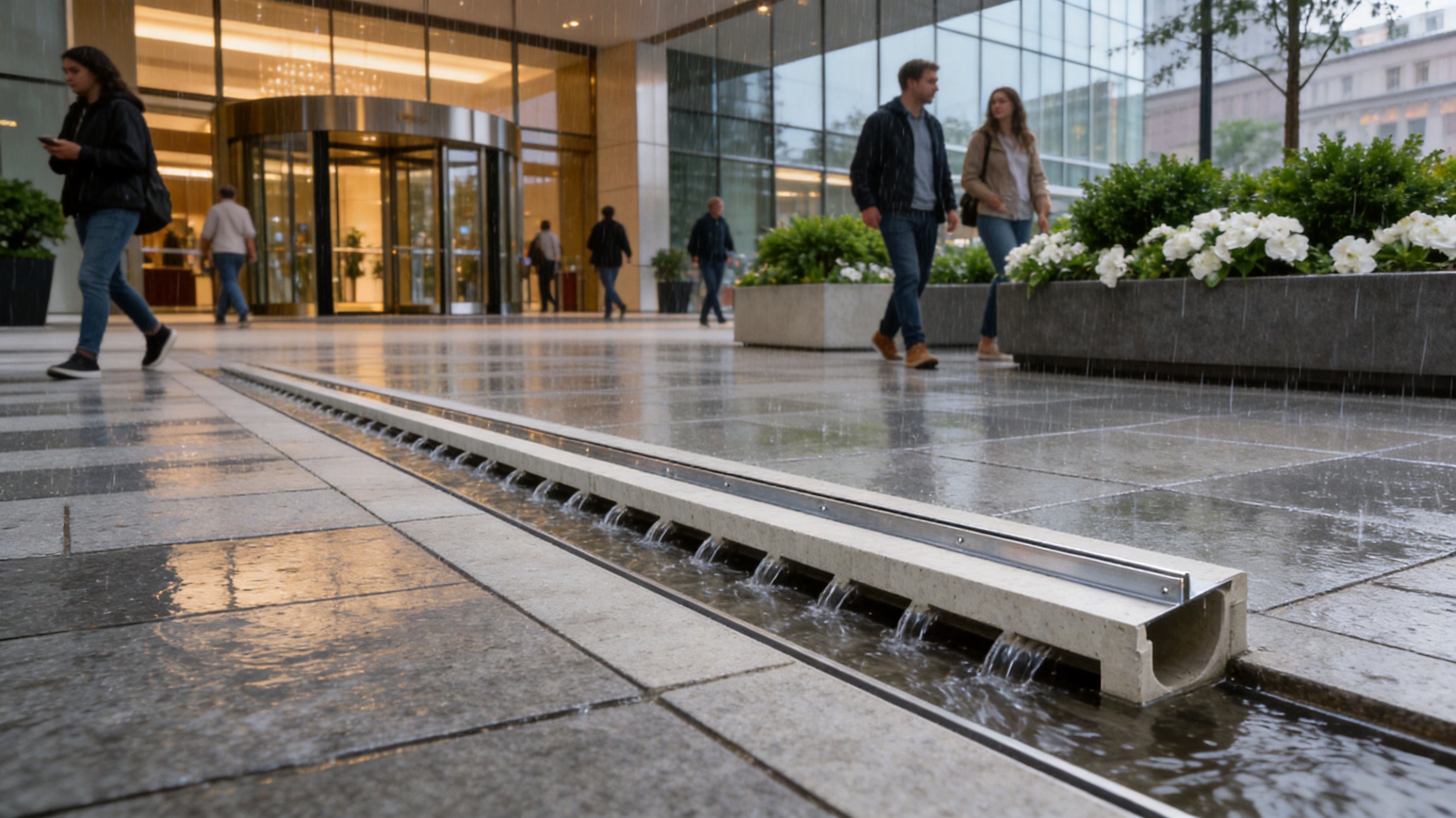
In high-quality urban landscapes, drainage must be both efficient and visually restrained. Designers do not want large, heavy-looking grates to interrupt stone paving, commercial plaza patterns, or pedestrian street finishes. Slot drainage channels provide an elegant solution. The narrow slot opening allows water to enter the channel while the majority of the system remains hidden beneath the surface. This creates a clean ground appearance that supports modern architectural design.
Commercial plazas, pedestrian streets, landscaped parks, shopping centers, hotel entrances, residential courtyards, and public squares benefit from this type of drainage. These environments often combine high pedestrian traffic with premium surface materials. Water accumulation can stain paving, create unsafe walking conditions, damage landscaping, or reduce user comfort. A well-installed linear precast drainage channel preserves the appearance of the space while protecting it from water-related deterioration.
Pedestrian safety is an important design factor. Grating apertures must be designed to reduce the risk of shoe heels becoming trapped. Anti-slip surface features are also important, especially in wet conditions. Drainage covers should sit level with surrounding paving to avoid trip hazards. Factory-produced channel systems help achieve accurate cover alignment and stable seating, which improves both comfort and safety.
Corrosion resistance is another requirement in urban and landscape settings. Drainage channels may be exposed to fountain water treatments, fertilizers, cleaning agents, domestic runoff, deicing salts, and changing weather conditions. Materials must resist corrosion and maintain appearance over time. Stainless steel covers, resin concrete channels, composite covers, and properly protected metal components can be selected according to the project environment.
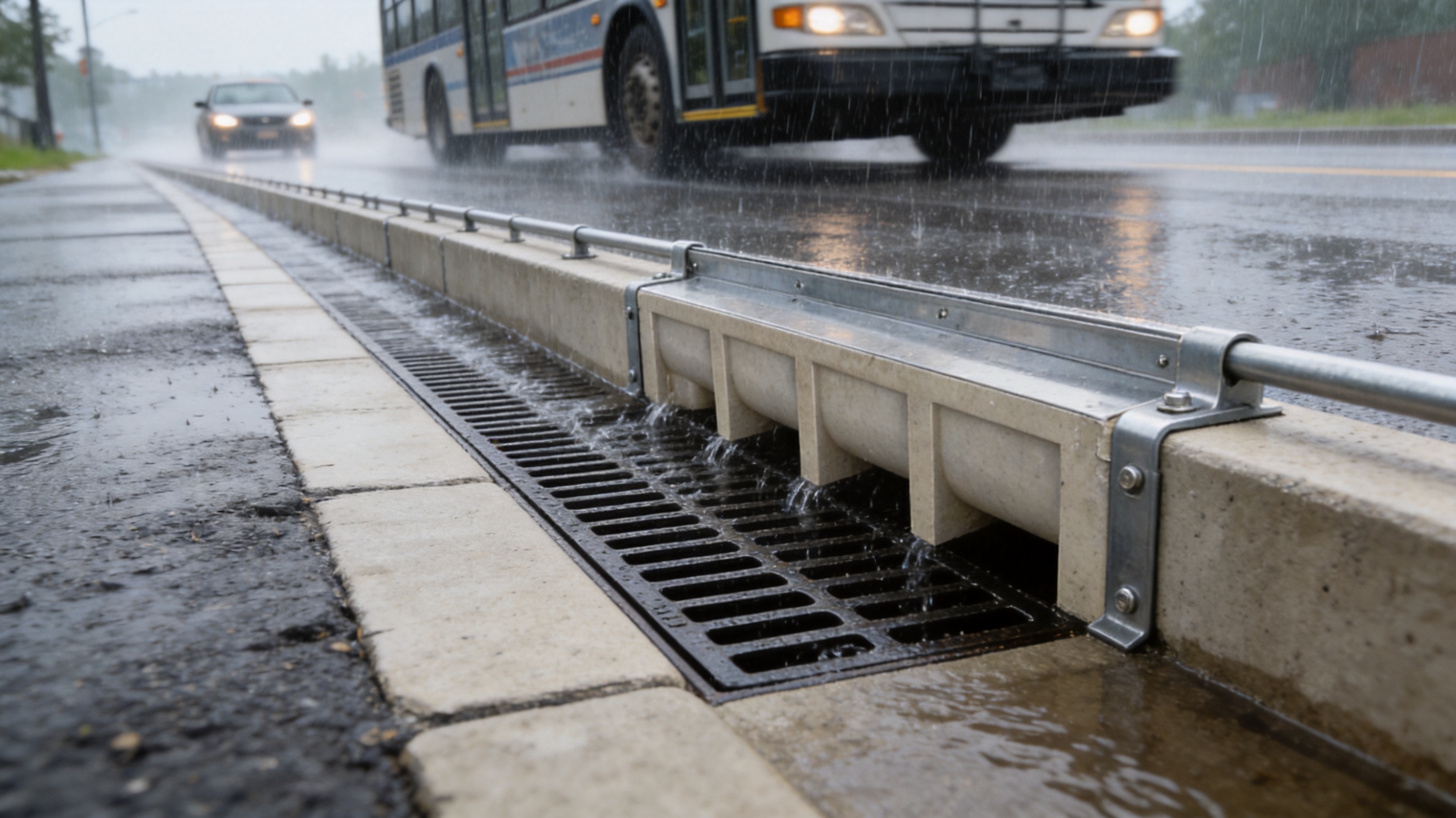
Transportation infrastructure places heavier mechanical demands on drainage systems. Roads, highways, overpasses, bus terminals, parking lots, service lanes, and traffic intersections require drainage channels that can handle repeated wheel loads and rapid stormwater inflow. In these locations, insufficient drainage can lead to dangerous water accumulation, pavement damage, traffic disruption, and increased maintenance cost.
High load classes are essential. Depending on application requirements, precast drainage channel systems can be configured for load ratings from D400 to F900. D400 is commonly used for roads and parking areas with heavy vehicular traffic, while higher ratings such as E600 and F900 are used for docks, airports, industrial zones, and locations exposed to exceptionally heavy loads. Proper load selection ensures that the grating, frame, channel body, and surrounding pavement work together as a structural system.
Anti-dislodgement locking is another key feature. When vehicles pass over drainage covers at speed, loose gratings can shift, vibrate, create noise, or become damaged. In severe cases, unsecured covers can become safety hazards. Boltless locking systems or engineered fastening structures can reduce movement while still allowing maintenance access. This balance between secure operation and convenient removal is an important sign of advanced drainage product design.
Linear drainage is particularly beneficial on roads because it intercepts water continuously instead of depending only on isolated point drains. Point drains may be overwhelmed during intense rainfall, and water must travel across the pavement surface to reach them. A linear channel placed at the correct slope or across a flow path can capture water more quickly. This reduces the chance of standing water and helps limit aquaplaning risk.
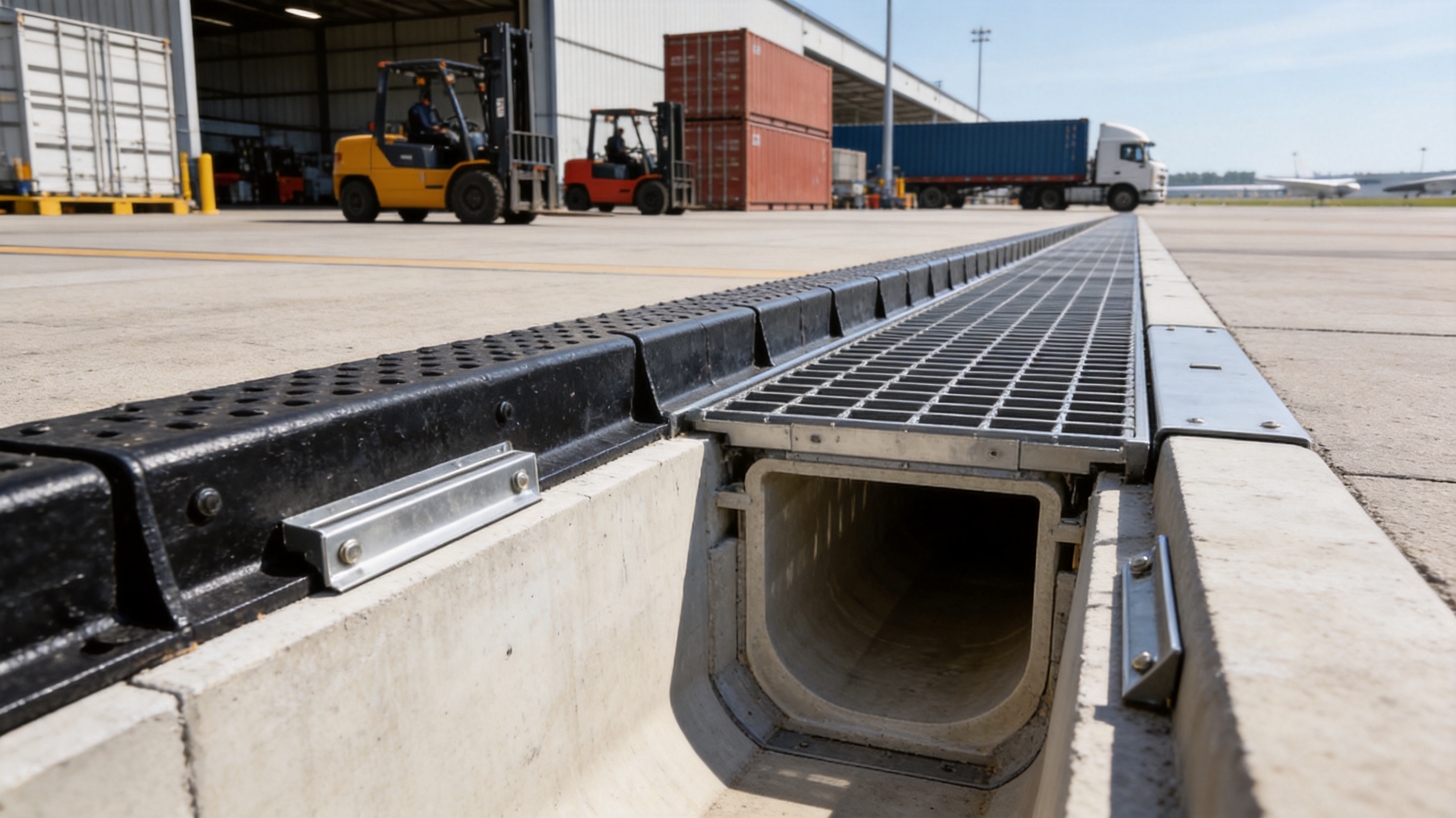
Industrial sites present some of the most demanding drainage challenges. Airport runways, airport aprons, container terminals, chemical warehouses, heavy logistics centers, manufacturing plants, ports, and large storage yards may expose drainage systems to high wheel loads, chemical spills, impact, sediment, oil, vibration, and severe weather. In these environments, ordinary drainage ditches often fail prematurely if they are not designed for structural and chemical resistance.
Resin concrete channel bodies are well suited for harsh environments because they are dense, non-porous, and non-absorbent. Low water absorption improves resistance to freeze-thaw damage. Chemical resistance helps protect the channel from acids, alkalis, salts, oils, and industrial runoff. The smooth internal surface also reduces sediment adhesion, making cleaning easier. In industrial drainage, maintenance efficiency is not a minor issue; it directly affects site uptime, safety, and environmental compliance.
Edge protection is critical under extreme loading. The upper edge of a drainage channel receives repeated impact from tires, forklifts, container handling equipment, trailers, and turning vehicles. Reinforced ductile iron or stainless steel rails protect the channel body from lateral shearing and edge breakage. This design greatly improves service life compared with unprotected concrete edges.
Inspection chamber modules and removable cover systems support routine maintenance. Industrial drainage often carries sand, dust, production residue, packaging debris, and other solids. Smooth channel interiors, planned inspection points, and accessible outlets make sediment removal more efficient. Maintenance teams can clean the system faster and reduce the risk of blockage during heavy rain.
The performance of a drainage channel depends heavily on the materials used in the channel body, cover plate, edge rail, and locking components. Material selection must match the project’s load, chemical exposure, appearance, traffic type, climate, and maintenance requirements. A strong manufacturer offers multiple material options rather than applying one solution to every environment.
Resin concrete is one of the most competitive materials for high-performance precast drainage systems. It is produced by combining selected aggregates with resin binders instead of traditional cement hydration alone. The resulting structure is dense and has very low porosity. This improves water resistance, freeze-thaw durability, and chemical stability. Because the internal surface can be made very smooth, resin concrete channels support efficient flow and reduce sediment accumulation.
Ductile iron is widely used for heavy-duty gratings and edge protection. It offers high strength, good impact resistance, and reliability under repeated vehicular loading. Compared with ordinary cast iron, ductile iron has improved toughness and is less brittle, making it suitable for roads, industrial yards, and municipal projects. When properly designed, ductile iron cover plates can provide excellent load-bearing performance while maintaining drainage opening capacity.
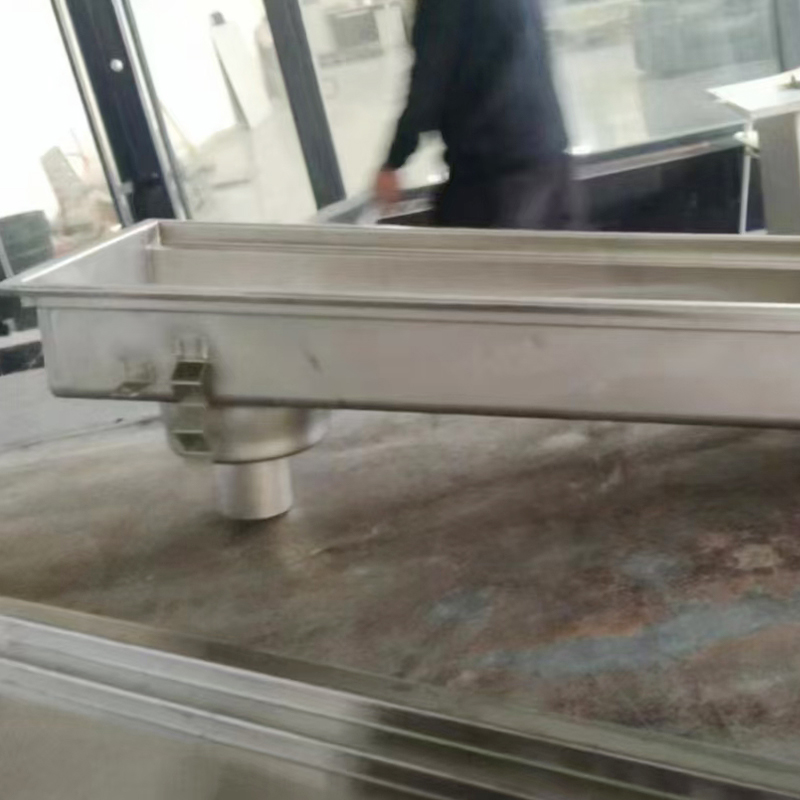
Stainless steel is preferred where corrosion resistance and appearance are important. Stainless steel stamped covers are suitable for commercial spaces, food-related facilities, architectural landscapes, building entrances, and areas exposed to moisture or cleaning chemicals. Stainless steel can also be used for slot drainage covers where a clean, refined surface line is desired.
Steel gratings provide large open areas and are often selected for industrial applications that require high water intake capacity. Surface treatments can improve corrosion resistance according to the project environment. Composite and resin-based covers can be used where lighter weight, corrosion resistance, or electrical insulation characteristics are valued.
GRC components add another layer of flexibility. Glass fiber reinforced concrete can be molded into complex shapes while maintaining good strength-to-weight performance. For architectural projects that require customized decorative forms, façade-related drainage details, or integrated landscape elements, GRC design and mold-making capabilities support project-specific solutions.
Advanced manufacturing is a decisive factor in drainage system quality. Even a well-designed product can fail if production lacks precision, material control, mold accuracy, curing discipline, inspection, and packaging standards. The company behind these drainage solutions emphasizes industrialized production, technical design support, mold development, CNC processing, and experienced construction guidance. This full-process capability is an advantage over suppliers that only provide standard goods without engineering depth.
The production process begins with project analysis and product selection. Engineers review the intended application, load class, drainage area, rainfall intensity, pavement structure, outlet arrangement, and aesthetic requirements. This helps determine channel size, cover type, material, edge protection, locking method, slope design, and maintenance access. By selecting the correct configuration early, the system avoids overdesign, underdesign, and costly changes during construction.
Mold design is another important strength. Precast channels require accurate molds to ensure consistent dimensions, straight edges, stable joints, and proper cover seating. Professional mold designers can create standard molds for mass production and customized molds for special projects. CNC engraving and machining improve mold precision, which directly improves finished product accuracy. Better molds lead to easier installation and better alignment on-site.
Material batching and mixing are carefully controlled. Whether producing resin concrete, concrete-based channel units, cover plates, or GRC components, stable raw material ratios are necessary for reliable strength and durability. Aggregates must be selected for grading, cleanliness, and compatibility. Binders, additives, fibers, pigments, or reinforcements must be measured accurately. Controlled mixing prevents weak zones, voids, segregation, and inconsistent finish.
Forming and compaction influence structural performance. Proper vibration, casting technique, and mold preparation help create dense products with fewer defects. For drainage channels, the internal surface must be smooth enough to support flow but dimensionally accurate enough to connect with adjacent units. Cover seating surfaces must be level and stable to prevent rocking and noise. Edge rail positioning must be precise to ensure load transfer.
Curing and demolding must follow controlled procedures. Premature demolding can cause deformation or microcracking, while improper curing can reduce strength. Factory conditions allow better control than on-site casting because temperature, timing, handling, and storage can be managed systematically. This is one of the strongest advantages of precast manufacturing.
Quality inspection is performed at multiple stages. Dimensional checks confirm length, width, height, wall thickness, joint accuracy, and grating fit. Visual checks identify surface defects, cracks, honeycombing, edge damage, and finishing problems. Load-related components are inspected for structural reliability. Finished products are stored and transported in ways that reduce damage before installation.
The company’s experienced production and construction technical team also supports installation. This is important because drainage performance depends not only on the product but also on the base preparation, alignment, slope, surrounding concrete support, outlet connection, and cover installation. Technical guidance helps contractors avoid common mistakes and ensures that the system performs as designed.
| Application Environment | Main Challenge | Recommended Product Features | Key Benefit |
|---|---|---|---|
| Commercial plazas and pedestrian streets | Need for discreet appearance and pedestrian safety | Slot drainage, heel-safe grating, stainless steel or decorative cover options | Maintains visual continuity while removing water efficiently |
| Residential communities and landscaped parks | Daily runoff, cleaning water, and aesthetic requirements | Corrosion-resistant covers, smooth channel body, modular layout | Improves comfort, protects paving, and reduces maintenance |
| Municipal roads and parking lots | Vehicle loading and rapid stormwater clearance | D400 or higher load rating, anti-dislodgement locking, reinforced edges | Reduces water pooling, noise, and cover movement |
| Highways and overpasses | Fast traffic, vibration, and drainage safety | High-flow linear channel, secure grating system, durable channel body | Improves road safety and reduces aquaplaning risk |
| Airport and logistics facilities | Extreme loads, impact, and operational continuity | E600 to F900 configurations, ductile iron edge rails, resin concrete body | Provides high compressive strength and long service life |
| Chemical warehouses and industrial plants | Chemical exposure and sediment accumulation | Non-porous resin concrete, inspection modules, corrosion-resistant covers | Resists acid and alkali corrosion while simplifying cleaning |
The linear layout of a precast drainage channel offers a major hydraulic advantage over isolated point drains. Water is intercepted along an extended length, reducing the flow path across the pavement. This means water enters the system sooner, especially during heavy rainfall. Linear continuity also improves design flexibility because channels can be placed along natural low lines, building edges, curbs, loading doors, or transverse road sections.
In commercial plazas, linear drainage prevents water from collecting around entrances and pedestrian routes. In roads, it helps remove stormwater before it spreads across lanes. In industrial yards, it can divide large paved surfaces into controlled drainage zones. This ability to organize surface water movement is one of the key reasons linear precast channels are replacing many traditional drainage methods.
A smooth internal bore improves flow and reduces sediment retention. Rough cast-in-place concrete often traps dirt, sand, and organic material. Over time, this accumulation reduces hydraulic capacity and may create odor or blockage problems. Factory-formed channels can maintain smoother surfaces and more consistent cross sections. This improves self-cleaning behavior during rainfall and makes manual cleaning easier when required.
Drainage channel edges are vulnerable because they sit at the interface between the grating and pavement. When vehicles brake, turn, or pass repeatedly over the channel, lateral forces can damage weak edges. Reinforced rails made from ductile iron or stainless steel distribute loads and protect the channel body. This feature is particularly valuable in areas with trucks, forklifts, buses, or aircraft service vehicles.
A drainage cover must remain stable under dynamic loading. Loose covers produce noise, wear quickly, and create safety concerns. Boltless locking or engineered anti-dislodgement systems keep covers in place while allowing removal for inspection. Competitor products with simple drop-in covers may seem convenient at first, but they often create long-term maintenance and safety problems. A secure locking design improves user comfort and system reliability.
Maintenance access should be designed into the system from the beginning. Inspection chambers, removable gratings, outlet modules, and accessible connection points allow teams to remove sediment, check flow paths, and clear blockages. A drainage channel that is difficult to clean may perform well only when new. Over time, poor access leads to reduced capacity. Modular maintenance features protect long-term performance.
Construction time is a critical factor in modern infrastructure projects. Delays can affect business openings, road traffic, project financing, labor allocation, and public satisfaction. Precast drainage channels help reduce construction uncertainty because most of the manufacturing work is completed before the product reaches the site. Contractors do not need to build complex formwork, wait for long curing periods, or correct extensive on-site dimensional errors.
A typical installation process includes setting out the drainage line, excavating the trench, preparing the base, placing the channel units, aligning the slope, connecting outlets, installing gratings, and completing surrounding pavement or concrete encasement. Because the channel units are standardized, installation teams can work quickly once the site is prepared. Modular lengths and matching accessories make it easier to follow the design layout.
Reduced wet work is another advantage. Traditional cast-in-place drainage involves more concrete mixing, curing, finishing, and weather-sensitive labor. Precast systems reduce the amount of on-site wet work, which can lower environmental impact and improve site cleanliness. This is especially valuable in urban renovations, commercial projects, and operating industrial facilities where dust, noise, access restrictions, and construction disturbance must be controlled.
Faster installation also lowers indirect costs. Road closures can be shorter. Shopping centers can open sooner. Logistics yards can return to service faster. Labor teams can complete more work within a limited schedule. Even when the initial product cost of a high-quality precast channel is higher than a basic cast-in-place ditch, total project cost may be lower because of reduced labor, fewer delays, less rework, and better service life.
Quality assurance further supports cost control. Factory production eliminates many risks caused by inconsistent on-site workmanship. Smooth channel surfaces, accurate dimensions, and stable cover seating reduce the need for repairs after installation. Leakage, cracking, grating noise, uneven cover height, and poor drainage slope are common sources of hidden cost in inferior systems. A well-made precast product reduces these risks.
Modern construction increasingly values environmental responsibility. Drainage systems contribute to sustainability by managing stormwater, protecting pavements, reducing erosion, and supporting safer urban surfaces. Precast drainage channels add further ecological benefits through efficient manufacturing, reduced on-site waste, and longer service life.
Factory production allows better control of raw materials and reduces waste compared with improvised on-site casting. Reusable molds, accurate batching, and standardized procedures help minimize material loss. Precast installation also reduces site disturbance because there is less formwork waste, less curing water demand, and less prolonged construction activity.
Long service life is an environmental advantage. Products that resist corrosion, freeze-thaw damage, chemical attack, and mechanical wear do not need frequent replacement. Fewer replacements mean lower material consumption, less demolition waste, and reduced transportation emissions over the life of the project. Durable drainage infrastructure is therefore part of sustainable construction practice.
Efficient stormwater removal also protects surrounding surfaces. Standing water can damage pavements, accelerate freeze-thaw deterioration, create erosion at landscape edges, and carry pollutants into uncontrolled areas. A properly designed drainage channel directs runoff to planned collection or treatment points. This supports broader stormwater management strategies in urban and industrial developments.
No two drainage projects are completely identical. A commercial plaza may require a narrow slot opening that aligns with stone paving joints. A municipal road may need ductile iron grates with high load capacity and anti-theft features. A chemical warehouse may require non-porous resin concrete and corrosion-resistant covers. An architectural landscape may need custom GRC pieces that coordinate with visible design elements. The ability to customize is therefore a major competitive strength.
The manufacturer’s design, mold-making, CNC engraving, production, construction, and after-sales capabilities allow it to support both standard and customized projects. Detailed design services can transform project drawings into practical product configurations. Mold designers can create special shapes, dimensions, or decorative components. CNC processing improves the accuracy of molds and custom details. Production teams then manufacture the components under controlled conditions.
Customization is not only about appearance. It also includes hydraulic capacity, channel width, depth, outlet location, slope configuration, grating pattern, load rating, material composition, locking method, and installation accessories. For example, a parking lot may require a moderate-depth channel with a ductile iron grating, while an airport apron may require a heavy-duty resin concrete body with reinforced edge rails and F900-rated covers. A pedestrian street may require a shallow slot drainage system that blends into paving lines.
GRC customization expands the company’s ability to serve architectural and landscape projects. Professional designers and mold specialists can create decorative or functional concrete-based components that match project aesthetics. This integrated capability is valuable for developers and designers who want both drainage performance and visual harmony.
Reliable drainage performance requires a complete quality chain. It begins before manufacturing, with correct product selection and engineering review. It continues through mold production, material preparation, casting, curing, finishing, inspection, packaging, transportation, installation guidance, and after-sales support. A weakness at any stage can affect the final result.
Design review ensures that the selected channel system matches actual conditions. Load class must correspond to traffic type. Hydraulic capacity must match rainfall intensity and catchment area. Material resistance must match chemical exposure. Cover design must match pedestrian or vehicle safety requirements. Outlet placement must connect properly with the downstream drainage network. Without these checks, even a strong product may be used incorrectly.
Manufacturing quality control ensures stable product performance. Dimensional tolerance matters because small deviations can accumulate along long drainage runs. Cover seating accuracy matters because uneven covers cause noise and hazards. Surface finish matters because rough interiors collect sediment. Material consistency matters because weak batches reduce durability. Factory inspection reduces these risks before products reach the site.
Packaging and transportation are also important. Precast products can be damaged by improper stacking, lifting, or impact. Professional handling methods protect channel edges, cover plates, and connection surfaces. Clear product identification helps installation teams place the correct units in the correct locations.
After-sales support adds long-term value. Projects may require installation advice, maintenance guidance, replacement parts, or additional modules. A supplier with technical knowledge and service awareness can respond more effectively than a supplier focused only on initial sales. This is especially important for municipal, industrial, and large commercial projects with long operating lives.
The drainage channel market includes many low-cost products that may satisfy basic appearance requirements but fail under demanding conditions. The strongest competitive advantage of this precast system is the combination of engineering design, material performance, manufacturing precision, customization capability, and practical installation support. Rather than relying on a single feature, the product is competitive because the entire system is developed around real project needs.
Compared with ordinary concrete ditches, it offers faster installation, smoother surfaces, better dimensional control, more stable cover seating, and reduced on-site labor. Compared with low-grade precast channels, it offers stronger material options, higher load configurations, improved edge protection, and more reliable locking systems. Compared with suppliers that only provide standard sizes, it offers broader customization through professional design, mold-making, CNC engraving, and GRC production capabilities.
In architectural spaces, the advantage is visual integration. Narrow slot designs and refined covers allow drainage to disappear into the surface design. In roads and parking areas, the advantage is safety and load resistance. High load classes, reinforced edges, and secure gratings help prevent damage and noise. In industrial zones, the advantage is chemical stability and maintenance efficiency. Resin concrete bodies and inspection modules support long service life in harsh conditions.
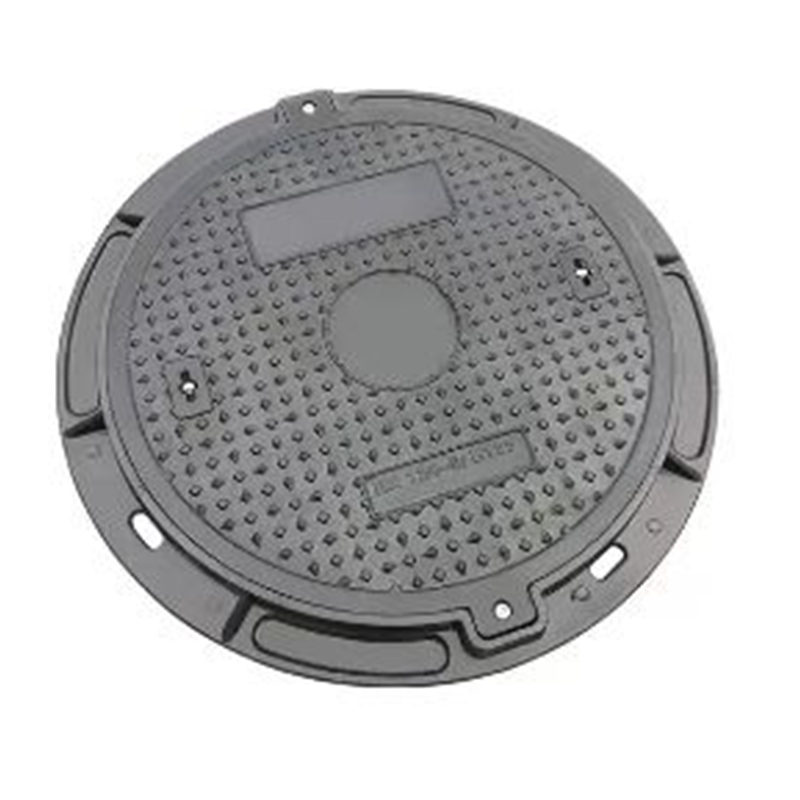
Another important differentiator is the product range. Linear drainage ditches, finished drainage ditches, polymer-based drainage ditches, slot drainage ditches, U-shaped drainage ditches, ductile iron cover plates, stainless steel stamped cover plates, steel gratings, resin concrete cover plates, composite manhole covers, stainless steel manhole covers, ductile iron manhole covers, drainage pipes, PE pipes, and related accessories can be coordinated to provide complete project solutions. This reduces the complexity of sourcing multiple components from unrelated suppliers.
Choosing the right precast drainage channel requires a clear understanding of project conditions. The first consideration is load. Pedestrian areas do not need the same load class as airport runways, while industrial truck routes require more strength than residential pathways. Selecting the correct load class protects both safety and budget.
The second consideration is hydraulic demand. Designers should estimate catchment area, rainfall intensity, surface slope, discharge points, and acceptable water depth. Channel width, depth, internal profile, outlet size, and grating open area should be selected to meet these conditions. Underestimating hydraulic demand can cause overflow, while overdesign may increase cost unnecessarily.
The third consideration is material exposure. If the site is exposed to deicing salts, chemicals, oils, cleaning agents, or freeze-thaw cycles, material resistance becomes critical. Resin concrete, stainless steel, ductile iron, composite materials, or protected steel should be selected according to the exposure type.
The fourth consideration is appearance. In plazas, hotels, parks, and residential projects, drainage should support the surface design. Slot drainage and decorative cover options may be appropriate. In industrial settings, appearance may be less important than flow capacity and maintenance access.
The fifth consideration is maintenance. Channels should include removable covers, inspection points, and accessible outlets. Projects with high sediment loads should pay special attention to cleaning convenience. Maintenance planning at the design stage prevents operational problems later.
Even the best drainage channel must be installed correctly. The foundation must support the product evenly. The channel alignment must follow the planned slope. Joints must be properly connected. Surrounding concrete or pavement must provide lateral support. Covers must be installed securely and remain level with the finished surface. Outlet connections must be clear and correctly sized.
For heavy-duty applications, surrounding concrete encasement is especially important. The channel and pavement must act together to distribute loads. If the base is weak or side support is insufficient, even a high-strength channel may experience movement or damage. Installation teams should follow technical recommendations for base thickness, concrete grade, reinforcement, expansion joints, and curing time.
For pedestrian and architectural areas, surface alignment is critical. Covers should be flush with paving to avoid trip hazards. Slot openings should align with the design pattern where possible. During paving work, workers should prevent mortar, sand, or debris from entering the channel. Temporary protection may be used until construction is complete.
For industrial sites, installation should consider cleaning access and outlet protection. Inspection chambers should be placed at logical intervals and near direction changes. Sediment-prone areas may require additional maintenance modules. Chemical environments may require compatible sealants or connection details.
They can be used in commercial plazas, pedestrian streets, residential communities, landscaped parks, municipal roads, parking lots, highways, overpasses, airport areas, container terminals, chemical warehouses, logistics centers, and industrial plants. Different covers, materials, and load classes are selected according to the project environment.
Precast channels are manufactured in the factory and delivered ready for installation. Contractors do not need to build extensive formwork or wait for long on-site curing periods. This can make installation three to five times faster than traditional cast-in-place methods, depending on site conditions.
Resin concrete is dense, non-porous, and non-absorbent. It resists freeze-thaw damage, acid and alkali corrosion, water penetration, and many industrial chemicals. Its smooth internal surface also improves flow and simplifies sediment removal.
Slot drainage channels expose only a narrow opening at the surface. Most of the channel body remains hidden below the pavement. This allows drainage to blend with stone paving, architectural surfaces, and landscape designs while still collecting water efficiently.
Drainage systems can be configured for high load classes such as D400, E600, and F900. D400 is suitable for many roads and parking areas, while E600 and F900 are used in more demanding environments such as industrial yards, ports, airports, and heavy logistics facilities.
Secure locking prevents covers from shifting, rattling, or dislodging when vehicles pass over them. This reduces noise, improves safety, and protects the drainage system from premature wear. A good locking system should also allow maintenance teams to remove covers when cleaning is required.
Yes, when designed with removable covers, smooth internal surfaces, inspection chambers, and accessible outlets. These features make it easier to remove sediment and check flow paths. Maintenance convenience is especially important in industrial and high-traffic areas.
Yes. Channel dimensions, cover types, grating patterns, load ratings, outlet locations, materials, slot designs, edge rails, and GRC components can be customized according to project requirements. Professional design and mold-making capabilities support both standard and special solutions.
Precast drainage channels reduce on-site wet work, shorten construction time, minimize material waste, and provide long service life. Efficient stormwater management also protects pavements and landscapes from water damage, supporting sustainable infrastructure performance.
Key factors include load class, hydraulic capacity, material exposure, aesthetic requirements, maintenance access, installation conditions, outlet connection, and long-term operating environment. Correct product selection ensures safety, durability, and cost efficiency.
Precast drainage channels provide a versatile and reliable approach to surface water management. Their value lies not only in collecting rainwater but also in improving safety, protecting pavements, supporting architectural design, reducing construction time, and lowering long-term maintenance risks. From urban landscapes to roads, airports, ports, warehouses, and industrial facilities, the system can be adapted to meet very different performance requirements.
The product’s competitive advantages come from a combination of material strength, hydraulic efficiency, modular design, high load capacity, secure locking, corrosion resistance, reinforced edge protection, and maintenance-friendly details. Compared with traditional cast-in-place drainage ditches and low-grade alternatives, it offers better consistency, faster installation, improved durability, and greater design flexibility.
Behind the product is a manufacturing system supported by professional design, mold development, CNC engraving, controlled production, experienced technical teams, and after-sales service. This full-process capability enables the company to deliver not only standard drainage products but also customized solutions for complex projects. In today’s construction environment, where speed, quality, appearance, sustainability, and reliability are all essential, a well-engineered precast drainage channel is a practical investment in long-term infrastructure performance.
American Concrete Institute. Guide to Precast Concrete Construction and Quality Control.
European Committee for Standardization. EN 1433: Drainage Channels for Vehicular and Pedestrian Areas.
International Organization for Standardization. Standards for Concrete Durability, Industrial Materials, and Quality Management Systems.
Construction Industry Research and Information Association. Sustainable Drainage Systems: Design and Maintenance Guidance.
Portland Cement Association. Principles of Concrete Durability and Surface Water Management.
Transportation Research Board. Highway Drainage Design, Road Surface Safety, and Pavement Water Management Studies.
Related Products
Energy-Efficient Sustainable GRC Curtain Wall Panels are high-performance architectural panels desig...
READ MOREEnergy-Efficient Sustainable GRC Curtain Wall Panels are high-performance architectural panels desig...
READ MOREEnergy-Efficient Sustainable GRC Curtain Wall Panels are high-performance architectural panels desig...
READ MOREEnergy-Efficient Sustainable GRC Curtain Wall Panels are high-performance architectural panels desig...
READ MOREEnergy-Efficient Sustainable GRC Curtain Wall Panels are high-performance architectural panels desig...
READ MOREEnergy-Efficient Sustainable GRC Curtain Wall Panels are high-performance architectural panels desig...
READ MORE
Contact us
Factory Address
Group 12, Quanxin Village, Donghai Town, Qidong City, Nantong City, Jiangsu Province, China
phone
+86-13914963840
+86-13451754670
products
QR CODE
 Wholesale Drainage Ditch Manufacturers