 English
 Español
 عربى
عربى
Our Modular GRC System merges installation speed with long-term durability, providing a high-perform...
READ MOREJun 15, 2026
Content
When ground settlement occurs, a resin manhole cover consistently outperforms a cast iron manhole cover in terms of flexibility, structural integrity, and long-term serviceability. Cast iron is rigid and brittle under uneven substrate movement, while resin composite materials absorb and distribute stress across their structure. For engineers, facility managers, and contractors selecting a replacement manhole cover after ground shift damage, understanding this distinction is critical to avoiding repeated failures.
Ground settlement — whether caused by soil erosion, freeze-thaw cycles, utility trench compaction, or subsidence — creates uneven bearing surfaces around manhole frames. This unevenness applies concentrated point loads to the cover. How each material responds to that stress determines its suitability for settlement-prone environments.
Cast iron has a tensile strength of approximately 150–250 MPa, but it is inherently brittle. When ground settlement shifts the bearing frame by even 5–10 mm unevenly, a cast iron manhole cover experiences bending stress it cannot absorb elastically. The result is cracking, fracture, or rocking — a condition where the cover tilts and creates a hazard for pedestrians and vehicles.
Rocking cast iron covers are one of the most common infrastructure complaints in urban areas. Each time a vehicle passes over a rocking cover, the repeated impact accelerates frame degradation and widens the settlement gap. Repairs typically require full frame replacement, road closure, and significant labor cost — often exceeding $800–$2,000 per intervention in urban settings.
Additionally, cast iron offers no flexibility in its seating interface. If mortar bedding beneath the frame deteriorates due to settlement, the cover loses uniform support entirely, concentrating load on one or two contact points and dramatically increasing fracture risk.
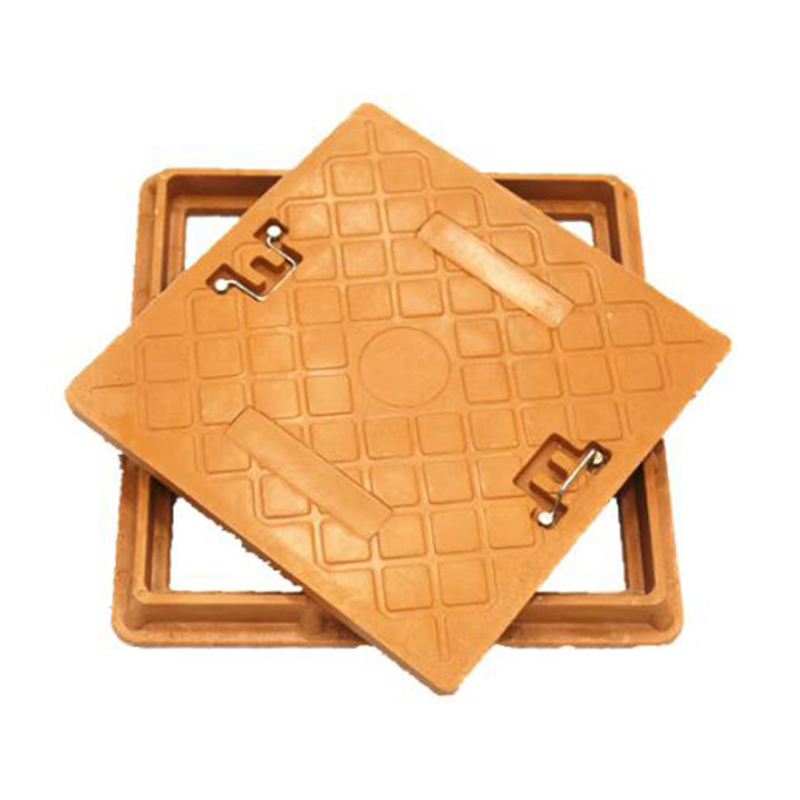
A resin manhole cover is manufactured from composite materials — typically unsaturated polyester resin reinforced with fiberglass, mineral fillers, and sometimes recycled rubber aggregates. This composite matrix gives the cover a degree of controlled flexibility that cast iron simply cannot replicate.
When one side of the frame drops due to settlement, a resin manhole cover can micro-flex across its body, redistributing the applied load over a broader surface area. Laboratory testing on Class D400 resin covers (rated for 400 kN load capacity) has shown that even with a 12 mm differential settlement at the frame edge, the cover maintains structural integrity without cracking or permanent deformation.
Many resin manhole cover designs incorporate integrated elastomeric seating gaskets or rubber edge inserts. These components act as a buffer between the cover and its frame, compensating for minor settlement-induced gaps of 2–6 mm without creating the noise or movement associated with rocking cast iron covers. This makes resin covers particularly effective in pedestrian zones and residential streets where noise and safety are priorities.
A standard resin manhole cover weighs 40–60% less than an equivalent cast iron cover. For a 600 mm diameter cover, a cast iron unit typically weighs 40–55 kg, while a resin composite equivalent weighs 16–26 kg. This reduced mass means the cover exerts less downward force on a compromised or settling frame, slowing further deterioration of the bearing surface.
| Performance Factor | Resin Manhole Cover | Cast Iron Manhole Cover |
|---|---|---|
| Flexibility under uneven load | High — micro-flex composite structure | None — brittle, fracture-prone |
| Tolerance to differential settlement | Up to 12 mm without failure | 5 mm may cause cracking or rocking |
| Anti-rocking performance | Excellent — elastomeric seating | Poor — rigid metal-to-metal contact |
| Self-weight (600 mm diameter) | 16–26 kg | 40–55 kg |
| Repair cost after settlement damage | Low — cover replacement only | High — often full frame replacement |
| Corrosion resistance in wet soil | Excellent — non-metallic | Moderate — rust accelerates failure |
| Load class availability | A15 to D400 | B125 to F900 |
The standard manhole cover size plays a role in how sensitively a cover responds to ground movement. Larger covers span greater distances across the frame, which means a given settlement depth creates a smaller angular deflection relative to the cover's width — making larger covers somewhat more tolerant of absolute settlement depth.
Common standard manhole cover sizes used internationally include:
For the most common diameter of manhole cover at 600 mm, resin composite covers have demonstrated sufficient flexural rigidity to bridge minor voids or edge gaps created by settlement without transferring damaging stress to the frame. This is especially valuable in clay-heavy soils where seasonal expansion and contraction regularly shift buried infrastructure by 8–15 mm annually.
Selecting a resin manhole cover as a replacement manhole cover is most justified in the following settlement-risk scenarios:
In these scenarios, switching from cast iron to resin not only reduces the risk of cover failure but also extends the service interval before the next replacement manhole cover is needed — typically from 5–8 years (cast iron in high-settlement sites) to 20–30 years (resin composite under equivalent conditions).
Both resin and cast iron manhole covers are classified under EN 124 load standards, ranging from A15 (pedestrian areas, 15 kN) to F900 (airport aprons, 900 kN). For settlement-prone road surfaces, the recommended minimum class is:
Resin manhole covers are commercially available up to D400 class, making them suitable for the vast majority of road and utility applications where settlement is a concern. Only applications requiring E600 or F900 — such as heavy industrial sites or airport taxiways — currently fall outside the resin composite product range and require ductile iron or steel alternatives.
For most municipal, commercial, and residential infrastructure work, a D400-rated resin manhole cover provides all the load capacity of cast iron while delivering substantially superior performance when ground settlement is an active or anticipated risk factor.
Even with a resin manhole cover's superior flexibility, proper installation maximizes performance in settlement-risk areas:
Following these steps alongside the selection of a quality resin manhole cover gives infrastructure assets the best possible resilience against the long-term effects of ground movement — reducing lifecycle costs, improving road safety, and extending the interval before any replacement manhole cover is required.
Related Products
Our Modular GRC System merges installation speed with long-term durability, providing a high-perform...
READ MOREOur Modular GRC System merges installation speed with long-term durability, providing a high-perform...
READ MOREOur Modular GRC System merges installation speed with long-term durability, providing a high-perform...
READ MOREOur Modular GRC System merges installation speed with long-term durability, providing a high-perform...
READ MOREOur Modular GRC System merges installation speed with long-term durability, providing a high-perform...
READ MOREOur Modular GRC System merges installation speed with long-term durability, providing a high-perform...
READ MORE
Contact us
Factory Address
Group 12, Quanxin Village, Donghai Town, Qidong City, Nantong City, Jiangsu Province, China
phone
+86-13914963840
+86-13451754670
products
QR CODE
 Wholesale Drainage Ditch Manufacturers