 English
 Español
 عربى
عربى

Our Modular GRC System merges installation speed with long-term durability, providing a high-perform...
READ MOREMay 25, 2026
Content
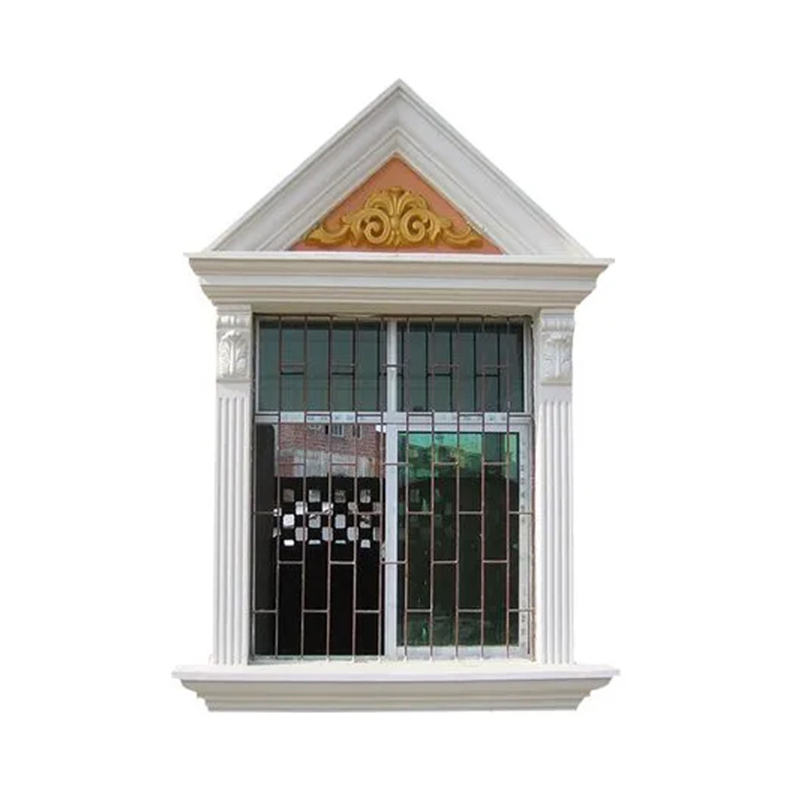
Architectural door and window frames are more than decorative borders. In modern construction, they define façade rhythm, protect openings from environmental stress, support transitions between wall systems and fenestration units, and influence the long-term appearance of buildings. The Alkali-Resistant Durable GRC door and window frames are engineered for projects that demand stable appearance, reliable strength, and reduced maintenance over an extended service life.
Glass fiber reinforced concrete, commonly known as GRC, has become an important material for architectural components because it combines cement-based durability with the forming flexibility of fiber reinforcement. Compared with ordinary plaster, traditional cement moldings, or heavy precast concrete pieces, high-quality GRC can achieve refined shapes, lighter weight, better crack resistance, and more efficient installation. When the material is further upgraded with alkali-resistant glass fiber technology, it becomes especially suitable for exterior frames exposed to moisture, ultraviolet radiation, temperature fluctuation, and the natural alkalinity of cement matrices.
The product discussed in this article is designed around three central performance goals: superior alkali integrity, high-density anti-cracking structure, and life-cycle cost efficiency. These advantages make it suitable for residential communities, public buildings, commercial complexes, cultural projects, transportation-related facilities, municipal architecture, and renovation projects where both aesthetic consistency and long-term reliability are essential.
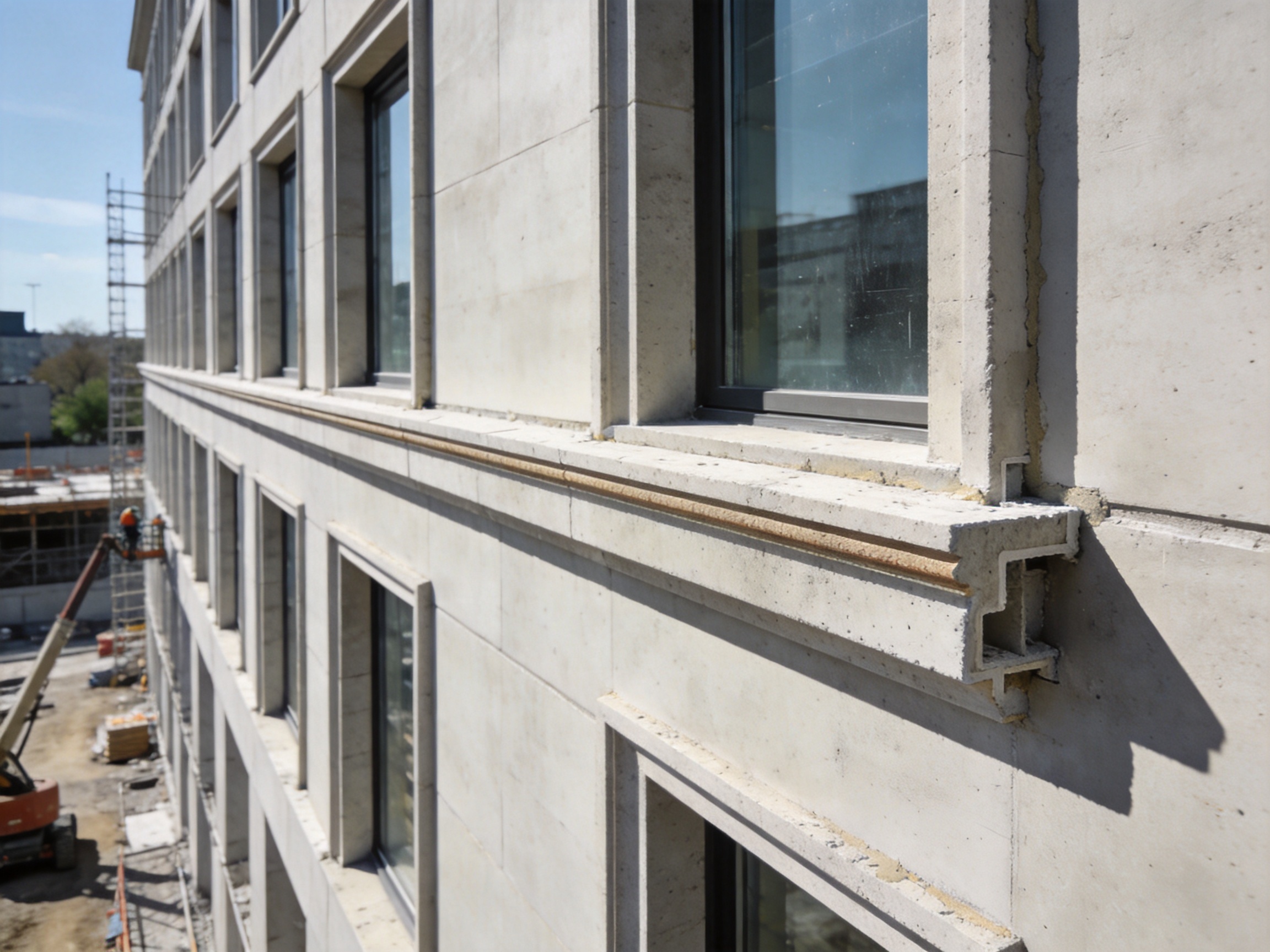
Door and window openings are among the most sensitive areas of a building façade. They must resist rainwater intrusion, prevent surface deterioration, maintain dimensional stability, and remain visually aligned with the surrounding architectural design. If frames crack, peel, warp, or lose edge definition, the whole façade can appear aged even when the main wall remains structurally sound.
Traditional exterior decorative frames are often made from plaster, ordinary cement mortar, stone, metal, wood, or polymer materials. Each option has strengths, but each also has limitations. Plaster may be economical but is vulnerable to moisture and impact. Ordinary concrete may be strong but heavy and difficult to shape into delicate profiles. Natural stone provides prestige but increases cost and installation burden. Metal elements can be precise but may require corrosion protection and thermal detailing. Polymer foam moldings are lightweight but can suffer from low impact resistance, aging, and surface degradation under harsh sunlight.
Alkali-resistant GRC frames solve many of these issues by creating a reinforced cementitious composite that can be molded into elegant profiles while maintaining strong resistance to environmental damage. Because the reinforcement is distributed throughout the matrix, the product does not depend only on mass for strength. It can be made thinner, lighter, and more adaptable than conventional precast concrete, while still offering the mineral texture and durability expected from cement-based façade materials.
The defining feature of these GRC door and window frames is the use of alkali-resistant glass fiber, particularly high-zirconia fiber. Ordinary glass fiber can deteriorate in cement because cement paste is naturally alkaline. Over time, alkaline attack may weaken the fiber, reduce reinforcement performance, and contribute to long-term strength degradation. This is one reason why conventional glass fiber products are not always suitable for cement-based exterior applications unless the fiber chemistry is properly engineered.
High-zirconia alkali-resistant fibers are designed to withstand the alkaline environment inside cement matrices. By incorporating these fibers into the GRC formulation, the frames maintain reinforcement integrity for a much longer period. This improves resistance to microcracking, preserves flexural performance, and reduces the risk of hidden deterioration that may only become visible after years of exposure.
For architects and project owners, alkali integrity is not just a material science concept. It directly affects façade performance. A frame that retains its internal reinforcement properties can better resist temperature movement, wind vibration, installation stress, and the repeated wet-dry cycles common in exterior walls. This means fewer surface cracks, fewer repair interventions, and a more stable architectural appearance.
Another major advantage is the optimized aggregate grading used in the product. Proper aggregate grading improves particle packing, reduces voids, and helps create a dense cementitious matrix. A dense structure is crucial for exterior components because water penetration, freeze-thaw stress, salt exposure, and pollutant absorption often begin through pores and microvoids.
The high-density structure contributes to enhanced surface hardness, including improved resistance to abrasion and small impact damage. In exposed architectural frames, corners and edges are frequently touched, cleaned, impacted during installation, or affected by wind-driven particles. A harder surface helps maintain crisp profiles and reduces premature wear.
Anti-cracking performance is especially important in humid or ultraviolet-intensive environments. Moisture can enter low-density materials, causing swelling, staining, biological growth, or bond failure between layers. Strong sunlight can accelerate aging in polymer-modified or poorly finished surfaces. The dense GRC composition helps minimize such risks by creating a more stable physical structure. Combined with alkali-resistant fibers, the product is better equipped to resist cracking, peeling, and surface fatigue.
Initial purchase price is only one part of construction cost. A more accurate evaluation considers the full life cycle: manufacturing, transportation, installation, finishing, inspection, maintenance, repair, replacement, and the cost of disruption when façade work must be repeated. In many large projects, maintenance access can be expensive, especially for high-rise buildings, public facilities, or buildings with complex exterior forms.
Alkali-Resistant Durable GRC door and window frames are designed to reduce maintenance frequency. Their physical properties exceed those of ordinary plaster and many standard concrete decorative components. Because they resist cracking, peeling, and long-term strength loss, they can help building owners avoid frequent repainting, patching, replacement, and inspection-related labor.
This makes them particularly attractive for large-scale residential communities, schools, hospitals, transportation buildings, commercial streets, and public infrastructure. In these projects, the number of openings can be significant. Even a small reduction in maintenance per frame can create substantial savings across the entire development.
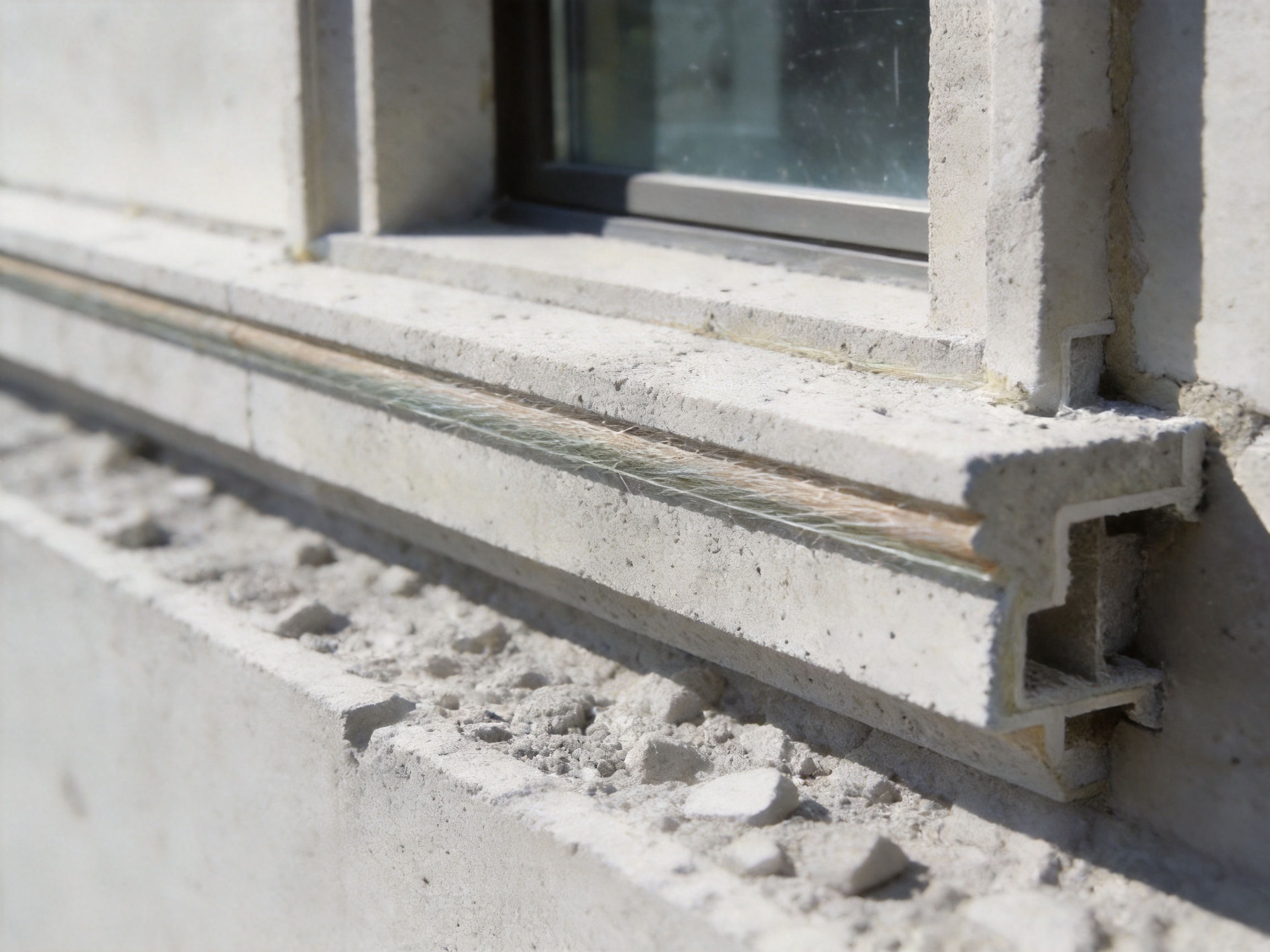
Compared with plaster moldings, alkali-resistant GRC frames offer far better exterior durability. Plaster is generally more vulnerable to moisture, impact, and surface powdering. It may perform acceptably in protected interior areas, but exterior openings expose it to conditions that accelerate deterioration. GRC provides a cement-based structure with fiber reinforcement, making it more appropriate for outdoor use.
Compared with ordinary concrete frames, the product provides better formability and a lower weight-to-performance ratio. Ordinary concrete may need greater thickness to achieve strength, which increases weight and installation difficulty. GRC can be manufactured in refined profiles with controlled thickness, allowing designers to create elegant details without excessive structural burden.
Compared with natural stone, GRC provides greater design flexibility and cost control. Stone is heavy, limited by quarry characteristics, and often costly to cut into repeatable custom frame profiles. GRC molds can reproduce consistent shapes across large quantities, making it easier to maintain uniformity in architectural elevations.
Compared with metal decorative frames, GRC offers a mineral appearance that integrates naturally with cement, stone-like, or textured façades. Metal may require thermal isolation, anti-corrosion coating, and careful detailing to avoid staining or galvanic issues. GRC is also less likely to create unwanted glare and can be finished in textures and colors that suit classical, modern, or regional architectural styles.
Compared with polymer foam or lightweight plastic trim, alkali-resistant GRC provides superior impact resistance, fire-related confidence as a cement-based material, and better long-term surface stability. Polymer materials can be useful for lightweight decorative applications, but they may not match the toughness, mineral texture, and environmental resilience of well-produced GRC.
| Evaluation Factor | Alkali-Resistant Durable GRC Frames | Ordinary Plaster Frames | Standard Concrete Frames | Polymer Foam Trim |
|---|---|---|---|---|
| Alkali resistance | High, supported by high-zirconia alkali-resistant fiber | Low to moderate depending on formulation | Moderate, usually without distributed alkali-resistant fiber reinforcement | Not cement-based, but may age under ultraviolet exposure |
| Crack resistance | Strong due to fiber reinforcement and dense matrix | Relatively weak in exterior conditions | Moderate but may require heavier sections | Variable, often vulnerable to impact and surface damage |
| Weight efficiency | Good strength with controlled thickness | Light but less durable | Heavy | Very light but less robust |
| Design flexibility | High, suitable for customized profiles and repeated molding | Moderate | Moderate to low for delicate details | High for simple decorative shapes |
| Maintenance demand | Low when properly installed and finished | High in humid or exposed environments | Moderate | Moderate to high depending on exposure |
| Best application | Long-life exterior door and window frames for demanding projects | Interior or protected decorative areas | Heavy-duty simple exterior components | Low-impact lightweight decoration |
GRC performance depends on the interaction between cementitious binder, aggregate, water content, fiber type, fiber distribution, admixtures, mold precision, curing control, and finishing quality. The material must be balanced carefully. Too much water can create porosity. Poor fiber dispersion can create weak zones. Inaccurate curing can cause shrinkage defects. Low-quality molds can reduce profile accuracy. For this reason, manufacturing discipline is as important as raw material selection.
The alkali-resistant fiber provides reinforcement at a scale that helps control microcracking. Cement-based materials naturally experience shrinkage during hydration and drying. Without reinforcement, shrinkage can create visible cracks, especially in thin decorative components. Distributed fibers bridge microcracks and help prevent them from developing into wider cracks. This improves the product’s ability to survive handling, transportation, installation, and long-term façade movement.
Optimized aggregate grading supports density. When fine and coarse particles are proportioned effectively, smaller particles fill voids between larger particles. This reduces capillary pathways and improves the compactness of the product. A denser matrix contributes to better surface hardness, improved weather resistance, and lower permeability.
The result is a composite frame that is not merely decorative. It is a functional exterior component designed to endure chemical, physical, and climatic stress while maintaining architectural value.
Jiangsu Yameng Traffic Road Facilities Co., Ltd. has manufacturing experience in drainage channel projects and GRC customization. This combination is significant because drainage products require dimensional accuracy, load awareness, material durability, and resistance to water-related deterioration. These capabilities support the company’s approach to GRC exterior components, where precision, structural reliability, and environmental resistance are equally important.
The company’s GRC series is supported by professional designers, mold designers, CNC engraving personnel, and an experienced production and construction technical team. This integrated capability allows the manufacturer to provide a full service chain from detailed design and drawing development to mold making, production, on-site construction, and after-sales support. For door and window frame projects, this is a major advantage because façade components must match architectural drawings, opening dimensions, wall thicknesses, installation methods, and finish requirements.
Advanced manufacturing begins with project analysis. The technical team reviews the design intent, building type, frame dimensions, joint planning, installation substrate, color expectations, texture requirements, and site conditions. This step helps prevent mismatches between product design and real construction conditions. A frame profile may look simple in drawings, but its performance depends on slope details, drip lines, fixing points, joint width, panel segmentation, and compatibility with waterproofing systems.
After design confirmation, mold design becomes critical. High-quality molds ensure repeatability, sharpness, and dimensional stability. CNC engraving improves mold precision, especially for profiles requiring fine decorative lines, curves, classical patterns, or modern minimalist edges. Accurate molds reduce the need for on-site correction, improve façade consistency, and shorten installation time.
One of the company’s strengths is its ability to provide detailed design services. In many projects, architectural renderings show the desired appearance but do not fully define manufacturable GRC components. The manufacturer must convert design intent into practical shop drawings. These drawings clarify dimensions, thickness, reinforcement approach, joint locations, embedded parts, installation direction, and component numbering.
Detailed drawings reduce uncertainty. They allow architects, contractors, and owners to review exactly how each frame will be produced and installed. For large projects with repeated window modules, drawing standardization also improves manufacturing efficiency and quality consistency. For custom buildings, drawings ensure that special corners, arches, deep reveals, and transition details are properly coordinated.
The company’s experience with drainage systems also supports technical thinking. Drainage channel manufacturing requires attention to slope, water movement, load-bearing cover plates, and long-term performance under wet conditions. These principles are useful when designing exterior frames, because window and door openings must also manage water. Proper frame design can include slopes, drip grooves, and joint planning that help prevent water from lingering on exposed surfaces.
Mold quality directly affects product quality. A poor mold can produce uneven surfaces, distorted profiles, inconsistent edges, and dimensional errors. CNC engraving allows mold makers to create accurate and repeatable profiles based on digital drawings. This is especially valuable for projects requiring high consistency across many façade openings.
For classical-style buildings, decorative GRC frames may include curves, grooves, layered bands, cornice-like details, or symmetrical patterns. For modern buildings, frames may require clean lines, slim profiles, and precise shadow gaps. CNC-supported mold making can serve both design directions. The result is a product that can express architectural character without sacrificing production accuracy.
Well-made molds also reduce waste. If components come out of the mold with clean geometry and smooth surfaces, less rework is needed. This saves labor, reduces material loss, and helps maintain consistent strength because excessive grinding or patching can compromise surface uniformity. In competitive manufacturing, precision is not only an aesthetic benefit; it is also a cost-control and quality-control advantage.
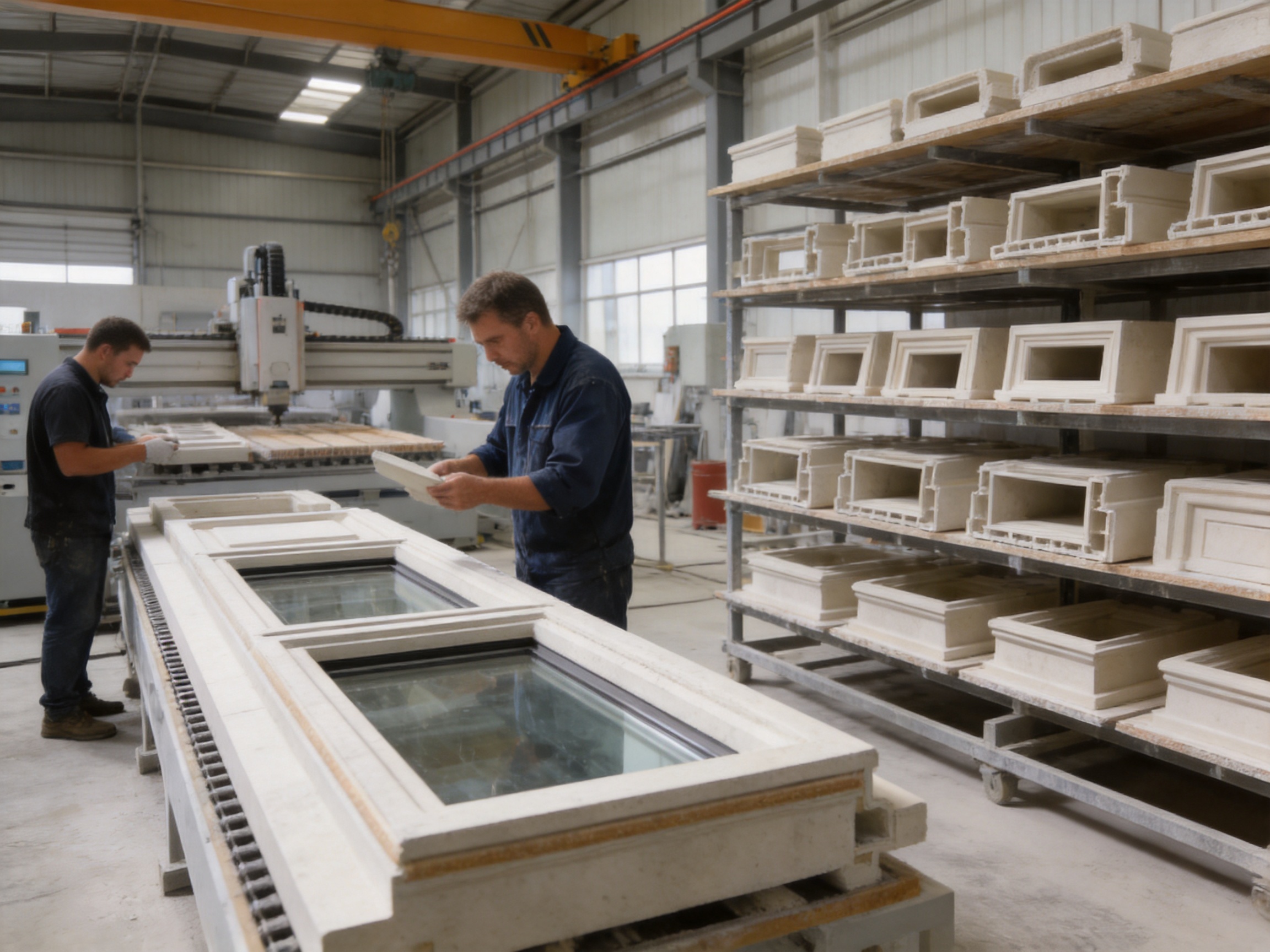
Production control includes raw material selection, batching, mixing, fiber dispersion, casting or spraying method, compaction, demolding, curing, finishing, inspection, packaging, and logistics. Each stage must be managed carefully to produce GRC frames that perform consistently.
Raw materials should be selected for compatibility and reliability. The cementitious binder must work well with alkali-resistant fibers and selected aggregates. Aggregates should be clean, properly graded, and suitable for exterior exposure. Admixtures may be used to adjust workability, reduce water demand, improve density, or enhance surface quality. Pigments or finishing materials may be selected according to project requirements.
Mixing is a crucial stage. Fibers must be distributed evenly to prevent clumping and weak spots. Water content must be controlled to avoid excessive porosity. The mix must remain workable enough to fill mold details while maintaining the density and strength required for exterior service.
Curing is another essential process. Cement-based products gain strength through hydration, and improper curing can lead to shrinkage cracks, reduced strength, or surface defects. Controlled curing helps the frame achieve stable physical properties before transportation and installation. This is particularly important for thin or detailed profiles, where early-age stress can affect long-term performance.
Quality inspection should include dimensional checks, surface checks, edge integrity evaluation, embedded component verification, and visual assessment for cracks, voids, or deformation. For custom projects, component labeling and matching with installation drawings are also important. A correct component in the wrong location can delay installation, while clear numbering supports efficient site work.
Because the product is intended for long-term exterior use, inspection cannot focus only on appearance. Hidden issues such as poor density, weak curing, or inadequate fiber distribution can affect durability later. A disciplined manufacturer uses process control to prevent these problems before final inspection. This means quality is built into the product rather than corrected after defects appear.
Jiangsu Yameng Traffic Road Facilities Co., Ltd. emphasizes integrity, responsibility, focus, and innovation. These values are relevant to manufacturing because durable building components require honest material selection, careful process control, and continuous improvement. In projects where components will remain on a building for decades, reliability is more important than short-term savings from inferior materials.
GRC door and window frames can support many architectural styles. They may be finished to resemble stone, concrete, painted mineral surfaces, or customized textures. The product’s dense structure helps produce a refined surface with good edge definition. This is important because frames are often viewed at close range from balconies, walkways, entrances, streets, and courtyards.
Surface finishing should be selected according to project environment. In humid regions, breathable but protective coatings may be preferred. In intense sunlight, ultraviolet-resistant finish systems help maintain color stability. In urban areas, dirt resistance and cleanability are important. The GRC substrate provides a strong foundation, but final appearance and maintenance also depend on suitable finishing specifications.
Another advantage of mold-produced GRC is consistency. When many openings require the same frame profile, repeated molds can produce uniform geometry across the building. This improves visual order and avoids the uneven appearance that can occur when decorative frames are formed manually on site.
Even the best product needs correct installation. GRC door and window frames should be installed according to approved drawings and site conditions. Important considerations include substrate strength, fixing method, joint treatment, waterproof detailing, alignment, level control, and protection during subsequent construction.
Frames around windows and doors are exposed to water flow. Proper joint sealing, flashing coordination, drip details, and slope design help prevent water accumulation. If water is allowed to enter behind the frame or remain in horizontal grooves, staining and deterioration may occur over time. The manufacturer’s construction technical team can support installation planning and help contractors avoid common mistakes.
Component weight is generally more manageable than heavy precast concrete, but safe handling remains important. Frames should be lifted and stored correctly to avoid edge damage. During installation, workers should protect finished surfaces from mortar contamination, impact, and abrasive cleaning.
After installation, inspection should confirm that joints are sealed, alignment is correct, surfaces are undamaged, and drainage-related details are functioning. Good installation transforms the product’s material advantages into real building performance.
Large-scale residential communities are one of the most suitable applications for alkali-resistant GRC door and window frames. Such projects often include hundreds or thousands of openings. Consistency, cost efficiency, and maintenance reduction are highly valuable. A frame system that remains stable over time helps maintain the overall image of the community and supports property value.
In residential architecture, frames can create depth, shadow, and proportion. They can make standard windows appear more refined and provide a stronger sense of façade structure. The lightweight and moldable nature of GRC enables developers to achieve attractive design effects without the cost and weight burden of natural stone or heavy precast concrete.
Because maintenance in residential communities can be disruptive, the low-maintenance nature of alkali-resistant GRC is particularly beneficial. Residents prefer buildings that do not require frequent façade repairs, scaffolding, or noisy maintenance work. Property managers benefit from reduced long-term repair budgets.
Public buildings and infrastructure-related architecture require materials that balance appearance, safety, durability, and budget responsibility. Schools, hospitals, administrative buildings, cultural centers, transportation stations, and municipal facilities often have strict requirements for long service life and low maintenance.
GRC frames can provide a dignified and stable appearance while supporting customized design. For public projects, architectural details must often convey permanence and civic quality. Alkali-resistant GRC helps achieve this by offering a mineral-based material with strong environmental resistance and flexible shaping capacity.
The company’s background in drainage ditches, cover plates, manhole covers, drainage pipes, PE pipes, and related infrastructure products reinforces its understanding of public works durability. Products used in traffic and drainage environments must tolerate water, load, wear, and long-term exposure. This practical manufacturing culture supports the production of reliable architectural GRC components.
Commercial buildings rely heavily on façade identity. Door and window frames help shape storefronts, hotel elevations, office entrances, shopping streets, and mixed-use podiums. In such projects, aesthetic quality directly influences customer perception and business value.
Alkali-resistant GRC frames can be customized to match modern minimalist designs, classical commercial streets, European-style façades, cultural tourism districts, or boutique architectural themes. Because the product is moldable, it can create repeated decorative systems with accurate geometry. This enables designers to develop strong visual branding without relying on fragile or high-maintenance materials.
Commercial buildings often experience higher cleaning frequency and greater exposure to public contact. The high-density surface and improved hardness of the product help resist minor wear and maintain better appearance. When combined with suitable coatings, the frames can support easier cleaning and longer-lasting color consistency.
Customization is one of the major strengths of GRC. The product can be manufactured in different profiles, sizes, textures, and finishes. This allows it to serve both standardized construction and highly individualized architectural design.
The company’s complete GRC service process supports customization from concept to installation. Designers can communicate architectural intent, while mold designers and CNC technicians convert that intent into manufacturable shapes. Production staff then create components according to controlled procedures, and construction teams support site implementation.
Customization also helps solve renovation challenges. Older buildings may require replacement frames that match original styles. GRC can reproduce decorative profiles without the weight or cost of carved stone. For façade upgrades, new GRC frames can improve visual quality while minimizing structural burden.
Durable materials support sustainability by reducing replacement frequency and waste. A product that lasts longer requires fewer raw materials over the building life cycle. Alkali-resistant GRC frames contribute to this goal by improving resistance to deterioration and lowering maintenance demand.
The lighter weight of GRC compared with many traditional concrete or stone components may also reduce transportation and handling burdens. In addition, the ability to manufacture components precisely according to drawings can reduce on-site waste and rework. High-quality molds support repeatable production, which improves material efficiency.
Maintenance reduction is another sustainability benefit. Frequent repairs consume labor, coatings, sealants, scaffolding, and replacement materials. If frames remain stable for longer periods, the environmental impact associated with repair cycles can be reduced.
Many products may appear similar when newly installed, but differences emerge after years of exposure. Manufacturing experience determines whether a GRC frame will maintain its shape, surface, and strength. The correct fiber, mix design, curing method, mold accuracy, and inspection routine all influence long-term results.
A manufacturer with professional designers, mold designers, CNC engraving capability, production technicians, construction support, and after-sales service can provide more than a simple product. It can provide project assurance. This is important because façade components interact with many construction trades, including masonry, insulation, waterproofing, window installation, coating, and sealant work.
Jiangsu Yameng Traffic Road Facilities Co., Ltd. is located in Nantong, Jiangsu Province, China, with convenient transportation and waterway access. This location supports production logistics and delivery coordination. The company’s product range includes linear drainage ditches, finished drainage ditches, polymer-based drainage ditches, slot drainage ditches, U-shaped drainage ditches, ductile iron cover plates, stainless steel stamped cover plates, steel gratings, resin concrete cover plates, resin composite manhole covers, stainless steel manhole covers, ductile iron manhole covers, drainage pipes, PE pipes, and GRC customized products. This broad manufacturing background demonstrates experience with both infrastructure durability and architectural customization.
Project owners are often concerned about cost overruns, schedule delays, quality disputes, and post-completion maintenance claims. Choosing a durable and well-manufactured GRC frame system helps reduce these risks. Accurate drawings reduce design ambiguity. CNC molds improve repeatability. Controlled production reduces defects. Professional installation support reduces site errors. After-sales service provides confidence after delivery.
Alkali-resistant performance is a major risk-reduction feature because it addresses a known weakness in cement-based fiber composites. By using high-zirconia alkali-resistant fibers, the product is designed to avoid long-term reinforcement degradation. This helps protect the project from hidden material failure that may not be obvious during initial acceptance.
The dense anti-cracking structure also reduces risk in harsh climates. Buildings exposed to high humidity, strong sunlight, or frequent wet-dry cycles need exterior components that can maintain stability. The product’s density and fiber reinforcement help resist cracking and peeling, reducing the likelihood of future façade repair disputes.
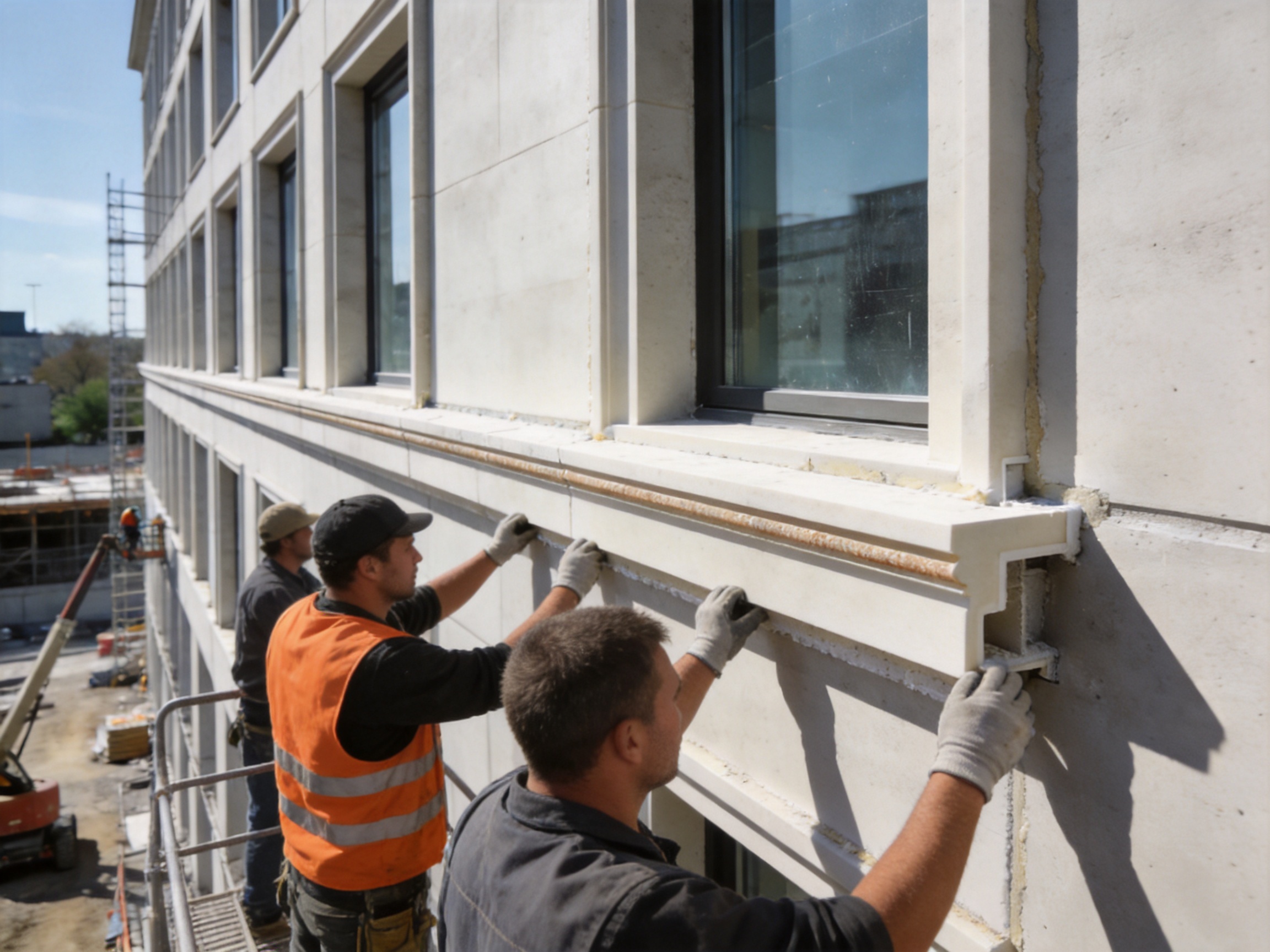
When selecting GRC door and window frames, buyers should evaluate more than price. Important procurement questions include: What type of glass fiber is used? Is the fiber alkali-resistant? How is aggregate grading controlled? Can the manufacturer provide detailed drawings? Are molds produced with sufficient precision? What curing process is used? How are components inspected? Can the manufacturer support installation? What finishing options are available? How will components be packaged and delivered?
Buyers should also consider project scale. For large developments, consistency and delivery coordination become essential. The manufacturer must be able to produce repeated components without dimensional drift. Component numbering, packaging, and logistics planning help ensure that installation proceeds efficiently.
For customized projects, communication is critical. Designers should provide drawings, renderings, dimensions, wall details, and finish expectations early. The manufacturer can then advise on profile feasibility, joint planning, mold requirements, and installation methods. Early coordination prevents costly revisions later.
Although the product is designed for low maintenance, proper care will extend its service life. Regular inspection should focus on sealant joints, coating condition, impact damage, water accumulation, and connection points. Cleaning should use suitable methods that do not abrade the surface or damage protective finishes.
If minor damage occurs, repairs should be performed promptly to prevent water intrusion. Compatible repair materials should be selected to match the GRC substrate and surface finish. Harsh chemicals should be avoided unless confirmed safe for the coating and cementitious material.
Most maintenance issues in exterior frames are related not only to the frame itself but also to surrounding systems. Window sealants, wall coatings, flashing, and drainage paths should be inspected together. A durable frame performs best when integrated into a well-maintained façade system.
It is an architectural frame component made from glass fiber reinforced concrete using alkali-resistant glass fibers. The product is designed for door and window openings, offering decorative value, dimensional stability, crack resistance, and long-term exterior durability.
Cement-based materials are naturally alkaline. Ordinary glass fibers may weaken in this environment over time. Alkali-resistant fibers, especially high-zirconia fibers, are engineered to withstand cement alkalinity, helping the frame maintain strength and crack resistance over a longer service life.
The product combines distributed fiber reinforcement with optimized aggregate grading. Fibers help bridge microcracks, while the dense matrix reduces voids and improves structural stability. This combination helps resist cracking caused by shrinkage, humidity, temperature changes, and external stress.
Yes, GRC can usually achieve strong performance with thinner sections than ordinary precast concrete. This reduces weight while maintaining durability, making transportation, handling, and installation more efficient.
Yes. GRC is highly moldable and suitable for customized profiles, textures, sizes, and decorative styles. With professional design, mold making, and CNC engraving support, frames can be adapted to classical, modern, commercial, residential, and public building designs.
They are suitable for residential communities, public buildings, commercial developments, cultural facilities, municipal architecture, renovation projects, and other exterior façades requiring durable and attractive door and window detailing.
They are much more suitable for exterior use. Plaster is generally more vulnerable to moisture, cracking, and surface deterioration. Alkali-resistant GRC provides better strength, density, weather resistance, and life-cycle value.
Key steps include accurate design drawings, precise mold making, controlled raw material batching, even fiber dispersion, proper compaction or forming, controlled curing, surface finishing, quality inspection, careful packaging, and installation coordination.
Maintenance demand is low compared with many competing materials, but regular inspection is still recommended. Sealant joints, coatings, drainage details, and impact damage should be checked periodically to preserve long-term performance.
Drainage products require durability, water management, dimensional accuracy, and long-term performance. These capabilities complement GRC façade manufacturing, especially for exterior frames that must resist moisture and environmental stress while maintaining precise appearance.
Alkali-Resistant Durable GRC door and window frames represent a practical and advanced solution for architectural exterior openings. By incorporating high-zirconia alkali-resistant fibers, the product addresses one of the major long-term challenges of cement-based composites: fiber degradation in alkaline environments. By using optimized aggregate grading and a high-density structure, it improves surface hardness, crack resistance, and weather stability. By reducing maintenance frequency, it delivers meaningful life-cycle cost advantages for large-scale residential, public, and commercial projects.
The product’s value is not limited to material performance. It is strengthened by an integrated manufacturing process that includes professional design, detailed drawings, mold design, CNC engraving, controlled production, construction support, and after-sales service. Jiangsu Yameng Traffic Road Facilities Co., Ltd. combines experience in drainage channel products and GRC customization, supporting a manufacturing approach rooted in durability, precision, and project responsibility.
For architects, the frames provide design freedom and reliable façade expression. For contractors, they offer manageable installation and repeatable dimensions. For owners, they provide long service life and reduced maintenance burden. In a market where many decorative frame products look similar at first glance, alkali-resistant GRC distinguishes itself through material engineering, manufacturing discipline, and long-term performance.
1. Bentur, A., and Mindess, S. Fibre Reinforced Cementitious Composites. Modern Concrete Technology Series.
2. PCI Committee on Glass Fiber Reinforced Concrete Panels. Recommended Practice for Glass Fiber Reinforced Concrete Panels.
3. American Concrete Institute. Guide for the Design, Construction, and Repair of Fiber-Reinforced Concrete.
4. Neville, A. M. Properties of Concrete. Pearson Education.
5. Brandt, A. M. Cement-Based Composites: Materials, Mechanical Properties and Performance.
6. International Federation for Structural Concrete. Structural Concrete Textbook on Behaviour, Design and Performance.
Related Products
Our Modular GRC System merges installation speed with long-term durability, providing a high-perform...
READ MOREOur Modular GRC System merges installation speed with long-term durability, providing a high-perform...
READ MOREOur Modular GRC System merges installation speed with long-term durability, providing a high-perform...
READ MOREOur Modular GRC System merges installation speed with long-term durability, providing a high-perform...
READ MOREOur Modular GRC System merges installation speed with long-term durability, providing a high-perform...
READ MOREOur Modular GRC System merges installation speed with long-term durability, providing a high-perform...
READ MORE
Contact us
Factory Address
Group 12, Quanxin Village, Donghai Town, Qidong City, Nantong City, Jiangsu Province, China
phone
+86-13914963840
+86-13451754670
products
QR CODE
 Wholesale Drainage Ditch Manufacturers