 English
 Español
 عربى
عربى

Energy-Efficient Sustainable GRC Curtain Wall Panels are high-performance architectural panels desig...
READ MOREJun 10, 2026
Content
In modern drainage, fuel-station, utility, and municipal access systems, the manhole cover is no longer a simple removable plate. It is a safety component, a load-bearing structural element, a sealing device, and a long-term maintenance control point. A poorly selected cover can allow rainwater to enter underground chambers, expose electrical or fuel infrastructure to moisture, create unsafe working conditions for technicians, corrode in harsh environments, or become a target for theft. A well-engineered resin square manhole cover solves these problems by combining mechanical strength, waterproof sealing, chemical resistance, anti-static safety, and convenient handling in one integrated product.
The Resin Square Manhole Cover A15-D40 is designed for demanding outdoor and underground access applications where reliability matters. Manufactured from advanced fiber-reinforced polymer resin materials, it offers a practical alternative to traditional cast iron and steel covers. It is especially suitable for gas stations, service areas, drainage facilities, electrical vaults, inspection chambers, road access points, and utility maintenance zones where sealing, corrosion resistance, and operational safety are essential.
Unlike conventional metal covers, this resin composite cover is engineered to resist rust, reduce spark risk, discourage theft, and maintain a clean appearance over years of service. Its EPDM rubber gasket and multi-point bolting structure provide a dependable waterproof seal, helping prevent rainwater, surface runoff, sand, oil residue, and contaminants from entering underground tanks or equipment chambers. In fuel-related environments, this can protect fuel quality and reduce the risk of water contamination. In electrical or communication vaults, it helps keep sensitive infrastructure dry and stable.
Jiangsu Yameng Traffic Road Facilities Co., Ltd. brings together drainage channel production experience, GRC customization capability, mold design, CNC engraving, and practical construction knowledge to deliver products that are not only manufactured for strength but also designed for real installation conditions. The company’s product scope includes drainage ditches, cover plates, resin composite manhole covers, ductile iron covers, stainless steel covers, PE pipes, and related road and drainage facilities. This broad manufacturing background allows the company to understand how manhole covers interact with drainage systems, pavement structures, underground chambers, and long-term maintenance demands.
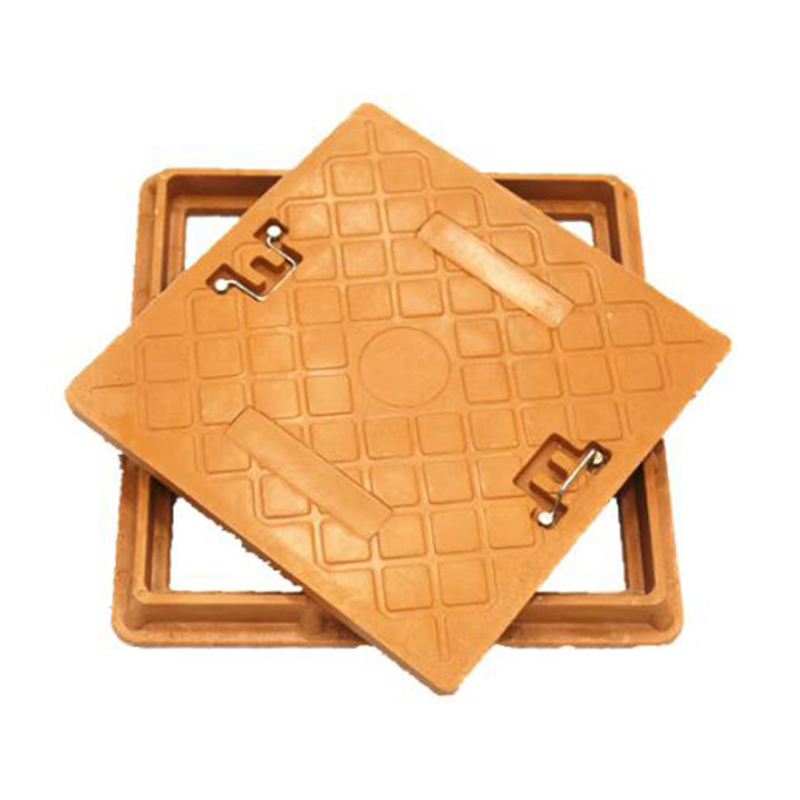
Resin square manhole cover A15-D40
The Resin Square Manhole Cover A15-D40 belongs to the resin manhole cover category and is developed for access points requiring durability, safety, and sealing performance. The square format provides convenient alignment with prefabricated access chambers and concrete openings. It is also practical for fuel-station tank sumps, cable inspection boxes, drainage access points, and other underground service systems where repeated inspection and safe maintenance access are required.
The product uses fiber-reinforced polymer resin technology, often associated with FRP or SMC composite manufacturing. This material structure combines a resin matrix with reinforcing fibers to create a cover that is strong, stable, and resistant to deformation. Compared with plain plastic, reinforced resin has significantly higher mechanical strength and dimensional stability. Compared with metal, it has better natural corrosion resistance and reduced scrap value, making it less attractive to thieves.
Load-bearing performance is one of the most important considerations for any manhole cover. The product is engineered for load classes used in pedestrian, light-traffic, and vehicle-access environments, with options developed to satisfy demanding road and station conditions. In applications where heavy passenger vehicles, fuel tankers, maintenance trucks, or service vehicles are present, the cover must resist cracking, bending, and permanent deformation. The composite structure distributes stress across the cover body and frame, while the carefully designed rib pattern and material formulation support long-term mechanical performance.
Waterproofing is another key advantage. Many access covers appear strong but fail at the sealing interface. Water entering underground tanks, electrical vaults, or inspection chambers can create serious operational problems. The use of high-quality EPDM rubber gaskets improves sealing resilience, while a multi-point bolting system ensures uniform compression around the cover. This design reduces the weak points often found in loose-fit or single-lock covers.
Safety is equally central. Fuel stations and service areas may contain volatile vapors, petroleum residues, and flammable materials. Traditional metal covers can conduct electricity and may create spark concerns during handling, impact, or tool contact. Resin composite material is non-conductive and non-sparking, making it more suitable for environments where ignition risk must be minimized. While complete site safety depends on proper installation, ventilation, grounding strategies, and operational procedures, the cover material itself contributes to a safer access solution.
One of the product’s most important advantages is its waterproof sealing performance. Underground spaces often contain valuable infrastructure: fuel tanks, valve chambers, cables, control units, drainage inspection points, or utility connections. When rainwater or surface runoff enters these spaces, the result may include contamination, corrosion, equipment failure, sediment buildup, and increased maintenance cost.
The resin square manhole cover addresses this issue through EPDM rubber gasket sealing and a multi-point bolting structure. EPDM rubber is widely used in outdoor sealing applications because of its resistance to weathering, ozone, moisture, and temperature variation. When properly compressed, the gasket forms a reliable barrier between the cover and the frame. The bolting system provides consistent pressure distribution, reducing the chance of localized leakage caused by uneven cover seating.
This is a major difference from many traditional metal covers, which often rely mainly on gravity seating. A loose cast iron cover may move under traffic, vibrate, create noise, and allow water to seep through. Even when a metal cover is fitted with a gasket, corrosion, deformation, or improper seating can reduce sealing performance. A resin composite structure avoids rust expansion and helps maintain a stable sealing interface for longer service life.
Modern access covers must perform under real dynamic loads, not only static test conditions. In a gas station, for example, passenger cars, delivery vehicles, maintenance trucks, and fuel tankers may pass near or directly over access points. In municipal environments, covers may face repeated traffic, impact, vibration, and seasonal temperature changes. The Resin Square Manhole Cover A15-D40 is designed with load-bearing reliability in mind.
The fiber-reinforced polymer structure improves impact resistance and distributes mechanical force throughout the cover body. The product is engineered according to load class requirements associated with EN124-style expectations, supporting use in a range of environments from pedestrian areas to vehicle-access zones. For heavy-duty projects, suitable load class selection and installation design are essential. The cover, frame, bedding material, and surrounding concrete structure must work together as one load-bearing system.
Compared with low-grade plastic or thin metal plates, reinforced resin offers a better balance between strength and weight. Compared with cast iron, it can deliver the required load performance without excessive mass. This improves handling while still protecting underground chambers from impact and traffic stress.
In fuel-related environments, safety is not optional. A manhole cover near fuel storage tanks, dispensing areas, or service zones must reduce risks associated with flammable vapors. Resin composite material has a natural advantage because it is non-conductive and non-sparking. It does not behave like cast iron or steel during impact, friction, or tool contact.
This characteristic is especially valuable at gas stations, petrochemical facilities, maintenance depots, and similar areas. While the cover alone cannot replace site-level safety systems, it supports safer operating conditions by removing one potential source of spark generation. Workers lifting or reinstalling the cover benefit from a material that is easier to handle and less likely to create sudden metallic impact sparks.
In electrical vaults and communication chambers, non-conductive material also provides practical value. It reduces the chance of accidental electrical conduction through the cover itself. Combined with appropriate site design and professional installation, this makes resin composite covers a suitable choice for many underground utility projects.
Traditional metal covers are vulnerable to corrosion, especially in environments exposed to rainwater, road salt, petroleum products, acids, alkalis, and industrial chemicals. Once corrosion begins, it can reduce cover thickness, weaken structural strength, affect appearance, damage sealing surfaces, and make removal difficult. Rust can also contaminate the surrounding area and increase maintenance frequency.
The resin square manhole cover is naturally resistant to many corrosive influences. Its composite material does not rust, does not require frequent repainting, and is not affected by de-icing salts in the same way as metal. In gas-station environments, resistance to gasoline, diesel, oil residue, and related chemicals helps preserve long-term product performance. This makes the product particularly suitable for harsh outdoor applications.
Chemical resistance also contributes to lifecycle value. A cover that remains stable over time reduces replacement frequency, maintenance labor, and downtime. For project owners, this means a lower total cost of ownership even if the initial procurement decision focuses on performance rather than only unit price.
Maintenance technicians often need to open access covers for inspection, cleaning, repair, or emergency response. Heavy cast iron covers can be difficult and dangerous to lift, especially in wet or confined conditions. Worker injuries related to lifting and handling are a real concern for infrastructure operators.
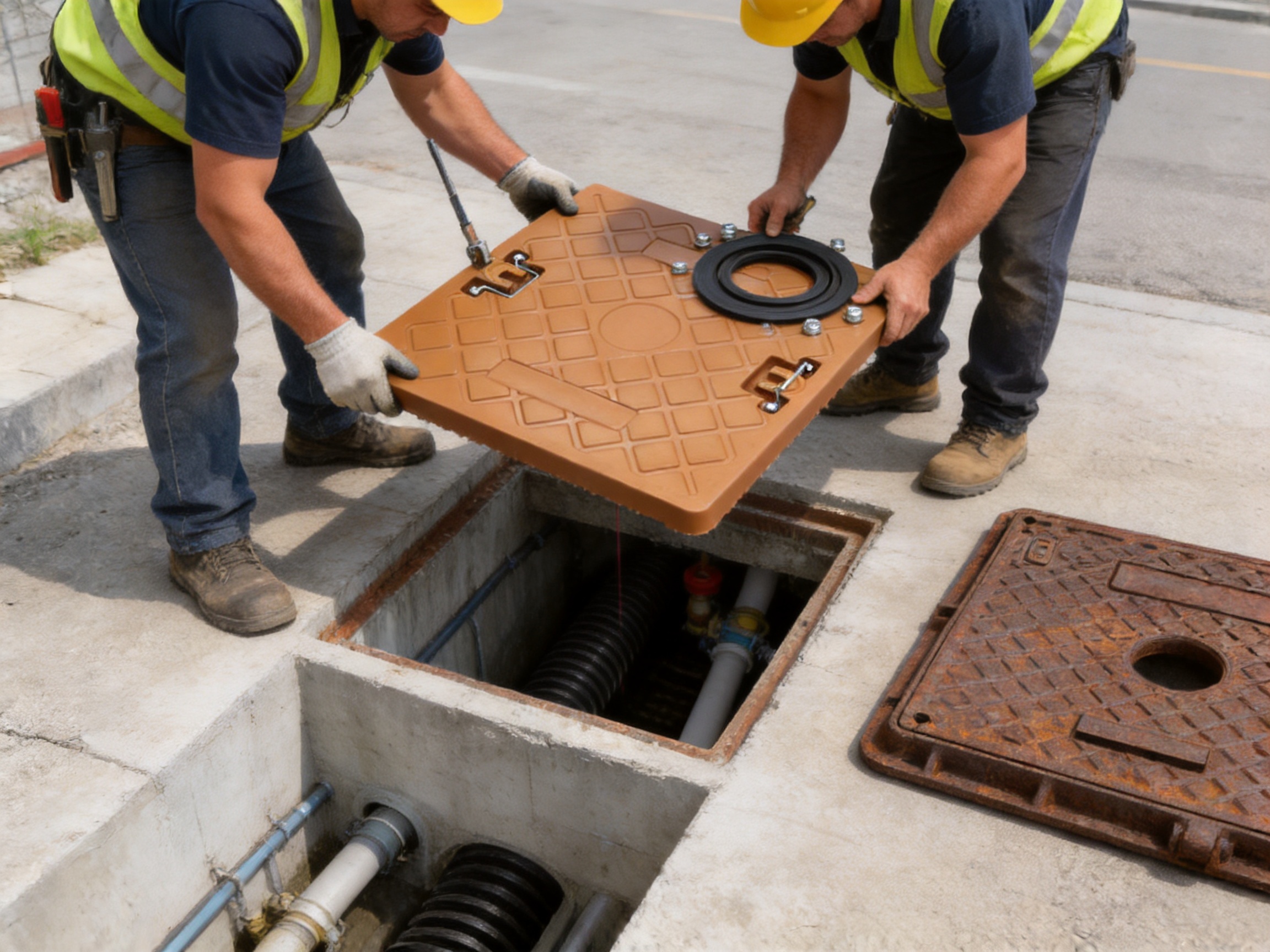
Resin composite covers are typically much lighter than cast iron covers of comparable size. The product may weigh approximately one-third of an equivalent iron cover, depending on specification and load class. This lighter weight reduces physical strain and makes routine inspection more efficient. Workers can lift and reinstall the cover more safely, with less risk of back injury, hand injury, or accidental dropping.
Lightweight handling also improves installation efficiency. During construction, crews can position the cover and frame more easily, reducing labor time and simplifying alignment. For projects involving multiple access points, the cumulative labor savings can be significant.
Metal cover theft is a serious issue in many regions. Cast iron and steel covers can be stolen and sold as scrap metal, leaving dangerous open holes in roads, sidewalks, stations, and public facilities. The result can be traffic accidents, pedestrian injuries, emergency repair costs, and public safety hazards.
Resin composite covers have almost no attractive scrap value because they cannot be melted down and resold like metal. This greatly reduces theft risk. For municipal authorities, industrial sites, and commercial operators, theft deterrence is not merely a financial advantage; it is a public safety benefit.
By replacing metal covers in theft-prone locations, operators can reduce emergency maintenance work and avoid the risk of exposed underground openings. The product therefore supports both asset protection and community safety.
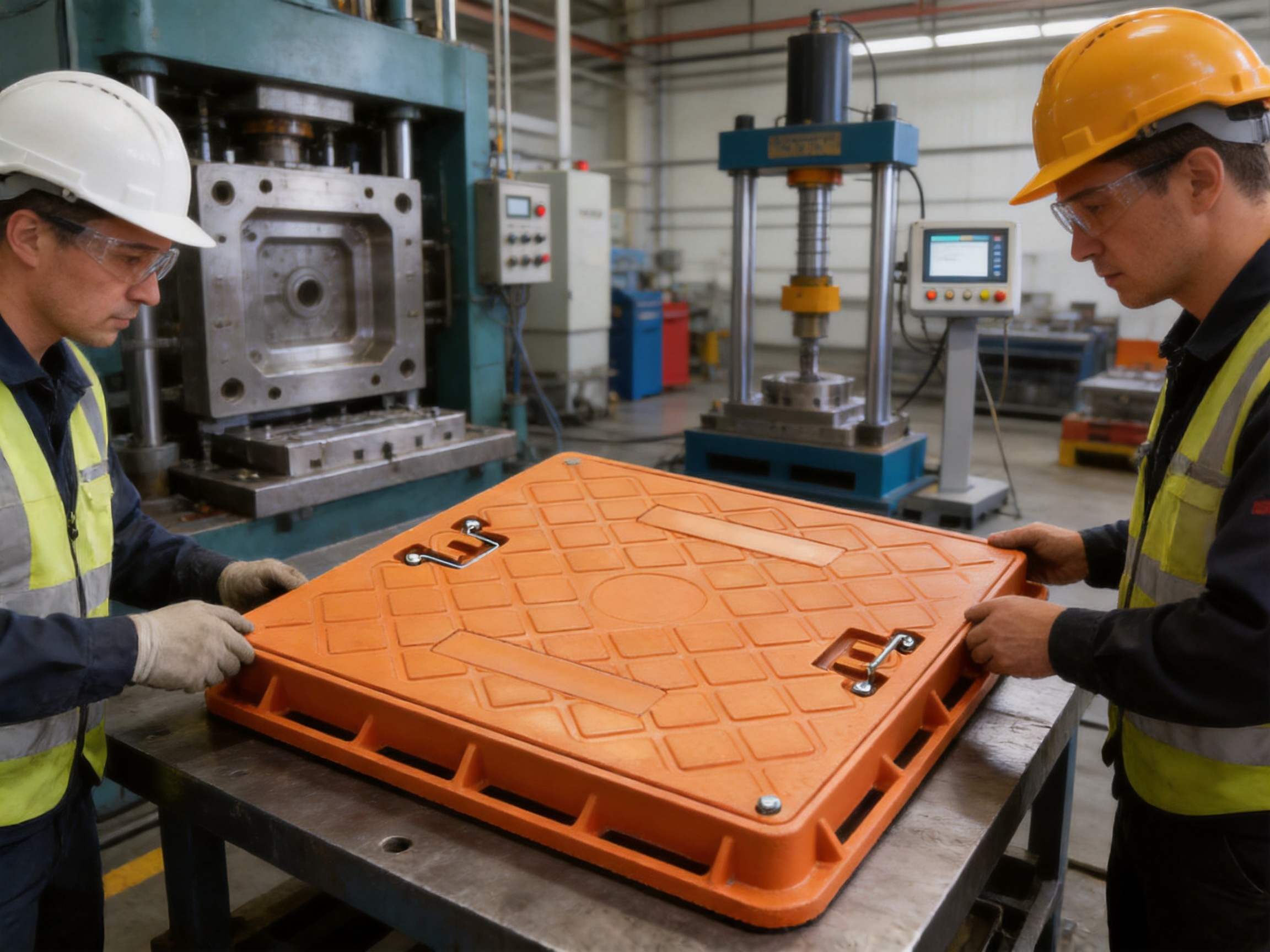
A high-performance manhole cover depends on more than material choice. It requires controlled formulation, precise mold design, reinforcement placement, curing control, surface finishing, assembly accuracy, and quality inspection. Jiangsu Yameng Traffic Road Facilities Co., Ltd. benefits from a manufacturing system that combines drainage product production, mold development, CNC processing, GRC customization, and construction service knowledge. This integrated capability supports products that are practical, repeatable, and suitable for different project environments.
The foundation of the product is fiber-reinforced resin composite. In such materials, the resin matrix provides shape, chemical resistance, and environmental protection, while reinforcing fibers provide tensile strength, impact resistance, and dimensional stability. Proper formulation is essential. If the resin content is too high without enough reinforcement, the product may become brittle or weak. If the reinforcement is not properly distributed, the cover may develop stress concentration points. If curing is not controlled, the final product may warp, crack, or lose strength.
Manufacturing expertise lies in controlling these variables. The production process must ensure that reinforcement is evenly integrated and that the resin material achieves the required density and curing performance. For manhole covers, the final product must resist compression, bending, impact, temperature change, and environmental exposure. A balanced composite formula allows the product to achieve strength while remaining lighter than metal.
Manhole cover performance is strongly influenced by geometry. Rib patterns, edge thickness, gasket grooves, bolt holes, anti-slip surfaces, seating angles, and frame dimensions all affect real-world performance. Professional mold design ensures that each product has consistent dimensions and reliable assembly fit.
The company’s mold design and CNC engraving capability help create accurate tooling for both standard and customized products. Precision tooling improves the consistency of the sealing surface, the alignment of the cover and frame, and the strength of structural ribs. Good tooling also improves production efficiency and reduces variation between batches.
This is a competitive advantage over suppliers that rely on outdated molds, inconsistent manual processing, or low-precision fabrication. For customers, dimensional consistency means easier installation, fewer site adjustments, better sealing, and more predictable long-term performance.
Resin composite manhole covers are often produced through compression molding or similar processes. Material is placed into a heated mold, pressure is applied, and the resin cures into the final shape. Temperature, pressure, time, and material distribution must be carefully controlled.
Controlled molding improves density and reduces internal defects. It also allows the cover to form complex features such as reinforcement ribs, anti-slip textures, gasket channels, and bolt seating points in one integrated structure. When properly executed, this process produces a strong and stable product with good surface quality and repeatable dimensions.
For load-bearing products, hidden internal defects can be a serious risk. Voids, poor curing, uneven fiber distribution, or weak corners may not be visible during casual inspection but can reduce performance under traffic loads. A manufacturer with disciplined production control can reduce these risks and deliver more dependable products.
The waterproofing system depends heavily on the gasket. EPDM rubber must be selected for suitable hardness, resilience, weather resistance, and long-term compression performance. The gasket groove must be accurately formed so that the rubber remains in position during installation and use. If the groove is too shallow, the gasket may slip. If it is too deep, compression may be insufficient. If the gasket is poorly matched to the bolt system, sealing may be uneven.
The product’s multi-point bolting design works together with the EPDM gasket. When bolts are tightened, the cover compresses the gasket uniformly against the frame. This creates a stable barrier against water infiltration. Good manufacturing accuracy ensures that the gasket is neither over-compressed nor under-compressed, both of which could reduce service life.
The bolting system provides security, sealing pressure, and resistance to unwanted opening. In applications such as gas stations or electrical vaults, secure closure is essential. The cover must remain seated under traffic vibration, and unauthorized access should be discouraged.
Multi-point bolting distributes clamping force more evenly than single-point locking. This helps maintain waterproofing and reduces cover movement. It also improves the feeling of stability when vehicles pass over the cover. Proper hardware selection and accurate bolt hole positioning are important. Misalignment can make installation difficult and may reduce sealing performance. Precision manufacturing helps avoid these problems.
Outdoor covers must remain safe for pedestrians and workers in rain, snow, fuel residue, or dusty conditions. The surface texture of the resin cover can be molded to create anti-slip performance. Unlike painted metal surfaces, where coating wear may reduce friction, a molded anti-slip pattern is part of the cover structure.
The texture must be designed carefully. It should provide grip without making the surface difficult to clean. It must also avoid sharp edges that could chip or wear prematurely. Through proper mold design and material selection, the product can maintain a professional appearance while supporting safe foot traffic.
Quality control is essential for infrastructure products. Inspection may include dimensional checking, surface inspection, gasket fit evaluation, bolt assembly testing, and load-related verification according to project requirements. For products intended to meet EN124-style load expectations, the manufacturer must understand the relationship between laboratory testing and field installation.
A cover that performs well in testing must still be installed on a suitable frame, bedding, and concrete support structure. The manufacturer’s experience with drainage channels, cover plates, and construction support helps customers select and install products correctly. This practical knowledge is an important strength because many failures in the field result from poor installation rather than product design alone.
The following table summarizes the practical differences between resin composite manhole covers and several traditional alternatives. Exact performance depends on specification, load class, installation quality, and application environment, but the comparison highlights why resin composite covers are increasingly selected for modern infrastructure.
| Feature | Resin Composite Cover | Cast Iron Cover | Steel Cover | Ordinary Plastic Cover |
|---|---|---|---|---|
| Waterproof sealing potential | Excellent when combined with EPDM gasket and multi-point bolts | Moderate; often affected by rust, vibration, or loose seating | Moderate; depends on coating and sealing design | Limited in demanding load applications |
| Corrosion resistance | High resistance to rust, salts, moisture, and many chemicals | Prone to rust without maintenance | Prone to corrosion if coating is damaged | Generally corrosion resistant but may lack strength |
| Weight | Lightweight compared with metal | Very heavy | Medium to heavy | Lightweight |
| Theft deterrence | High because of low scrap value | Low because of scrap value | Low to moderate because of scrap value | High but often weaker |
| Spark risk | Non-sparking composite material | Metallic impact may create spark concerns | Metallic impact may create spark concerns | Non-sparking but may not suit heavy loads |
| Load-bearing capability | Strong when properly engineered and installed | Strong but heavy and corrosion-prone | Strong but coating-dependent | Usually limited |
| Maintenance demand | Low; no repainting required in normal use | Higher due to rust and weight | Higher if coating or welding points degrade | Low but may require earlier replacement |
| Best use cases | Gas stations, drainage, utility vaults, corrosion-prone sites | Traditional roads and heavy municipal covers | Industrial covers and fabricated access plates | Light pedestrian or temporary access points |
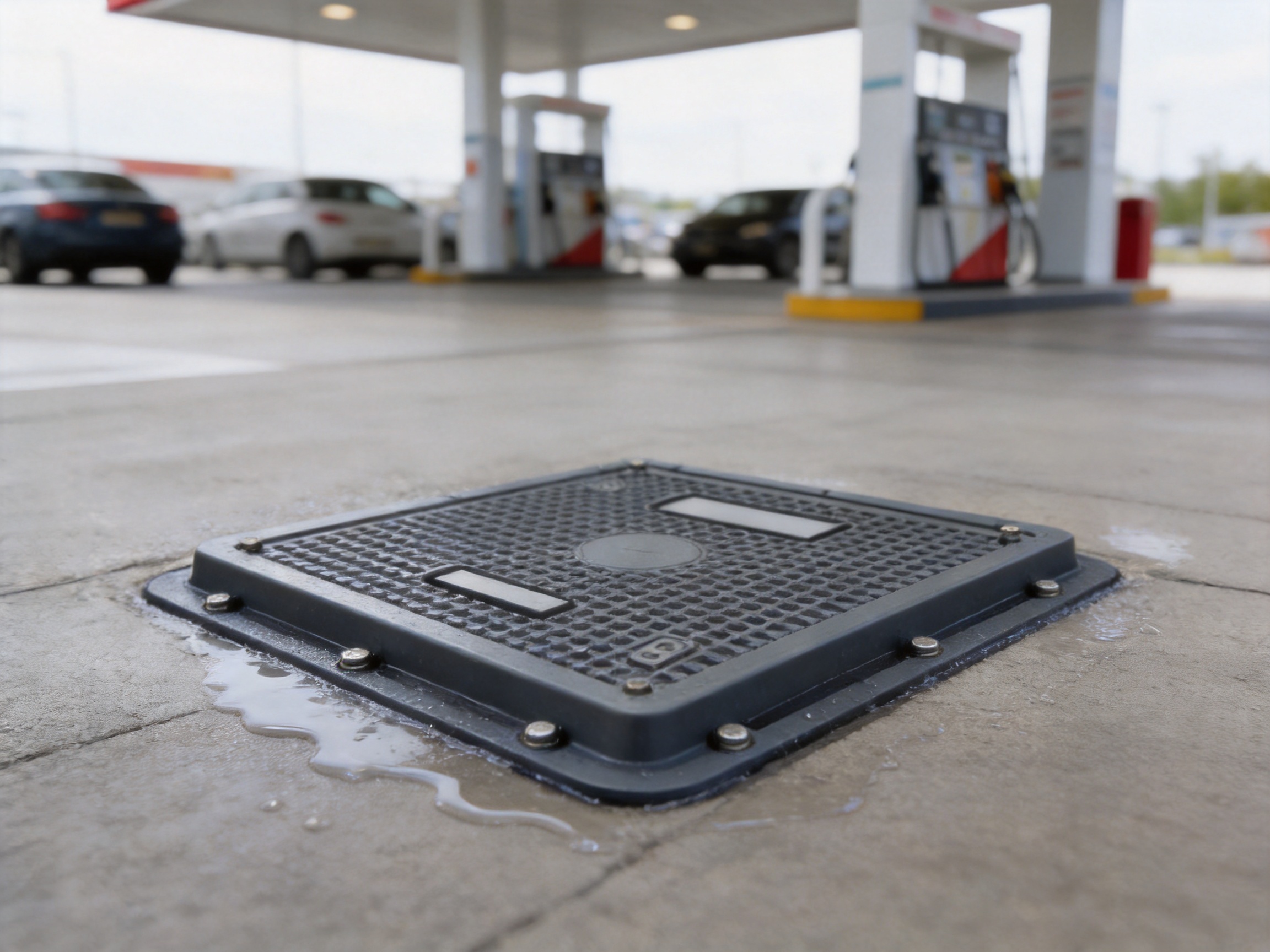
Gas stations are one of the most important application environments for waterproof resin manhole covers. Underground fuel tanks, valve chambers, vapor recovery systems, and inspection sumps require secure and clean access. Water infiltration into these systems can create contamination, corrosion, and operational problems. A waterproof cover helps protect the chamber from rainfall, vehicle wash water, and surface runoff.
Fuel station covers must also withstand repeated vehicle movement. Passenger cars may turn slowly over the cover, creating twisting and uneven loading. Fuel tankers may impose heavier loads during delivery. The cover must remain stable and secure during these conditions. A bolted resin composite design helps prevent movement and noise while maintaining sealing pressure.
Anti-static and non-sparking properties are especially valuable in this environment. When workers open an access point for inspection, the cover should not introduce unnecessary ignition risk. Resin composite material provides a safer alternative to heavy metal covers, particularly when combined with proper site operating procedures.
Corrosion resistance is another major benefit. Gas stations may expose covers to fuel drips, oil residue, cleaning chemicals, rainwater, and temperature changes. Metal covers may rust or require repainting, while composite covers can maintain appearance and function with less maintenance.
The company’s background in drainage ditch systems makes the resin square manhole cover suitable for broader drainage and municipal infrastructure. Drainage networks include inspection wells, catch basins, channel connections, pump station access points, and underground maintenance chambers. In these environments, covers must resist water, sediment, traffic, and weather.
Traditional drainage covers are often exposed to road salts, standing water, and abrasive debris. Over time, metal components can corrode, especially at edges and contact surfaces. Resin composite covers avoid rust and provide a cleaner long-term solution. Where sealing is required, the EPDM gasket and bolting system help prevent unwanted inflow or odor release.
In pedestrian areas, parks, commercial plazas, and sidewalks, a lighter cover can simplify maintenance work. The anti-theft property also supports public safety. Missing manhole covers are dangerous and costly; using low-scrap-value composite covers can reduce this risk.
Electrical and communication vaults require dry, secure, and accessible underground spaces. Moisture can damage cables, connectors, control units, and communication equipment. A waterproof resin manhole cover helps reduce the risk of water intrusion, especially in areas where surface runoff is common.
The non-conductive nature of resin composite material is also useful in utility environments. While electrical safety always depends on complete system design and professional procedures, a non-metallic cover reduces one potential conduction pathway. This makes the product attractive for inspection chambers, cable pits, control boxes, and service access points.
For utility maintenance teams, lightweight handling is a practical daily benefit. Covers that are easier to remove allow faster inspection and reduce worker strain. When many access points must be checked across a facility or city network, improved ergonomics can have a meaningful effect on productivity and safety.
The square format offers practical advantages for many construction projects. It aligns naturally with square or rectangular access chambers and prefabricated concrete openings. This reduces the need for special adapter work and makes installation more efficient. Square covers also provide clear orientation for bolt alignment and gasket seating.
For fuel-station tank sumps and utility boxes, square covers are often preferred because the underground chamber is rectangular. A matching cover reduces wasted space and provides easier access to valves, cables, or inspection points. The frame can be integrated into pavement or concrete surfaces to create a flush and professional finish.
A manhole cover should not be evaluated alone. The frame is equally important because it transfers load to the surrounding structure and supports the sealing interface. A well-designed frame keeps the cover stable, reduces rocking, and protects the gasket. The resin square manhole cover is intended to function as a system in which cover, frame, gasket, bolts, and installation base work together.
During installation, the frame should be fully supported by suitable concrete or bedding material. Uneven support can cause stress concentration and reduce product life. Proper leveling is also important for vehicle and pedestrian safety. The company’s experience with drainage and road facilities allows it to advise customers on practical installation considerations.
Modern infrastructure products must perform well and look professional. The cover’s molded surface can include anti-slip patterns, clean edges, and a consistent finish. Resin composite material can maintain its appearance without rust stains or peeling paint. This is particularly valuable in commercial areas such as gas stations, shopping centers, industrial parks, and municipal plazas.
A clean cover also supports brand image for commercial operators. Customers may not notice every infrastructure detail, but rusted, noisy, or damaged covers create a poor impression. A stable, corrosion-resistant resin cover helps maintain a neat and safe environment.
Loose metal covers often create noise when vehicles pass over them. This can be a nuisance in residential areas, commercial facilities, and service stations. A bolted composite cover with gasket support can reduce movement and impact noise. The gasket acts as both a sealing component and a cushioning interface, helping create quieter operation.
Noise reduction is not only a comfort issue; it may indicate better stability. A cover that does not rattle is less likely to wear its seating surface prematurely. Stable seating supports longer service life and improved safety.
Jiangsu Yameng Traffic Road Facilities Co., Ltd. is located in Nantong, Jiangsu Province, China, an area with convenient transportation and waterway access. This location supports efficient supply, logistics, and shipment for domestic and international customers. The company focuses on drainage ditch projects, cover plate supply, GRC customization, and related road facility products.
The company’s product range includes linear drainage ditches, finished drainage ditches, polymer-based drainage channels, slot drainage ditches, U-shaped drainage ditches, ductile iron cover plates, stainless steel stamped cover plates, steel gratings, resin concrete cover plates, resin composite manhole covers, stainless steel manhole covers, ductile iron manhole covers, drainage pipes, PE pipes, and related accessories. This broad product system allows customers to source compatible infrastructure components from one supplier rather than coordinating many separate vendors.
One important company strength is the combination of design and production capability. The GRC series is supported by professional designers, mold designers, CNC engravers, and an experienced production and construction technical team. Although GRC and resin composite covers are different product categories, the same manufacturing culture of accurate drawings, mold development, production control, on-site coordination, and after-sales support contributes to overall product reliability.
The company provides complete services from detailed design and drawings to mold making, production, on-site construction, and after-sales support. For project customers, this is more valuable than simply buying a product. Infrastructure projects often require dimension confirmation, load class selection, installation advice, and coordination with surrounding drainage or pavement systems. A supplier with engineering awareness can help reduce mistakes and improve final project results.
Integrity, responsibility, focus, and innovation are important values for the company. In the manhole cover market, these values translate into consistent quality, honest specification communication, practical customization, and ongoing product development. Customers need covers that match their application, not generic products that may fail under site conditions. The company’s commitment to research and development supports improved materials, molds, and product structures.
The market for manhole covers includes many low-cost products, but not all covers deliver long-term value. Some covers may appear acceptable at first glance but fail because of weak materials, poor sealing, inaccurate dimensions, thin structures, low-quality gaskets, or insufficient quality control. The Resin Square Manhole Cover A15-D40 stands out because it addresses the full set of performance requirements: strength, sealing, safety, chemical resistance, handling, and theft deterrence.
Its waterproofing system is a major advantage. Many competitors focus only on load rating but neglect water infiltration. For fuel stations and utility vaults, sealing performance can be as important as structural strength. The use of EPDM gaskets and multi-point bolts gives the product a clear functional advantage over loose covers or covers with simple contact seating.
Its composite material also creates a strong competitive position. Cast iron remains widely used, but it is heavy, theft-prone, and corrosion-sensitive. Steel can be strong, but it depends heavily on coatings and may corrode at welds or cut edges. Ordinary plastic may be lightweight and corrosion-resistant, but it often lacks sufficient load-bearing capacity. Reinforced resin composite occupies a balanced middle ground, offering strength, low weight, corrosion resistance, and low scrap value.
The product is also safer for sensitive environments. Non-conductive and non-sparking properties are meaningful in gas stations and electrical vaults. In locations where safety requirements are strict, material choice becomes more than a cost decision; it becomes part of the risk management strategy.
Finally, the company’s manufacturing and project support capability provides an advantage over trading-only suppliers. Customers benefit from a manufacturer that understands drainage systems, cover plates, molds, custom dimensions, and field installation. This reduces communication gaps and supports more reliable project execution.
When selecting a resin manhole cover, buyers should evaluate the full application environment. The first consideration is load class. A pedestrian area, sidewalk, parking area, service station driveway, and heavy vehicle lane may require different specifications. The correct cover must match expected traffic, wheel loads, impact conditions, and installation structure.
The second consideration is sealing requirement. If the access chamber protects fuel tanks, electrical equipment, or sensitive utilities, waterproof sealing should be prioritized. Buyers should confirm gasket material, bolt quantity, frame design, and installation method. A waterproof cover must be installed correctly to perform as intended.
The third consideration is chemical exposure. Gasoline, diesel, oil, road salt, cleaning chemicals, and industrial runoff may affect some materials. Resin composite covers offer strong resistance in many such environments, but project-specific chemical conditions should still be communicated during procurement.
The fourth consideration is opening frequency. If workers must open the cover often, lightweight handling and ergonomic design become important. A cover that is too heavy may slow maintenance and increase injury risk. Resin composite provides a practical solution for frequently accessed points.
The fifth consideration is theft risk. In public or unsupervised areas, low scrap value is a major benefit. Composite covers reduce the financial incentive for theft and help prevent dangerous open access holes.
The sixth consideration is installation quality. Even the best cover can fail if the frame is unsupported, uneven, or placed in weak concrete. Project teams should ensure proper bedding, leveling, curing, and surrounding pavement support. For heavy-load applications, professional installation is essential.
Before installation, the access opening should be checked for correct dimensions, structural strength, and level condition. The frame should be placed on a stable base and aligned with the finished pavement or floor surface. Any gaps beneath the frame should be filled with suitable mortar or concrete support so that loads are transferred evenly.
The gasket should be inspected to ensure it is clean, properly seated, and free from damage. Dirt, stones, or concrete residue on the gasket surface can affect sealing performance. During installation, the cover should be lowered carefully into the frame to avoid damaging the gasket or bolt holes.
Bolts should be tightened evenly in a balanced sequence. Over-tightening one side before the others may create uneven compression. A uniform tightening process helps achieve the intended waterproof seal. After installation, the cover should sit flush and stable without rocking.
Routine maintenance is simple. Operators should periodically inspect the cover surface, bolts, gasket, and frame. The anti-slip surface should be kept free from excessive oil or mud. If the cover is opened frequently, the gasket should be checked for wear or deformation. Damaged gaskets should be replaced to maintain sealing performance.
Because the resin composite material does not rust, repainting is generally unnecessary. This reduces maintenance work compared with metal covers. However, like all infrastructure products, the cover should not be subjected to loads beyond its specified class or improper use such as direct hammering, uncontrolled dropping, or unsupported installation.
A resin composite cover is made from fiber-reinforced polymer material rather than metal. It is lighter, corrosion-resistant, non-sparking, non-conductive, and unattractive to scrap-metal thieves. Cast iron is strong but heavy, rust-prone, and more likely to be stolen in some regions.
Yes. The product is especially suitable for gas stations because it provides waterproof sealing, corrosion resistance to petroleum-related exposure, lighter handling, and non-sparking material characteristics. It helps protect underground fuel infrastructure from water infiltration and supports safer maintenance access.
The cover uses an EPDM rubber gasket and a multi-point bolting system. When the bolts are tightened, the gasket is compressed evenly between the cover and frame, creating a barrier against rainwater and surface runoff. Correct installation is essential for best sealing performance.
Properly engineered resin composite covers can handle vehicle traffic when the correct load class is selected and the frame is installed on a suitable support structure. Buyers should confirm the required load class based on the application, such as pedestrian areas, parking zones, service roads, or heavy vehicle access areas.
EPDM rubber is known for weather resistance, moisture resistance, elasticity, and durability in outdoor sealing applications. It helps maintain sealing performance despite temperature changes and exposure to rain, ozone, and general environmental conditions.
No routine anti-rust treatment is required because the resin composite material does not rust like iron or steel. This reduces maintenance cost and helps preserve appearance over time.
No product can be described as completely theft-proof, but resin composite covers are strongly theft-deterrent because they have little or no scrap-metal value. They cannot be melted and resold like cast iron or steel covers, so they are much less attractive to thieves.
Yes. Resin composite covers are much lighter than comparable iron covers, making them easier for technicians to lift and reinstall. The bolting system provides security, so workers should use the correct tools and follow site procedures when opening the cover.
The frame must be fully supported, level, and properly embedded. The gasket should be clean and correctly positioned. Bolts should be tightened evenly. The surrounding concrete or pavement must be strong enough for the expected load. Improper installation can reduce sealing and load performance.
Customization may be available depending on project requirements, including dimensions, load class, surface pattern, frame design, and related drainage or access system coordination. The company’s mold design, CNC engraving, and production capabilities support project-based solutions.
The Resin Square Manhole Cover A15-D40 represents a practical advancement in access cover technology. It combines high-strength fiber-reinforced resin material with waterproof EPDM sealing, multi-point bolting, corrosion resistance, anti-static safety, and lightweight handling. These advantages make it a strong alternative to traditional cast iron and steel covers, particularly in gas stations, drainage systems, electrical vaults, communication chambers, municipal access points, and industrial facilities.
Its value is not limited to one feature. The product reduces water infiltration, resists harsh chemicals, lowers theft risk, improves worker safety, reduces maintenance demands, and supports cleaner long-term site appearance. For project owners and contractors, these benefits translate into improved reliability and lower lifecycle costs.
Jiangsu Yameng Traffic Road Facilities Co., Ltd. strengthens this product offering through broad manufacturing experience, drainage system knowledge, mold design capability, CNC processing, technical support, and complete service from design to after-sales assistance. By combining advanced composite manufacturing with practical infrastructure understanding, the company provides a resin manhole cover solution designed for real-world performance rather than short-term appearance alone.
For buyers seeking a waterproof, corrosion-resistant, theft-deterrent, and safer manhole cover for modern infrastructure, the resin square manhole cover is a dependable choice. It responds directly to the problems that traditional covers often fail to solve and supports the growing demand for durable, efficient, and maintenance-friendly access systems.
European Committee for Standardization. EN 124: Gully Tops and Manhole Tops for Vehicular and Pedestrian Areas.
Strong, A. Brent. Fundamentals of Composites Manufacturing: Materials, Methods, and Applications.
Mallick, P. K. Fiber-Reinforced Composites: Materials, Manufacturing, and Design.
ASTM International. Standard Practices and Test Methods Related to Rubber Gaskets and Composite Materials.
Construction Industry Research and Information Association. Design and Construction Guidance for Drainage and Access Systems.
American Concrete Institute. Guide for Concrete Floor and Pavement Support Around Embedded Frames and Access Covers.
Related Products
Energy-Efficient Sustainable GRC Curtain Wall Panels are high-performance architectural panels desig...
READ MOREEnergy-Efficient Sustainable GRC Curtain Wall Panels are high-performance architectural panels desig...
READ MOREEnergy-Efficient Sustainable GRC Curtain Wall Panels are high-performance architectural panels desig...
READ MOREEnergy-Efficient Sustainable GRC Curtain Wall Panels are high-performance architectural panels desig...
READ MOREEnergy-Efficient Sustainable GRC Curtain Wall Panels are high-performance architectural panels desig...
READ MOREEnergy-Efficient Sustainable GRC Curtain Wall Panels are high-performance architectural panels desig...
READ MORE
Contact us
Factory Address
Group 12, Quanxin Village, Donghai Town, Qidong City, Nantong City, Jiangsu Province, China
phone
+86-13914963840
+86-13451754670
products
QR CODE
 Wholesale Drainage Ditch Manufacturers